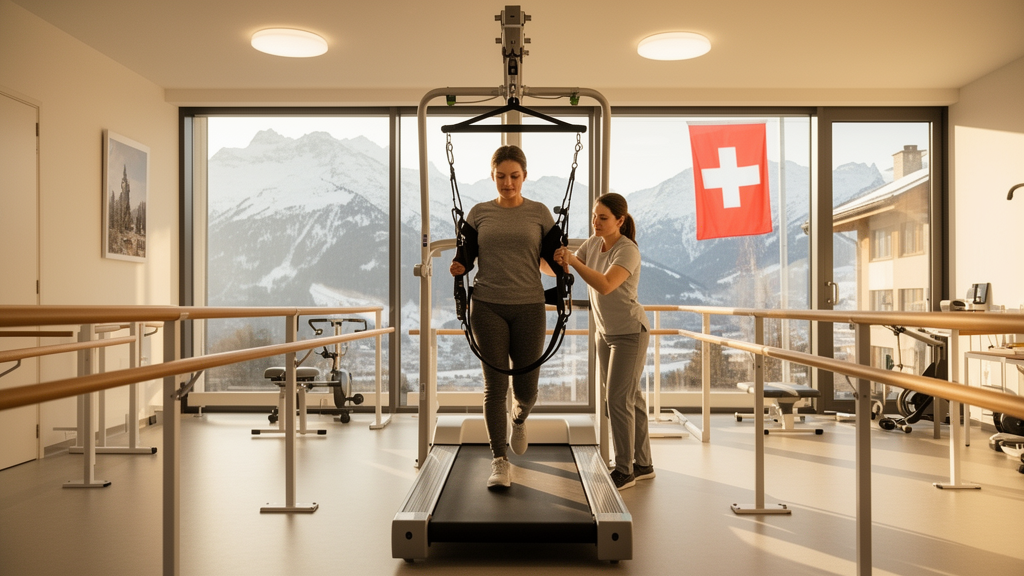
Switzerland has launched a national strategy for spinal cord injury that was built not by government decree but through a bottom-up, participatory process involving people with lived experience of paralysis, clinicians, researchers, insurers, and disability organizations. The Swiss National Strategy for Spinal Cord Injury, covering the period 2025 to 2033, was formally launched on September 8, 2025, in Berne, and a new paper in Frontiers in Rehabilitation Sciences documents how it was developed and how its early implementation is now unfolding. The initiative arrives at a moment when even a country internationally recognized for the quality of its rehabilitation is confronting persistent gaps in long-term follow-up, psychosocial support, and equitable access to services across regions.
Spinal cord injury is a lifelong condition with consequences that extend far beyond the acute phase. It requires coordinated management across medical, rehabilitative, psychological, and social domains, and for individuals it often represents a profound change in independence and identity. For health systems, it exposes the capacity to provide sustained, equitable, person-centered support. The World Health Organization’s International Perspectives on Spinal Cord Injury report presented the condition as an illustrative case for how rehabilitation can optimize functioning across the life course, and the Swiss strategy is explicitly framed as a national-level implementation of that vision, translating its principles into concrete action.
Switzerland’s existing system is well developed. Highly specialized acute rehabilitation is delivered in four centers, combined with outpatient follow-up and community-based services. Core components include interdisciplinary rehabilitation, long-term medical follow-up, and access to assistive technologies such as mobility aids, transfer aids, and environmental control systems provided through disability insurance, alongside home adaptations. Financing, however, is organized through a combination of accident and health insurance schemes that differ in scope and may affect continuity of support over the life course. A distinctive structural feature is the integration of research, clinical, and community actors through established data infrastructures, notably the Swiss Spinal Cord Injury Cohort Study, known as SwiSCI, which provides longitudinal national data on functioning, health, and quality of life, and the International Spinal Cord Injury survey, which enables cross-national comparison.
Despite this well-resourced system, evidence highlights gaps in psychosocial support, continuity of care, and access to community services, with disparities mainly affecting women, older adults, and people in rural areas. These inequalities occur amid demographic and systemic pressures: an aging population living with spinal cord injury, a higher rate of injuries among older individuals, increasing complexity of multimorbidity, workforce shortages, financial limitations, and constraints in rehabilitation length of stays. The strategy was developed in response by a coordinated group comprising the Swiss Association of SCI Centers, the Swiss Paraplegic Foundation, the Swiss Paraplegic Association, and Swiss Paraplegic Research.
The development process began with a focused review of key scientific evidence on spinal cord injury in Switzerland, drawing mainly on publications based on SwiSCI and the InSCI community survey, supplemented by informal consultations with clinicians, researchers, and professionals active in SCI care and policy. A national kick-off meeting in June 2023 presented the strategic vision, gathered input, and identified key actors for long-term involvement. Two formal consultation rounds followed in May and September 2024 with an Expert Panel of five members and an SCI Advisory Board of nine members. Participants rated each proposed measure by priority level, high, medium, or low, and provided written justifications. Measures receiving a majority of high-priority ratings in both groups were retained without further discussion, while those receiving a majority of low-priority ratings in both groups were removed. Ratings were also used to identify measures requiring further discussion in subsequent in-person meetings, which resulted in the confirmation, removal, reformulation, or splitting of proposed measures.
An initial set of 54 proposed measures was presented during the consultation rounds. Through confirmation, reformulation, splitting, removal, and the addition of measures proposed by the Expert Panel and the Advisory Board, this grew to 60 proposed measures for subsequent prioritization. A national stakeholder workshop with 35 participants, divided into four working groups, then prioritized the strategic aims using predefined criteria such as impact, feasibility, urgency, and system alignment. This stage produced the main reduction in the number of measures: aims receiving lower priority were not retained, and the measures associated with them were removed. The consolidated result is 16 aims and 32 associated measures.
The strategy is organized around nine fields of action rather than clinical specialties or phases of care. Eight fields emerged from the evidence synthesis, addressing prevention of spinal cord injury, prevention and management of secondary conditions and comorbidities, follow-up care, mental health, accessibility, employment, caregiver support, and data use. A ninth field, called ‘Safeguard what works,’ was added following stakeholder consultation to reflect the importance of explicitly protecting existing strengths in the Swiss system alongside identified gaps. Key measures include targeted fall prevention for older adults, structured screening protocols for secondary health conditions, expanded peer and psychological support during and after rehabilitation, telemedicine and a national hotline for lifelong follow-up, enforcement of accessibility legislation, ongoing job coaching beyond reintegration, financial support and navigation services for informal caregivers, and improved use of routine data with outcome indicators for quality development. Inclusion is treated as a cross-cutting principle integrated across all fields through measures aimed at reducing barriers, strengthening capabilities, and supporting equal participation.
Implementation is supported by a multi-level governance structure that evolved substantially during the process. The Steering Committee was expanded to include people with spinal cord injury as full members, with representatives of the Swiss Conference of Cantonal Health Directors and the Federal Office of Public Health granted observer status. The stakeholder Forum grew to include representatives from 18 organizations, spanning rehabilitation professions, social care providers, health insurance associations, quality monitoring bodies, and home-care services. The Advisory Board of people with lived experience was expanded from three to nine members and includes one family caregiver. A Coordination Office with a 0.6 full-time-equivalent coordinator position links strategic decisions to operational implementation, and an Implementation Advisory Group provides input from policy, service delivery, monitoring, and lived-experience perspectives. From 2026 onwards, implementation follows annual prioritization cycles overseen by the Steering Committee, with measures selected on criteria including feasibility, expected impact, policy relevance, contribution to inclusion, and sustainability.
Three measures were selected for initial implementation in 2026: respiratory muscle training, psychosocial support for the transition from rehabilitation to everyday life, and informal caregiver support. For each, interdisciplinary working groups were established to analyze current practice, refine priorities, and prepare implementation steps. In the respiratory muscle training example, a brief survey across the four specialized rehabilitation clinics found that the training is established in all four and that a shared basic practice already exists, while differences were identified in the standardization of training delivery and the use of outcome measures, and follow-up and support for home-based training after discharge were often unstructured or absent. Potential priority directions include defining best practices across centers, developing systematic monitoring of respiratory muscle function during annual follow-up for higher-risk groups, and integrating indicators of respiratory complications into the SwiSCI Community Survey for long-term trend monitoring.
The authors are candid about the limits of what has been achieved so far. Implementation has only recently started, and the study does not yet evaluate the effectiveness or long-term impact of the strategy; future work will be required to assess whether the governance model translates strategic priorities into measurable improvements in care, participation, and equity. The development process reflects a single-country experience embedded in a specific institutional context, which may limit transferability, and the participatory process relied on engagement from established stakeholders within existing networks, so some groups may have been underrepresented. No dedicated external funding stream was established for strategy development, and no formal costing exercise was conducted during this phase. The authors also note structural challenges ahead, including Switzerland’s federal fragmentation across 26 cantons, the mismatch between short-term budgeting cycles and long-term system goals, existing workforce shortages, and measures that depend on legislative or intersectoral action beyond the health system. Still, they argue the experience demonstrates that a national strategy can originate through participatory, bottom-up processes and translate shared priorities into a governance framework designed to support implementation, potentially informing similar efforts for populations requiring long-term rehabilitation, including people living with stroke, traumatic brain injury, musculoskeletal conditions, or chronic neurological diseases.
Subject of Research: Development and early implementation of the Swiss National Strategy for Spinal Cord Injury 2025–2033
Article Title: The Swiss national strategy for spinal cord injury as a model of inclusive public health policy
Article References: Rubinelli, S., Stucki, G., Brach, M., Hanselmann, H., Jordi, M., & Zanini, C. (2026). The Swiss national strategy for spinal cord injury as a model of inclusive public health policy. Frontiers in Rehabilitation Sciences, 7, Article 1878464. https://doi.org/10.3389/fresc.2026.1878464
Image Credits: AI Generated
DOI: 10.3389/fresc.2026.1878464
Keywords: spinal cord injury, Switzerland, rehabilitation, health policy, participatory governance, SwiSCI, long-term care, disability inclusion, caregiver support, implementation science, public health, stakeholder engagement
Cite Scienmag News
Cassandra Pierce. (October 28, 2026). Switzerland Builds a National Spinal Cord Injury Strategy From the Ground Up. Scienmag. https://scienmag.com/switzerland-builds-a-national-spinal-cord-injury-strategy-from-the-ground-up/
Cassandra Pierce. "Switzerland Builds a National Spinal Cord Injury Strategy From the Ground Up." Scienmag, 28 October 2026, https://scienmag.com/switzerland-builds-a-national-spinal-cord-injury-strategy-from-the-ground-up/. Accessed 28 October 2026.
Cassandra Pierce. "Switzerland Builds a National Spinal Cord Injury Strategy From the Ground Up." Scienmag. October 28, 2026. https://scienmag.com/switzerland-builds-a-national-spinal-cord-injury-strategy-from-the-ground-up/