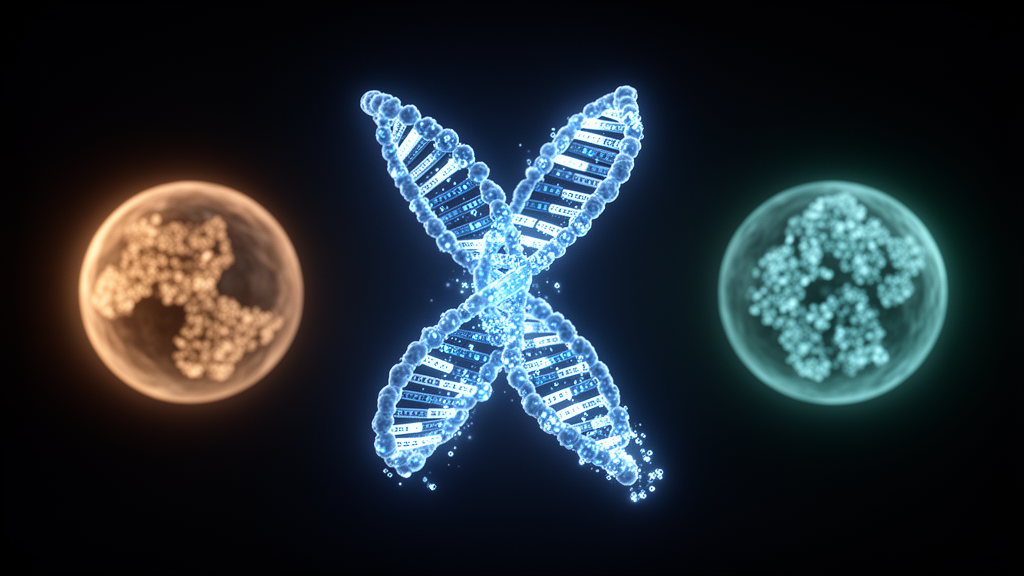
A new analysis of the 1000 Genomes Project suggests otherwise. Comparing the published GRCh38 and T2T-CHM13 callsets for 3,202 people, the study finds that the switch alters the most basic summaries of X-chromosome variation, and that it changes how well classifiers trained on those summaries perform for men and for women — in opposite directions depending on the model.
The work, published in Genomics & Informatics, was carried out by R. Craig Stillwell using only public, de-identified data. The cohort comprised 1,603 females and 1,599 males across five continental superpopulations, all present in both the GRCh38 high-coverage callset produced by the NYGC and the T2T-CHM13v2.0 recalibrated PASS callset. Crucially, the two files were not generated by the same workflow: they differ in assembly, in phasing, in post-calling processing and in which variant sites they contain. The author did not realign the same reads to both references, so every difference reported belongs to the reference and its pipeline together, not to the assembly alone.
The headline finding concerns women. On the X chromosome, the heterozygous fraction of non-reference genotypes — the share of non-reference calls that are heterozygous rather than homozygous — was 0.6052 on GRCh38 and 0.6443 on T2T, a paired difference of +0.0391 (95% CI +0.0375 to +0.0405; Wilcoxon p = 5.23 × 10⁻²⁰⁰), about 6.5% of the GRCh38 mean. That rise, however, was not uniform. It fell slightly in African-ancestry women (−0.0055) and rose in the other four superpopulations, most steeply in Europeans (+0.0717). A Kruskal–Wallis test confirmed the five paired changes differ from one another (H = 1222.2, p = 2.49 × 10⁻²⁶³).
The genotype counts behind the fraction reveal a counterintuitive mechanism. Across all women, heterozygous genotypes did not increase — they fell by 1,504 per person. The fraction rose because non-reference homozygous genotypes collapsed, dropping by 7,757 per woman. In the four non-African groups, non-reference homozygotes fell by 8,870 to 12,860 per woman; in African-ancestry women they did not change at all (+19), while heterozygotes fell by 2,767, pushing the fraction down. The author notes that a fall in non-reference homozygotes would follow if a site’s alternative allele on one assembly is the reference allele on the other, but that neither this explanation nor filtering differences were directly tested.
Men tell a different story, because their haploid X calls enter the stored ratios differently. Men carried 4,690 heterozygous genotypes on the GRCh38 callset and 4,851 on T2T, against roughly 79,900 and 78,400 in women. Men’s haploid reference calls rose from 2.62 million to 4.32 million per person, meaning the T2T chrX file holds far more records per man. Missingness also diverged sharply: the GRCh38 tables show no missing genotypes in any person, consistent with a statistically phased panel, while the T2T callset carries 10,752 missing genotypes per woman and 15,718 per man on chrX.
Strikingly, chromosome 22 — an autosome with none of the sex-chromosome complications — shifted nearly as much. Heterozygous genotypes rose by 13,873 per woman and 13,674 per man, non-reference homozygotes by 3,959 and 4,028, and the heterozygous fraction climbed by about 0.033 in women and 0.032 in men. T2T showed 75,391 missing genotypes per woman and 78,002 per man on chr22. The callsets therefore differ in site content and missingness on an autosome, in both sexes, as well as on the X — a caution against attributing every change to sex-chromosome handling.
The second half of the study asked what these shifting summaries do to machine learning. Five classifier families — logistic regression, random forest, XGBoost, a radial-kernel support vector machine and a multilayer perceptron — were trained on six chrX summaries to predict superpopulation, across twenty stratified train/validation/test splits. The quantity of interest was the male–female gap in balanced accuracy on held-out people, and how that gap changed between callsets. Under both callsets, women were classified better than men. But when the callset changed, the models disagreed: logistic regression, random forest and XGBoost widened the female advantage on T2T (ΔΔ = +0.022, +0.066 and +0.042), while the support vector machine and the perceptron narrowed it (−0.136 and −0.031).
The direction of the change tracked each model’s overall performance on T2T. For the three models that improved, women’s balanced accuracy rose more than men’s — random forest gained 0.071 in women against 0.005 in men. For the two models that deteriorated, women fell harder: the support vector machine lost 0.190 in women and 0.054 in men, collapsing to 0.4145 against 0.3994 for men on T2T. Its narrower gap is therefore not an equalizing gain but a worse model for everyone. After Holm–Bonferroni correction across all twenty panel-by-model tests, random forest, XGBoost and the support vector machine remained significant (adjusted p = 0.007, 0.004 and 0.004); logistic regression did not (p = 0.13). Because the five models’ signs disagree, the author assigns no confirmatory tier to the panel.
Relatedness among the 1000 Genomes samples proved to matter for the weaker results. Refitting with family-blocked splits, with the 2,504-member phase 3 panel, and with one person per family left the tree models and the support vector machine in place — random forest (+0.034) and XGBoost (+0.036) stayed positive with one person per family, and the support vector machine stayed negative (−0.148) — but logistic regression turned negative (−0.037) and lost significance under a family-wide correction. A sex-classification control panel saturated, with balanced accuracy above 0.999 under both callsets, leaving no room to measure a change. Control panels built from the first 500 common SNPs per chromosome in VCF order showed no significant change after correction, though the author stresses this selection rule is reproducible but not representative: it is not random, not LD-pruned, and does not match loci across assemblies.
The practical lessons are modest and specific. The gap the study measures is classifier performance, not biological sex bias, and the author explicitly warns against reading it as evidence that T2T-CHM13 creates or removes one. Resolving what the assembly itself contributes would require processing the same reads through a single pipeline against both references. In the meantime, laboratories changing reference are advised to report which callset and workflow sit behind each reference, to report genotype counts alongside any ratio, to report each model and each sex separately — since a single summary hid opposite results here — and to include controls that do not depend on the region under study. Analysis code and results are available at github.com/rstil2/reference-genome-sex-bias.
Subject of Research: How switching between the GRCh38 and T2T-CHM13 reference callsets alters X-chromosome genotype summaries and sex gaps in classifier accuracy
Article Title: The reference shapes the signal: chrX genotype summaries and classifier sex disparity between GRCh38 and T2T-CHM13 callsets
Article References: Stillwell, R. C. (2026). The reference shapes the signal: chrX genotype summaries and classifier sex disparity between GRCh38 and T2T-CHM13 callsets. Genomics & Informatics, 24(1), Article 21. https://doi.org/10.1186/s44342-026-00083-6
Image Credits: AI Generated
DOI: 10.1186/s44342-026-00083-6
Keywords: GRCh38, T2T-CHM13, reference genome, X chromosome, 1000 Genomes Project, genotype summaries, heterozygosity, machine learning classifiers, balanced accuracy, sex differences, variant calling, population genomics
Cite Scienmag News
Juliet Wilcox. (October 28, 2026). Switching the human reference genome reshapes chrX summaries and shifts classifier accuracy between the sexes. Scienmag. https://scienmag.com/switching-the-human-reference-genome-reshapes-chrx-summaries-and-shifts-classifier-accuracy-between-the-sexes/
Juliet Wilcox. "Switching the human reference genome reshapes chrX summaries and shifts classifier accuracy between the sexes." Scienmag, 28 October 2026, https://scienmag.com/switching-the-human-reference-genome-reshapes-chrx-summaries-and-shifts-classifier-accuracy-between-the-sexes/. Accessed 28 October 2026.
Juliet Wilcox. "Switching the human reference genome reshapes chrX summaries and shifts classifier accuracy between the sexes." Scienmag. October 28, 2026. https://scienmag.com/switching-the-human-reference-genome-reshapes-chrx-summaries-and-shifts-classifier-accuracy-between-the-sexes/