


When molecules are irradiated with infrared light, they begin to vibrate due to the energy supply. For Andreas Hauser from the Institute of Experimental Physics at Graz University of Technology (TU Graz), this well-known phenomenon was the starting point for considering whether these oscillations could also be used to generate magnetic fields. This is because atomic nuclei are positively charged, and when a charged particle moves, a magnetic field is created. Using the example of metal phthalocyanines – ring-shaped, planar dye molecules – Andreas Hauser and his team have now calculated that, due to their high symmetry, these molecules actually generate tiny magnetic fields in the nanometre range when infrared pulses act on them. According to the calculations, it should be possible to measure the rather low but very precisely localised field strength using nuclear magnetic resonance spectroscopy. The researchers have published their results in the Journal of the American Chemical Society.

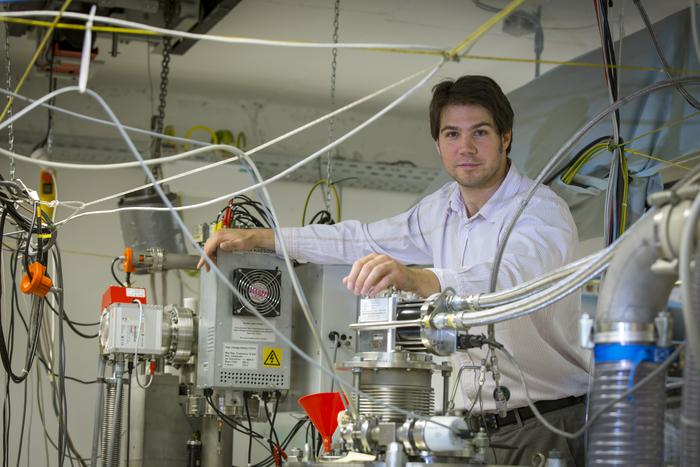
Credit: Lunghammer – TU Graz
When molecules are irradiated with infrared light, they begin to vibrate due to the energy supply. For Andreas Hauser from the Institute of Experimental Physics at Graz University of Technology (TU Graz), this well-known phenomenon was the starting point for considering whether these oscillations could also be used to generate magnetic fields. This is because atomic nuclei are positively charged, and when a charged particle moves, a magnetic field is created. Using the example of metal phthalocyanines – ring-shaped, planar dye molecules – Andreas Hauser and his team have now calculated that, due to their high symmetry, these molecules actually generate tiny magnetic fields in the nanometre range when infrared pulses act on them. According to the calculations, it should be possible to measure the rather low but very precisely localised field strength using nuclear magnetic resonance spectroscopy. The researchers have published their results in the Journal of the American Chemical Society.
Circular dance of the molecules
For the calculations, the team drew on preliminary work from the early days of laser spectroscopy, some of which was decades old, and used modern electron structure theory on supercomputers at the Vienna Scientific Cluster and TU Graz to calculate how phthalocyanine molecules behave when irradiated with circularly polarised infrared light. What happened was that the circularly polarised, i.e. helically twisted, light waves excite two molecular vibrations at the same time at right angles to each other. “As every rumba dancing couple knows, the right combination of forwards-backwards and left-right creates a small, closed loop. And this circular movement of each affected atomic nucleus actually creates a magnetic field, but only very locally, with dimensions in the range of a few nanometres,” says Andreas Hauser.
Molecules as circuits in quantum computers
By selectively manipulating the infrared light, it is even possible to control the strength and direction of the magnetic field, explains Andreas Hauser. This would turn the molecules into high-precision optical switches, which could perhaps also be used to build circuits for a quantum computer.
Experiments as next step
Together with colleagues from the Institute of Solid State Physics at TU Graz and a team at the University of Graz, Andreas Hauser now wants to prove experimentally that molecular magnetic fields can be generated in a controlled manner. “For proof, but also for future applications, the phthalocyanine molecule needs to be placed on a surface. However, this changes the physical conditions, which in turn influences the light-induced excitation and the characteristics of the magnetic field,” explains Andreas Hauser. “We therefore want to find a support material that has minimal impact on the desired mechanism.” In a next step, the physicist and his colleagues want to compute the interactions between the deposited phthalocyanines, the support material and the infrared light before putting the most promising variants to the test in experiments.
This research is anchored in the Field of Expertise “Advanced Materials Science“, one of five strategic foci of TU Graz.
Journal
Journal of the American Chemical Society
Method of Research
Computational simulation/modeling
Subject of Research
Not applicable
Article Title
Molecular Pseudorotation in Phthalocyanines as a Tool for Magnetic Field Control at the Nanoscale
Article Publication Date
14-May-2024
Cite Scienmag News
Bethany Barker. (June 11, 2024). Switching nanomagnets using infrared lasers. Scienmag. https://scienmag.com/switching-nanomagnets-using-infrared-lasers/
Bethany Barker. "Switching nanomagnets using infrared lasers." Scienmag, 11 June 2024, https://scienmag.com/switching-nanomagnets-using-infrared-lasers/. Accessed 4 September 2026.
Bethany Barker. "Switching nanomagnets using infrared lasers." Scienmag. June 11, 2024. https://scienmag.com/switching-nanomagnets-using-infrared-lasers/

