


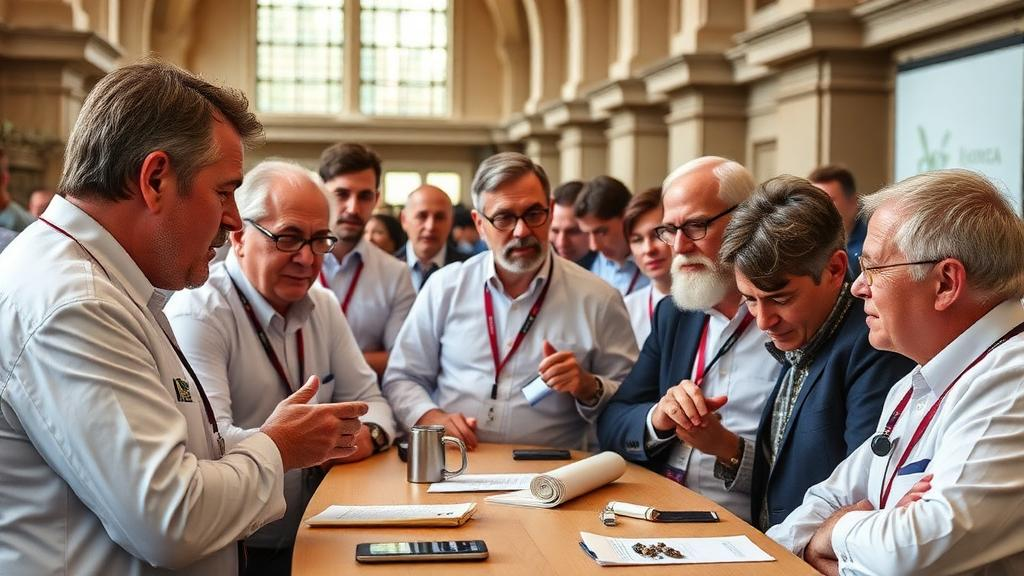
The Swiss Entomological Society held its annual meeting on 7 and 8 March 2025 at the HES-SO Valais-Wallis in Sion, bringing together researchers, museum curators and field biologists from across the country for two days of talks on insect evolution, alpine biodiversity and the growing pressures on Switzerland’s insect fauna. Unlike previous editions, the programme carried no single thematic focus, which allowed an unusually broad sweep of topics, from the evolutionary puzzles of insect reproduction to the arrival of invasive beetles and mosquitoes in the Alpine valleys.
The choice of Sion as the venue for the 2025 annual meeting carried a certain symbolic weight, since the host institution, HES-SO Valais-Wallis, sits at the heart of one of the driest and warmest regions of Switzerland, a landscape whose insect communities differ markedly from those of the Swiss Plateau or the higher Alps. The Valais has long been recognised as a hotspot for thermophilic species, including many that reach their northern distributional limits in the sunny slopes above the Rhône valley, and several of the talks delivered during the meeting touched directly on questions that arise from this regional context, such as the establishment of the Japanese beetle in the canton and the spread of the tiger mosquito into newly suitable habitats. Holding the meeting in Sion therefore offered participants not only a well-organised setting thanks to Andreas Sanchez and his team, but also a reminder that entomological research in Switzerland is increasingly shaped by processes unfolding at the southern, warmer edges of the country.
The opening keynote by Tanja Schwander of the University of Lausanne provided a conceptual frame for much of what followed, because the question of why sexual reproduction persists despite its apparent costs is one of the oldest and most stubborn problems in evolutionary biology. From a purely arithmetic standpoint, an asexual female that produces only daughters should enjoy a twofold reproductive advantage over a sexual female whose offspring are divided between sons and daughters, a discrepancy often described in the literature as the cost of males. Add to this the energetic expenses of finding mates, the risks of mating itself, and the slower intrinsic rate of increase of sexual populations, and the puzzle becomes sharper: sex should, in theory, be weeded out by natural selection, yet it dominates the animal kingdom. Schwander’s survey of the extraordinary diversity of insect reproductive systems, encompassing parthenogenesis, pseudogamy, hermaphroditism, hybridogenesis and androgenesis, illustrated why insects have become the premier model group for tackling this question. No comparable vertebrate group exhibits such a rich palette of reproductive modes, and the fact that many of these systems have evolved independently and repeatedly across the insect tree of life suggests that transitions between sexual and asexual reproduction are neither vanishingly rare nor biologically trivial.
The comparative experiments described in the keynote, involving thrips, mayflies and stick insects, reflect a broader methodological trend in which closely related sexual and asexual lineages are treated as natural replicates, allowing researchers to ask what asexual lineages lose and what sexual lineages gain over evolutionary time. The findings from the stick insect genus Timema, in which asexual species accumulated more deleterious mutations while sexual species showed more adaptive substitutions, align with theoretical expectations that sex helps purge harmful mutations through recombination and facilitates the fixation of beneficial allele combinations. Yet the keynote also made clear that the popular textbook answer, namely that sex generates the genetic variability needed to keep pace with changing environments, does not hold universally. The hypothesis that sexual lineages enjoy a survival advantage in more diverse habitats and under more variable environmental factors could not be confirmed in every comparison, a result that echoes a long-standing tension in the field between the elegance of theoretical models and the messiness of empirical data. The observation that some Drosophila lineages can spontaneously develop parthenogenesis, with eggs maturing without fertilisation, adds a further layer of interest, because it shows that the genetic machinery for asexual reproduction can lie dormant within otherwise sexual species and may surface under particular conditions, with implications for pest species in which a single asexual founder could in principle seed a new population.
Several of the shorter presentations on the Friday extended this evolutionary perspective into the realm of conservation and biogeography. Camille Cornet’s talk on the alpine butterfly genus Erebia highlighted a group that has become a flagship for alpine insect conservation, since these butterflies are largely restricted to high-elevation grasslands and are considered particularly sensitive to climate warming. The genus is species-rich in the Alps, and understanding how its members use and move through fragmented alpine landscapes is regarded as a prerequisite for designing effective protection measures. Eckehard Brockerhoff’s contribution brought an international comparison into the meeting, examining how land cover influences parasitism of the New Zealand red admiral butterfly, a reminder that questions about landscape structure and natural enemies are being pursued with similar methods on both sides of the globe. The phylogenomic work on Adephaga beetles presented by Cody Raul Cardenas addressed one of the largest suborders of beetles, a group that includes ground beetles and diving beetles, and whose internal relationships have proven difficult to resolve with morphology alone; integrative approaches combining genomic data with traditional characters are now reshaping this framework.
The talks on non-native species underscored how rapidly the composition of Switzerland’s insect fauna is changing. Stefano Bilotta’s retrospective and prospective view of the Japanese beetle in Valais concerned a pest that has caused enormous damage in North America and whose establishment in Europe is being monitored closely, with the canton of Valais among the first Swiss regions affected. José Ribeiro-Correia’s report on recently detected non-native ambrosia beetles and their fungal associates touched on a particularly insidious invasion pathway, because ambrosia beetles cultivate fungi inside the wood of their host trees, and it is often the fungus rather than the beetle itself that kills the tree. The global trade in wood products, packaging material and live plants has turned these tiny insects into one of the most successful groups of biological invaders worldwide, and their detection in Switzerland signals a growing surveillance challenge. Alexander Maess’s presentation on Lepidoptera range shifts and their interactions with host plants connected the invasion theme to climate-driven redistribution, since many moth and butterfly species are moving upslope and northwards, and the outcome of these shifts depends on whether their host plants are present in the newly colonised areas.
The Saturday programme, lacking a keynote and therefore richer in short presentations, showcased the institutional backbone of Swiss entomology. Inés Carrasquer Puyal’s talk on orthopteran phylogeny and genetic monitoring introduced the audience to multi-locus DNA barcoding, an approach that goes beyond the standard single-gene barcode by combining several genetic markers, thereby improving species discrimination and enabling population-level tracking. Jérémy Gauthier’s use of museomics, the extraction and analysis of genomic data from historical museum specimens, represents one of the most promising developments in biodiversity research, because natural history collections accumulated over the past two centuries now serve as archives of past genetic diversity. By comparing genomes of specimens collected throughout the twentieth century with those of living insects, researchers can reconstruct the timing and demographic signature of population declines that occurred long before systematic monitoring began, a perspective that is especially valuable for documenting the widely discussed insect decline.
The update on the Swiss Diptera checklist presented by Lisa Fisler connected directly to Fauna Helvetica volume 35, whose publication was reported at the general assembly. The growth of the checklist from 6,088 species in the 1998 first edition to 7,514 species in the new version illustrates how faunistic knowledge advances not only through new arrivals but also through taxonomic revisions, improved identification tools and intensified sampling, with 55 authors contributing to the revised volume. Jean-Luc Gattolliat’s provocatively titled talk on mayflies and politics made the case that even ephemeral insects, whose adult lives may last only days, have a role to play in policy debates, since mayfly larvae are sensitive indicators of water quality and their populations reflect the state of rivers and streams. Bärbel Koch’s representative study of saproxylic beetles in Ticino addressed a group whose dependence on dead wood makes them vulnerable to modern forestry practices, and such regional studies provide the baseline data needed for red lists and habitat management. Christophe Praz’s roadmap for certifying species knowledge in Switzerland responded to a practical concern that runs through many natural history societies: the pool of experts able to identify difficult insect groups is ageing, and structured certification of taxonomic competence is seen as one way to secure this expertise for the future. Camille Pitteloud’s account of the tiger mosquito in Valais closed the scientific programme with a public-health perspective, as the Asian tiger mosquito is not only a nuisance but a potential vector of diseases such as dengue and chikungunya, and its progressive establishment in Swiss valleys requires coordinated monitoring.
The business transacted at the general assembly offered a window into the society’s operations. The approval of the 2024 minutes from Neuchâtel, the president’s report on administrative support from info fauna and the platform Biology of the Swiss Academy of Sciences, and the grants of 10,300 and 6,000 Swiss francs from SCNAT and the Biedermann-Mantel foundation respectively, documented the modest but essential funding on which volunteer-driven scientific societies depend. The treasurer’s figures revealed the real costs of scholarly publishing, with more than 14,500 Swiss francs paid to Pensoft for the open-access platform of Alpine Entomology and over 12,000 francs for the production of Fauna Helvetica, alongside printing costs and digitisation projects carried out with the ETH library, whose e-periodica portal now makes the society’s historical journal volumes freely accessible. The editor-in-chief’s report on the journal recorded fourteen articles totalling 168 pages in the eighth issue, an average time from submission to publication of roughly two months, and a doubling of the journal impact factor from 0.4 to 0.8, figures that, while modest by international standards, reflect a healthy trajectory for a specialised regional journal. The choice of Rhyssa persuasoria, the giant woodwasp parasitoid, as Insect of the Year 2025 fitted the society’s outreach strategy, since the insect’s long ovipositor and its role in regulating woodwasp larvae make it a compelling ambassador for the ecological services provided by parasitoid wasps, a group that is species-rich in Switzerland yet largely invisible to the public. Taken together, the meeting in Sion demonstrated how a national entomological society functions simultaneously as a scientific forum, a custodian of faunistic data, a publisher, and an advocate for insects in public discourse.
Subject of Research: Insect biodiversity research and society affairs presented at the Swiss Entomological Society's 2025 annual meeting in Sion
Article Title: Protokoll der Jahresversammlung der Schweizerischen Entomologischen Gesellschaft vom 7. und 8. März 2025 an der HES-SO Valais-Wallis in Sion
Article References: Protokoll der Jahresversammlung der Schweizerischen Entomologischen Gesellschaft vom 7. und 8. März 2025 an der HES-SO Valais-Wallis in Sion. (n.d.). https://doi.org/10.3897/alpento.9.178557
Image Credits: AI Generated
Keywords: Swiss Entomological Society, entomology, insect reproduction, parthenogenesis, alpine butterflies, ambrosia beetles, invasive species, biodiversity, Fauna Helvetica, Alpine Entomology, insect decline, Switzerland
Cite Scienmag News
Gavin Prescott. (October 16, 2026). Swiss Entomologists Gather in Sion as Society Faces Funding Squeeze and Shaky Insect Data. Scienmag. https://scienmag.com/swiss-entomologists-gather-in-sion-as-society-faces-funding-squeeze-and-shaky-insect-data/
Gavin Prescott. "Swiss Entomologists Gather in Sion as Society Faces Funding Squeeze and Shaky Insect Data." Scienmag, 16 October 2026, https://scienmag.com/swiss-entomologists-gather-in-sion-as-society-faces-funding-squeeze-and-shaky-insect-data/. Accessed 16 October 2026.
Gavin Prescott. "Swiss Entomologists Gather in Sion as Society Faces Funding Squeeze and Shaky Insect Data." Scienmag. October 16, 2026. https://scienmag.com/swiss-entomologists-gather-in-sion-as-society-faces-funding-squeeze-and-shaky-insect-data/


