


People with diabetic peripheral neuropathy often lose the quiet, unconscious sense of where their feet are, and with it much of their confidence on stairs, pavements and kitchen floors. A new clinical study from India now reports that two widely used rehabilitation tools, the wobble board and the Swiss ball, can both restore measurable amounts of that lost function, but that one of them appears to pull ahead. In a trial of 200 patients aged 45 to 70, researchers at Baba Mastnath University in Rohtak, Haryana, found that eight weeks of supervised exercise produced significant gains in balance, mobility and functional independence in both groups, with the Swiss ball group finishing ahead on every measure tested.
The study, published in the Bulletin of Faculty of Physical Therapy, enrolled pre-diagnosed patients with type 2 diabetes who had lived with the condition for four to eight years and showed signs of peripheral nerve dysfunction on the Michigan Neuropathy Screening Instrument. All participants had lower limb muscle strength above grade 3, Berg Balance Scale scores between 35 and 47, and Timed Up and Go times not below 13 seconds, meaning they were impaired enough to benefit from training but stable enough to exercise safely. Patients with fractures, foot ulcers, vestibular disorders, stroke, sciatica, rheumatoid arthritis or vascular complications were excluded, so the results apply to a relatively well-defined slice of the neuropathy population.
The trial used a pre-test post-test two-group design with convenient sampling at SBMN General Hospital. Thirteen of the 213 initially enrolled participants dropped out after one or two sessions, for reasons the authors did not document, and were replaced by 13 newly recruited eligible participants, leaving 200 completers for the final analysis. One hundred participants were assigned to wobble board training and one hundred to Swiss ball training, each layered on top of an identical 30-minute conventional therapy session that included ankle range of motion exercises, deep breathing, sit-to-stand practice, weight shifting, heel and toe standing, single leg standing, ramp walking, stair climbing, spot marching, reaching activities and tandem walking.
The two experimental programmes each added 15 minutes of device-specific work, three days a week for eight weeks, for a total of 45 minutes per session. The wobble board group stood on the tilting platform with feet shoulder-width apart, rocking it forward, backward and side to side, rotating it in circles with and without letting the edge touch the floor, performing knee bends and squats on the unstable surface, and rotating the upper body with arms extended. All sessions, including the eyes-closed drills, were performed under close supervision, and the authors report that no falls, injuries or exercise-related adverse events occurred.
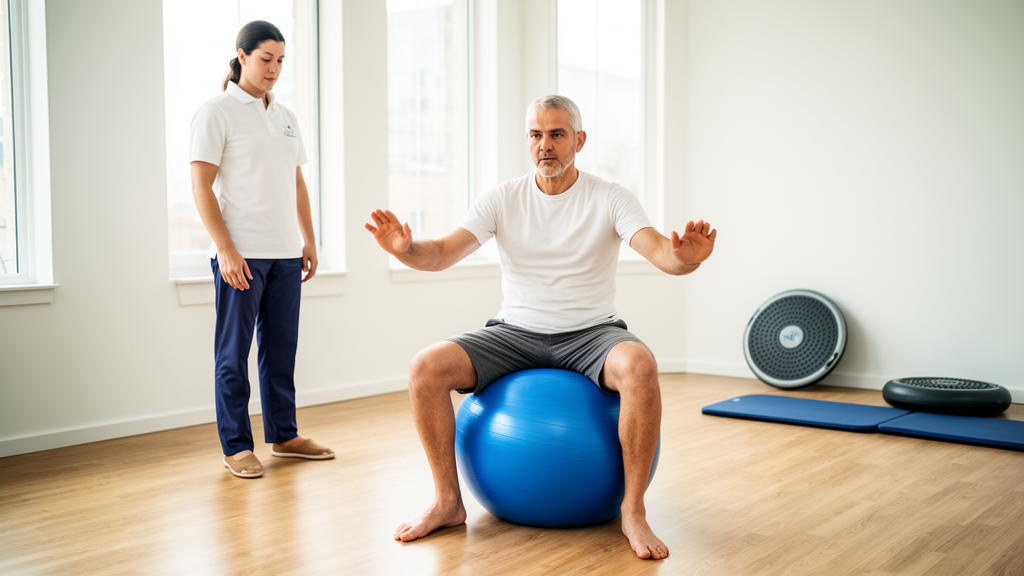
The Swiss ball group worked through a different repertoire. Seated on the ball, they performed unilateral and bilateral arm movements, forward bending and trunk rotation, heel raises, toe raises, simultaneous heel-and-toe raises, and resistance and weight-shifting drills against perturbation. In standing, they moved the ball up and down with both arms in straight and oblique lines, swept it with each leg forward, backward and laterally, and threw it against a wall with hands and feet. The authors note that the two programmes differed not only in equipment but in the type and content of the exercises themselves, an important caveat when interpreting which intervention came out ahead.
Outcomes were measured before and after the intervention using three established instruments. Analyses were run in SPSS 22, with paired t tests for within-group change, unpaired t tests for between-group change, and an analysis of covariance adjusting for baseline scores. Statistical significance was set at p less than 0.05, with no adjustment for multiple outcomes.
Both groups improved significantly on all three measures, with within-group p values below 0.001. At baseline the groups were statistically indistinguishable, with p values of 0.531 for the Berg Balance Scale, 0.078 for the Timed Up and Go test and 0.628 for the Functional Independence Measure. After adjustment for baseline values, the between-group differences also reached significance. The Swiss ball group gained an adjusted 1.08 more points on the Berg Balance Scale, a 95 percent confidence interval of 0.76 to 1.39 with an effect size of 0.95; completed the Timed Up and Go test 0.88 seconds faster, a confidence interval of minus 1.07 to minus 0.69 seconds with an effect size of 1.32; and scored 0.62 points higher on the Functional Independence Measure, a confidence interval of 0.48 to 0.75 with an effect size of 1.28.
The raw change scores tell a similar story. The Berg Balance Scale rose by an average of 3.56 points in the wobble board group and 4.75 points in the Swiss ball group, the Timed Up and Go improved by 2.87 and 3.74 seconds respectively, and the Functional Independence Measure climbed by 4.74 and 5.47 points. Yet the authors are unusually candid about what those numbers do and do not mean. Published estimates of minimal important or detectable change for the Berg Balance Scale and the Timed Up and Go vary by population and methodology, so the differences should be read cautiously rather than against a single universal threshold. Statistical significance, they stress, is not the same as clinical importance, and the between-group gaps were relatively modest.
The Functional Independence Measure results carry a further warning. Baseline scores were already 113.52 and 113.45 out of a maximum of 126, leaving so little headroom that a ceiling effect may have limited how much further improvement was even possible. The authors also caution that their finding is specific to the two exercise programmes evaluated and should not be interpreted as evidence that Swiss ball training is universally superior to wobble board training, since the programmes differed in exercise content as well as equipment. The study’s other limitations include recruitment from a single hospital, the absence of long-term follow-up, and the assessment of only short-term effects, leaving open the question of how long the benefits last.
Why might an inflated rubber ball outperform a tilting wooden board in this population? The authors point to the breadth of the Swiss ball repertoire, which engages trunk musculature, intervertebral and abdominal muscles, and is claimed in the supporting literature to build proprioception, joint stability, spinal flexibility and muscle endurance. Previous work they cite found Swiss ball exercises more beneficial than Frenkel exercises for balance in type 2 diabetic neuropathy, and other research links better balance to independence in cooking, cleaning, shopping and travel, with one stroke study reporting a correlation of 0.82 between balance and functional independence. For now, the practical takeaway is modest but useful: for patients with diabetic peripheral neuropathy who can safely participate, structured unstable-surface exercise added to conventional therapy appears to improve balance, mobility and daily functioning, and in this particular trial the Swiss ball version of that training delivered the larger gains.
Subject of Research: Comparative effects of Swiss ball and wobble board exercises on balance, mobility and functional independence in diabetic peripheral neuropathy
Article Title: Effectiveness of Wobble Board and Swiss Ball exercises on balance, mobility and functional independence in patients with diabetic peripheral neuropathy
Article References: Rani, S., & Jagga, V. (2026). Effectiveness of Wobble Board and Swiss Ball exercises on balance, mobility and functional independence in patients with diabetic peripheral neuropathy. Bulletin of Faculty of Physical Therapy, 31(1), Article 46. https://doi.org/10.1186/s43161-026-00382-7
Image Credits: AI Generated
DOI: 10.1186/s43161-026-00382-7
Keywords: diabetic peripheral neuropathy, Swiss ball exercises, wobble board training, balance rehabilitation, Berg Balance Scale, Timed Up and Go test, Functional Independence Measure, type 2 diabetes, physical therapy, randomised comparison, fall risk, exercise intervention
Cite Scienmag News
Ophelia Keating. (October 27, 2026). Swiss Ball Beats Wobble Board for Balance in Diabetic Nerve Disease Trial. Scienmag. https://scienmag.com/swiss-ball-beats-wobble-board-for-balance-in-diabetic-nerve-disease-trial/
Ophelia Keating. "Swiss Ball Beats Wobble Board for Balance in Diabetic Nerve Disease Trial." Scienmag, 27 October 2026, https://scienmag.com/swiss-ball-beats-wobble-board-for-balance-in-diabetic-nerve-disease-trial/. Accessed 28 October 2026.
Ophelia Keating. "Swiss Ball Beats Wobble Board for Balance in Diabetic Nerve Disease Trial." Scienmag. October 27, 2026. https://scienmag.com/swiss-ball-beats-wobble-board-for-balance-in-diabetic-nerve-disease-trial/









