


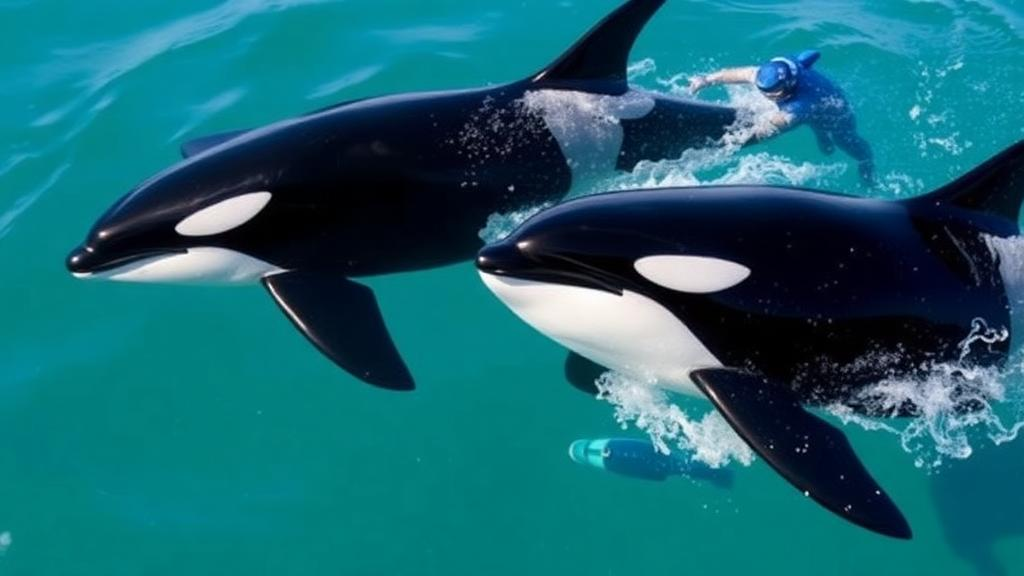
In the warm summer waters off Cerralvo Island in Baja California Sur, an unusual tourism industry is taking shape. When massive aggregations of mobula rays gather along the southeastern coast of the peninsula, orcas arrive to forage on them, and tour operators have learned to find the predators, sometimes with the help of small aircraft, before lowering swimmers into the water for close encounters. The activity, known as swim-with-orca tourism, has grown rapidly in the Gulf of California in recent years, and it has done so almost entirely without regulation. A new review published in Frontiers in Mammal Science by Simone Antichi of Syracuse University and Jorge Urbán R. and Lorena Viloria-Gómora of the Universidad Autónoma de Baja California Sur examines what is known about this emerging industry and describes how Mexican authorities are responding with one of the world’s first formal management plans for swimming with killer whales.
Swim-with-orca tourism is a recent and geographically restricted branch of the much larger marine mammal tourism sector. Dolphin-watching and swim-with-dolphin activities have expanded worldwide, from Mozambique and Panama to Egypt, delivering real economic benefits to coastal communities and, in principle, fostering conservation awareness among millions of participants. But decades of research have shown a darker side. Repeated exposure to vessels and swimmers can change how dolphins behave, how they use their habitat, and in some cases how many of them survive. Studies of Indo-Pacific bottlenose dolphins off Zanzibar found that the animals spent more time diving and less time resting or traveling when tourist boats were present, an apparent avoidance response. In Hawaii, researchers linked declining spinner dolphin abundance to mounting tourism pressure in the resting areas the animals depend on to recover from nighttime foraging.
The long-term consequences documented in some dolphin populations are sobering: habitat avoidance, reduced reproductive success, and outright declines in abundance. Notably, the effects of tour vessels are relatively well studied, while the impacts of direct in-water interaction with swimmers remain poorly understood, particularly in countries where legislation is recent or weakly enforced. Swim-with activities sometimes proceed without professional guidance or with large numbers of participants, encouraging inappropriate behavior such as attempts to touch the animals. Researchers worry that increased human contact may erode dolphins’ natural vigilance and raise their tolerance of people, leaving them more vulnerable to harmful activities such as vessel strikes. Regulations, the review notes, do not by themselves guarantee effective management; some heavily visited sites continue to experience high levels of disturbance despite rules on paper.
Against that backdrop, swim-with-orca tourism occupies an even more uncertain space. The best-studied example is Northern Norway, where seasonal aggregations of orcas feeding on overwintering herring have turned fjords near places like Skjervøy into a globally recognized snorkeling destination. Norwegian activities operate under national voluntary guidelines that are strikingly specific: in-water encounters are permitted only when orcas are hunting, feeding, or moving slowly, and are explicitly prohibited when the animals are resting or showing evasive behavior. Only one vessel carrying a maximum of six snorkelers may enter a zone 20 to 50 meters from a group of orcas, with additional boats held in a waiting area 50 to 300 meters away. Encounters typically last five to ten minutes, snorkelers must stay at least 20 meters from the animals, remain passive in the water, and avoid any attempt to approach or interact directly with them.
What happens when humans actually get in the water with wild orcas? Opportunistic underwater video from Norway, analyzed by researchers, showed no aggressive conduct toward swimmers; the most common behaviors recorded during encounters were calling and eye contact. Yet the authors of that work emphasized that such interactions still carry risks for both people and animals and demand careful monitoring. A more recent socio-tourism study of Northern Norway describes a destination transformed: rapid growth and the absence of clear regulatory frameworks have produced crowded conditions, with numerous boats and swimmers competing for encounters, and participants reporting both profound emotional connections with the animals and growing unease about the disturbance caused by tourism pressure. The scientific consensus, such as it is, amounts to this: short-term responses appear muted, but the long-term ecological consequences of repeated exposure remain essentially unknown.
Mexico presents a very different ecological and regulatory setting. All marine mammals there are protected under the Official Mexican Standard NOM-059, and whale watching targeting baleen whales and sperm whales is regulated by NOM-131-SEMARNAT, which sets minimum approach distances, speed limits, and caps on the number of vessels near an animal. The Mexican Pacific is a major migratory destination for blue, gray, and humpback whales, and whale watching has become economically important. But no equivalent regulation exists for dolphin watching or for swimming with whales and dolphins. Organized swims with whales are not formally advertised, yet opportunistic interactions are reported with increasing frequency and swim-with-dolphin experiences are increasingly promoted by operators, who generally follow voluntary guidelines borrowed from other countries, such as avoiding physical contact, not feeding animals, and avoiding groups with many calves. The review calls for a dedicated Mexican standard, developed with authorities, researchers, operators, and local stakeholders, with interim measures including voluntary codes of conduct, operator training, and standardized reporting.
The orcas themselves add layers of biological complexity. Globally the species is classified as Data Deficient by the IUCN Red List; in Mexico it is listed as Subject to Special Protection. A distinct generalist ecotype has been proposed for the Eastern Tropical Pacific, including the Mexican Pacific, where orcas feed on a remarkably wide range of prey: other cetaceans, sea turtles, bony fishes, and various elasmobranchs, with documented attacks on fin whales and even whale sharks. In the Gulf of California, photo-identification studies have documented at least four distinct communities, from the Midriff Islands and Canal de Ballenas to La Paz Bay, Loreto, and the southern entrance of the Gulf near Cabo San Lucas. More than 408 individuals have been photo-identified in the Gulf and the Mexican Pacific between 1973 and 2025, yet information on population structure, connectivity, and long-term trends remains limited, a critical gap given that tourism is now targeting one of these communities directly.
The response is the 2025–2026 swim-with-orca management plan for the Cerralvo Island region, described in the review as a case study in precautionary management. The designated area covers roughly 1,100 square kilometers, extending from the community of La Ventana eastward to Cerralvo Island and south toward the continental zone of the municipality of La Paz. The season runs from 1 August 2025 to 31 July 2026, and all activities must be authorized by the General Directorate of Wildlife, with vessel captains and guides completing annual training coordinated by SEMARNAT. The operational rules echo the Norwegian model: activities are scheduled between 07:00 and 18:00, observation or swimming is limited to 30 minutes per encounter, only vessels up to 10 meters are permitted, and a maximum of two vessels may attend the same group of orcas. Boarding and disembarking are restricted to Playa Central of La Ventana and Ensenada de Muertos, and compliance is monitored by SEMARNAT in coordination with the Federal Attorney for Environmental Protection, PROFEPA, supported by real-time GPS tracking of authorized vessels.
The in-water rules are equally detailed. Swimming is allowed only during social behavior and feeding involving prey consumption, never when orcas are resting, traveling, or actively hunting prey with unpredictable changes in speed, and never during feeding events involving prey larger than two meters, such as dolphins, sea lions, or whale sharks. A maximum of five people, four swimmers plus a guide, may enter the water, and swimmers must stay at least 20 meters from the animals. In parallel, the community, service providers, and academic institutions will monitor the orca population to build a baseline of data for future evidence-based management. The review’s authors are candid about the plan’s weaknesses. The decision to allow in-water interactions relies heavily on the real-time judgment of captains and guides, yet the plan sets no criteria for evaluating their field experience or behavioral assessment skills. Pre-excursion briefings on orca biology and threats are required but not standardized, and no mechanism tests whether they change participant behavior. Enforcement capacity is limited, and because tourism is allowed year-round, orcas get no respite from human presence; the authors suggest seasonal closures could be considered if monitoring reveals cumulative disturbance.
Still, the Gulf of California plan stands as an early and instructive experiment. The authors argue that future monitoring should look beyond population counts to individual welfare, using frameworks such as the Five Domains Model, which evaluates impacts on nutrition, environment, health, and behavior and their effects on the animal’s mental state, potentially detecting harm before demographic consequences appear. They also point to international guidance from the International Whaling Commission and the Convention on Migratory Species, both of which promote precautionary approaches to in-water interactions, and to open questions such as whether socially transmitted behaviors or cultural traits make some orca groups more sensitive to tourism than others. For a species listed as Data Deficient, and for an industry growing faster than the science that would constrain it, the Mexican plan is less a finished solution than a testable hypothesis: that limits, spatial restrictions, collaborative monitoring, and adaptive revision can keep a thrilling new form of wildlife tourism from repeating the disturbances documented in dolphins worldwide. Whether it works will be decided in the waters off Cerralvo, one season at a time.
Subject of Research: Ecological impacts of swim-with-orca tourism and precautionary management in the Gulf of California, Mexico
Article Title: Swim-with-orca tourism: impacts and management responses in the Gulf of California, Mexico
Article References: Antichi, S., Urbán R., J., & Viloria-Gómora, L. (2026). Swim-with-orca tourism: impacts and management responses in the Gulf of California, Mexico. Frontiers in Mammal Science, 5, Article 1888690. https://doi.org/10.3389/fmamm.2026.1888690
Image Credits: AI Generated
DOI: 10.3389/fmamm.2026.1888690
Keywords: orcas, killer whales, swim-with-orca tourism, Gulf of California, Cerralvo Island, marine mammal tourism, whale watching, dolphin watching, wildlife management, conservation, Baja California Sur, precautionary management
Cite Scienmag News
Margaret Porter. (October 15, 2026). Swimming With Orcas: Mexico Bets on Precaution as New Tourism Boom Hits the Gulf of California. Scienmag. https://scienmag.com/swimming-with-orcas-mexico-bets-on-precaution-as-new-tourism-boom-hits-the-gulf-of-california/
Margaret Porter. "Swimming With Orcas: Mexico Bets on Precaution as New Tourism Boom Hits the Gulf of California." Scienmag, 15 October 2026, https://scienmag.com/swimming-with-orcas-mexico-bets-on-precaution-as-new-tourism-boom-hits-the-gulf-of-california/. Accessed 15 October 2026.
Margaret Porter. "Swimming With Orcas: Mexico Bets on Precaution as New Tourism Boom Hits the Gulf of California." Scienmag. October 15, 2026. https://scienmag.com/swimming-with-orcas-mexico-bets-on-precaution-as-new-tourism-boom-hits-the-gulf-of-california/


