


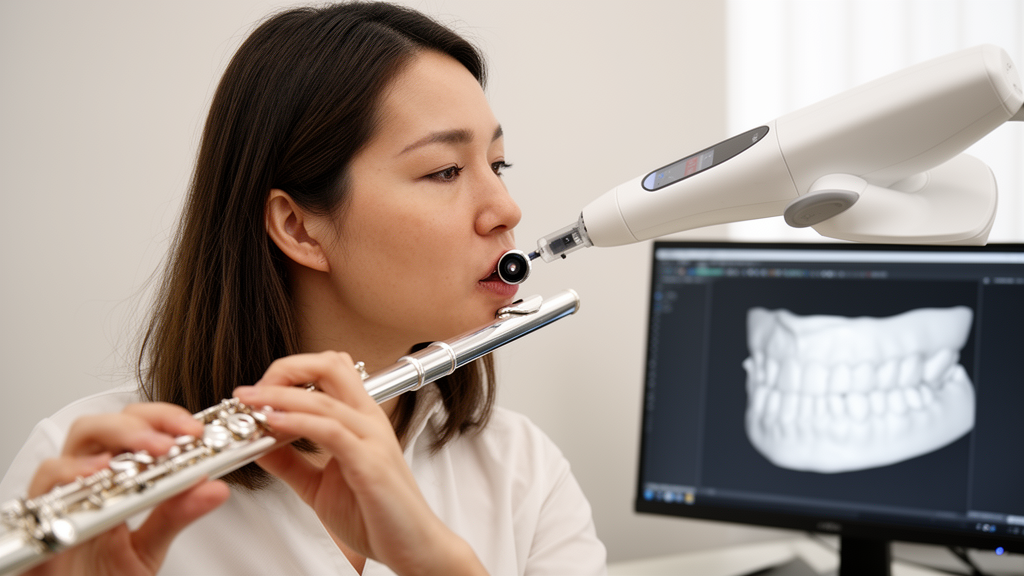
For centuries, the subtle art of playing wind instruments has been passed down through observation, imitation, and years of trial and error. A beginner watching a master shakuhachi player can see the flute, the hands, and the posture, but the critical detail — exactly how the lips meet the blowing edge — remains largely invisible, tucked away at the intersection of breath, anatomy, and geometry. Now, a team of researchers in Japan has borrowed a set of tools from an unexpected discipline, prosthodontics, to make that invisible relationship physical, printable, and reproducible.
In a proof-of-concept study published online on July 11, 2026, in the Journal of Prosthodontic Research, researchers at Institute of Science Tokyo, working with Associate Professor Dozan Fujiwara of Tokyo University of the Arts, demonstrated a fully digital workflow that captures the precise spatial relationship between an experienced shakuhachi player’s lips and the instrument, then reproduces it as a customized 3D-printed guide. The work was led by Assistant Professor Tamaki Hada and Professor Manabu Kanazawa of Science Tokyo, and it extends techniques normally reserved for dental surgery into the world of musical training.
The shakuhachi, a traditional Japanese end-blown flute, belongs to a family of air-reed instruments in which the player’s breath is split across a sharp edge to produce sound. Unlike a clarinet or trumpet, where the mouthpiece offers a defined physical anchor, the shakuhachi demands that the player shape and position their lips with extraordinary precision while directing a controlled stream of air across the blowing opening. Small changes in angle, distance, or lip posture translate immediately into changes in tone, pitch stability, and responsiveness. This is precisely why the instrument is notoriously difficult for beginners: the target they must hit with their lips is defined by an expert’s anatomy, not their own, and no two faces are alike.
Conventional teaching approaches rely on verbal instruction, demonstration, and the student’s own sensory feedback — a slow, subjective process. Some assistive devices have been proposed over the years, but they generally lack the ability to account for the individual dentofacial morphology of each player. The Science Tokyo team saw an opportunity here. Digital prosthodontics — the branch of dentistry concerned with replacing and restoring oral structures — has spent the last decade perfecting exactly the kind of technology needed: facial scanning, intraoral scanning, computer-aided design, and stereolithography 3D printing of biocompatible materials. What if those tools could record an expert’s embouchure the way they record a prepared tooth?
The workflow began with data acquisition. The researchers obtained an intraoral scan of an experienced male shakuhachi player, capturing the geometry of his teeth, occlusal plane, and oral structures with the same technology used to plan dental restorations. They then performed a facial scan, recording the external surface of his face and lips. Finally, they scanned the shakuhachi itself. The crucial step came next: the musician assumed his optimal playing position — the posture and lip placement he uses during actual sound production — and the team digitally captured the spatial relationship among his face, his lips, and the instrument in that configuration.
With all three datasets in hand, the researchers moved to computer-aided design software, where the real technical work took place. They registered the scans to one another using dental landmarks, the occlusal plane, and facial reference information, effectively fusing the internal oral anatomy, the external facial surface, and the instrument into a single coherent digital model. From this integrated dataset, they could measure and reproduce the exact relationship between the player’s lips and the shakuhachi’s blowing opening — the geometric target that defines a functional embouchure for that particular face.
The design that emerged from this model is elegantly simple in concept. In the gap between the musician’s chin and the shakuhachi, the team designed a spherical clay model approximately 70 millimeters in diameter, positioned to hold the instrument at the correct distance and angle relative to the lips. This spherical form was then converted into a hollow guide, reducing weight and material use. A window was incorporated into the design for a distinctly prosthodontic reason: it allowed uncured resin to drain during fabrication and facilitated post-curing of the printed part. The hollow, lightweight construction was a deliberate choice to maximize comfort during extended playing sessions, while a bracing arm could be precisely customized to allow fine positional adjustments.
Fabrication followed the standard digital dental pipeline. The guide design data were imported into printing software, and the guide was produced by stereolithography 3D printing — a technique in which a light source selectively cures liquid photopolymer resin layer by layer. Critically, the material selected was an autoclavable, biocompatible photopolymer of the kind routinely used for dental surgical guides. This choice matters beyond mere convenience: it ensures the guide can be disinfected and sterilized between users, a requirement for any device that contacts the face and mouth, whether in a dental clinic, a music classroom, or a rehabilitation setting.
When an expert musician evaluated the completed guide, it received high scores for stability, fit, and overall usability, and the device made it easier to identify potential problems during use. According to the researchers, the guide differs from conventional assistive devices in a fundamental way: it enables guided lip–instrument positioning based on each player’s individual dentofacial morphology, rather than relying solely on subjective sensory feedback or experiential instruction. The digital workflow may also reduce the time and labor associated with conventional plaster-cast fabrication methods, replacing a labor-intensive manual process with a scan-and-print pipeline.
The implications reach well beyond the practice room. “Beyond music education, we expect this concept could potentially be extended to maxillofacial prosthetics, orofacial rehabilitation, and other extraoral devices requiring precise perioral spatial control,” Hada concluded. In other words, the same workflow that records where a flutist’s lips must sit could one day help position prosthetic devices for patients with facial defects, guide rehabilitation exercises after surgery or injury, or support any application where the precise spatial relationship between the mouth and an external object must be captured, stored, and reproduced. “We developed a workflow to fabricate a guide that records and reproduces the positional relationship between an expert player’s lips and the shakuhachi during performance,” Hada explained. What began as a dental technology may thus find an unlikely second life — teaching beginners where their lips need to go, one 3D-printed guide at a time.
Subject of Research: A digital prosthodontic workflow using facial and intraoral scans to reproduce lip–instrument positioning for air-reed wind instruments
Article Title: A prosthodontic digital guide for reproducing lip–instrument positioning for wind instruments
Article References: A prosthodontic digital guide for reproducing lip–instrument positioning for wind instruments. (n.d.). Original publication
Image Credits: AI Generated
DOI: Not provided
Keywords: prosthodontics, digital dentistry, shakuhachi, 3D printing, embouchure, air-reed instruments, CAD, facial scanning, intraoral scanning, music education, maxillofacial prosthetics, orofacial rehabilitation
Cite Scienmag News
Courtney Benton. (October 15, 2026). Digital dental scanning technique captures a master flutist’s embouchure in 3D. Scienmag. https://scienmag.com/digital-dental-scanning-technique-captures-a-master-flutists-embouchure-in-3d/
Courtney Benton. "Digital dental scanning technique captures a master flutist’s embouchure in 3D." Scienmag, 15 October 2026, https://scienmag.com/digital-dental-scanning-technique-captures-a-master-flutists-embouchure-in-3d/. Accessed 15 October 2026.
Courtney Benton. "Digital dental scanning technique captures a master flutist’s embouchure in 3D." Scienmag. October 15, 2026. https://scienmag.com/digital-dental-scanning-technique-captures-a-master-flutists-embouchure-in-3d/


