


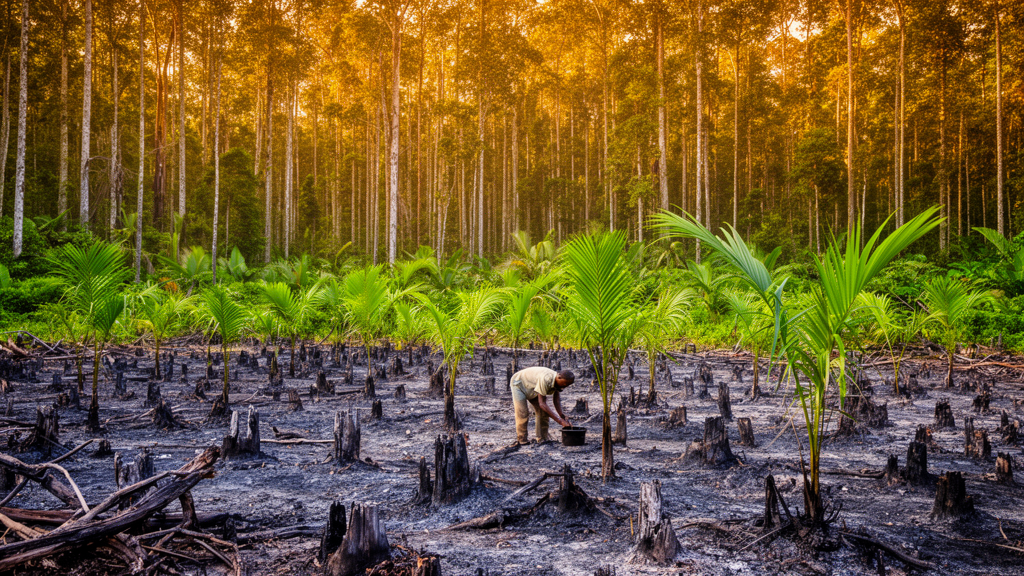
Deep in the forests of South-Central Guyana, a quiet transformation is taking place in the canopy and understory, one that challenges long-held assumptions about the ecological costs of Indigenous farming. A new study published in PLOS Sustainability and Transformation has used cutting-edge drone technology and machine learning to count, one by one, more than ten thousand individual palm trees scattered across a landscape shaped by centuries of swidden agriculture. The findings reveal a striking paradox: the very practice that many conservationists have assumed degrades tropical forests may actually increase the abundance of some of their most economically and culturally important plants, even as it reshapes the composition of the plant communities that depend on them.
The research, led by Matthew J. Drouillard and Anthony R. Cummings together with colleagues including Persaud Moses, Fabian Moses, and Catherine Auerbach, focused on a localized region of swidden agriculture, the traditional farming system in which small plots of forest are cut and burned, cultivated for a few seasons, and then left to regenerate as farmers move on to new ground. Rather than relying on ground surveys alone, which are slow and laborious in dense tropical terrain, the team turned to unmanned aerial vehicles, or UAVs, equipped to capture imagery of extraordinary detail. Over 255 hectares of both undisturbed forest and land disturbed by swidden activity, the researchers deployed convolutional neural networks, a form of artificial intelligence that excels at recognizing objects in images, to detect individual palms from the air.
The scale of the resulting census is remarkable. In total, the team identified 10,194 individual palms belonging to six different species. Each palm was mapped within its landscape context, allowing the researchers to compare how palm communities differed between forest that had never been cleared and forest recovering from swidden disturbance. The numbers told a clear story. Land disturbed by swidden agriculture supported a palm density of 53.3 individuals per hectare, compared with just 22.6 per hectare in undisturbed forest, an increase of 136 percent. In other words, disturbed plots held more than twice as many palms as intact forest, a result that runs directly counter to the expectation that human disturbance uniformly reduces the abundance of valued forest resources.
But abundance, the study shows, is only half the picture. When the researchers examined which species made up those palm populations, they found that swidden disturbance had dramatically simplified the palm assemblage. Using Local Moran’s I, a spatial statistics technique that identifies clusters of similar values across a landscape, the team determined that a single species, Attalea maripa, dominated both forest types, but to very different degrees. In undisturbed forest, A. maripa accounted for 77.1 percent of all palms identified. On swidden-disturbed land, its share rose to 89.0 percent. The disturbed landscape was not only richer in palms; it was also far more of a monoculture, overwhelmingly populated by one hardy, disturbance-tolerant species.
The species that lost ground in disturbed areas tell an equally important story. Astrocaryum vulgare, the second most common palm in the study area, declined in relative representation from 17.3 percent of palms in undisturbed forest to just 10.0 percent in disturbed forest. Other, less abundant palm species also saw their shares shrink. This pattern, in which total numbers rise while diversity falls, represents a genuine ecological trade-off. Swidden agriculture, the authors conclude, can increase total palm density while simultaneously simplifying the palm community and eroding the relative representation of rarer species. For Indigenous communities whose livelihoods and cultural practices depend on a variety of palm products, from food and construction materials to crafts and medicine, that erosion of diversity could carry consequences that raw density figures conceal.
The technical achievement behind these findings deserves attention in its own right. Counting individual trees across hundreds of hectares of tropical forest has always been one of ecology’s most stubborn challenges. Ground-based plots are accurate but tiny, while satellite imagery has historically been too coarse to distinguish individual crowns in closed-canopy forest. The convolutional neural network approach used here changes that calculus. CNNs are trained on labeled examples of the objects they must find, learning to recognize the distinctive spectral and textural signatures of palm crowns in aerial imagery. Once trained, they can scan vast image mosaics in a fraction of the time a human analyst would need, with consistent criteria applied across the entire dataset.
The study also provides a sobering lesson about the limits of satellite remote sensing for this kind of fine-scale ecological work. Alongside the UAV surveys, the researchers analyzed multispectral imagery from the WorldView-2 satellite, which offers a resolution of 0.5 meters, among the sharpest commercially available. Yet even at that resolution, the satellite imagery detected approximately 70 percent fewer palms than the drone-based approach. The discrepancy underscores how much ecological detail remains invisible to even advanced orbital sensors, and it suggests that studies relying on satellite data alone may substantially underestimate the abundance of individual trees, particularly in landscapes where understory and mid-story vegetation obscure the ground from above.
For the Wai Wai and other Indigenous peoples of the region, whose harvesting practices have helped shape these palm populations over generations, the findings carry practical weight. Swidden agriculture is often portrayed in policy debates as a driver of deforestation that should be curtailed or replaced with intensive permanent cultivation. This study complicates that narrative. If disturbed plots support more than double the palm density of intact forest, then the traditional cycle of clearing, cultivation, and fallow may function as a form of resource enhancement, at least for the dominant species. At the same time, the loss of relative diversity in disturbed areas suggests that unmanaged expansion of swidden activity could gradually homogenize palm communities, with uncertain consequences for the animals that depend on less common palm species and for the resilience of the ecosystem as a whole.
The authors frame their results as a contribution to what they call more sustainable land-use pathways, approaches that maintain the livelihood and cultural functions of swidden agriculture while conserving palm-community diversity. Achieving that balance will require understanding not just how many palms a landscape supports, but which species, where they cluster, and how their distributions shift across the disturbance gradient from mature forest to active gardens to old fallows. The spatial clustering analysis used in the study offers a template for this kind of work, showing exactly where dominant species concentrate and where rarer palms persist or disappear.
As tropical forests face mounting pressure from commercial agriculture, logging, and climate change, studies like this one highlight the value of combining Indigenous knowledge with modern technology. The 10,194 palms mapped across 255 hectares of Guyana are more than a dataset; they are evidence that human disturbance and ecological abundance are not always opposites, and that the future of tropical biodiversity may depend on understanding the nuanced trade-offs embedded in traditional land-use systems. The challenge for conservation, the study suggests, is not to exclude people from the forest, but to sustain the practices that enrich it while safeguarding the diversity that makes it whole.
Subject of Research: The effects of Indigenous swidden agriculture on palm population density and diversity in South-Central Guyana
Article Title: Impact of swidden agriculture on palm populations in South-Central Guyana
Article References: Drouillard, M. J., Cummings, A. R., Moses, P., Moses, F., & Auerbach, C. (2026). Impact of swidden agriculture on palm populations in South-Central Guyana. PLOS Sustainability and Transformation, 5(9), e0000275. https://doi.org/10.1371/journal.pstr.0000275
Image Credits: AI Generated
DOI: 10.1371/journal.pstr.0000275
Keywords: swidden agriculture, palms, Guyana, UAV remote sensing, convolutional neural networks, Attalea maripa, Astrocaryum vulgare, biodiversity, Indigenous land use, tropical forests, WorldView-2, spatial analysis
Cite Scienmag News
Margaret Porter. (October 9, 2026). Swidden Farming Boosts Palm Numbers but Simplifies Forest Diversity in Guyana. Scienmag. https://scienmag.com/swidden-farming-boosts-palm-numbers-but-simplifies-forest-diversity-in-guyana/
Margaret Porter. "Swidden Farming Boosts Palm Numbers but Simplifies Forest Diversity in Guyana." Scienmag, 9 October 2026, https://scienmag.com/swidden-farming-boosts-palm-numbers-but-simplifies-forest-diversity-in-guyana/. Accessed 9 October 2026.
Margaret Porter. "Swidden Farming Boosts Palm Numbers but Simplifies Forest Diversity in Guyana." Scienmag. October 9, 2026. https://scienmag.com/swidden-farming-boosts-palm-numbers-but-simplifies-forest-diversity-in-guyana/


