


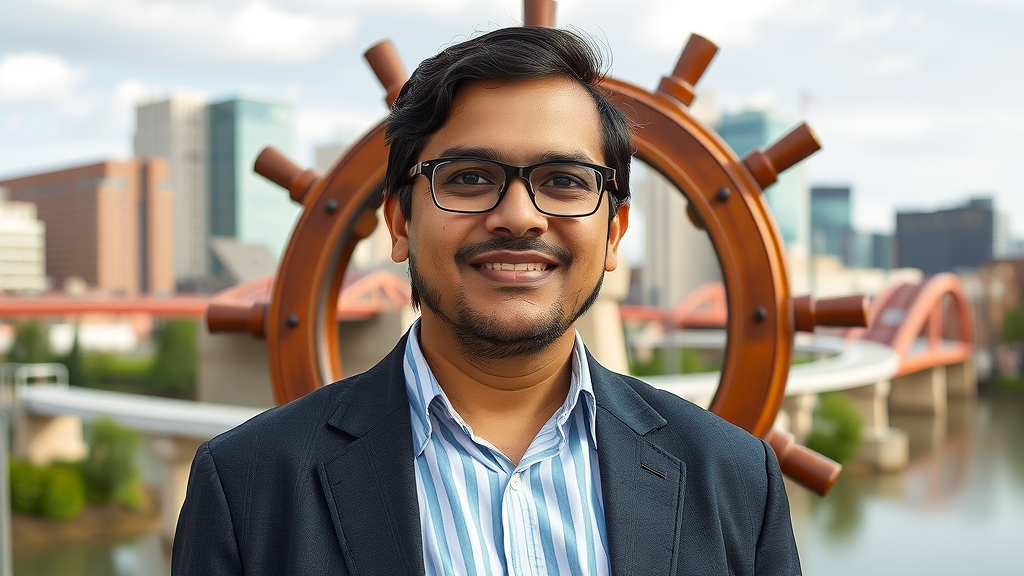
The University of Pittsburgh has appointed Vikas Khanna, a scholar whose career has been built around understanding how emerging technologies reshape the environment, as chair of the Department of Civil and Environmental Engineering in the Swanson School of Engineering. The appointment took effect on September 1, 2026, and closes a chapter that began more than a year earlier, when Khanna stepped into the role on an interim basis in July 2025. For a department whose work underpins the water systems, transportation networks, and built environment that modern society depends upon, the transition marks both continuity and a deliberate pivot toward the disciplines that will define infrastructure in the coming decades: artificial intelligence, public health, and resilient, data-driven design.
Khanna’s path to the chairmanship was, in a sense, an extended audition. During his fourteen months as interim chair, he undertook what colleagues describe as an unusually systematic listening exercise, meeting extensively with faculty, staff, and students while also engaging the department’s external partners in industry and government. The goal was not ceremonial. He wanted a granular picture of the department’s strengths, its unmet needs, and the opportunities where civil and environmental engineering could grow. Those conversations fed directly into concrete administrative changes, including strengthened departmental operations, more rigorous academic and faculty planning, and the creation of a CEE Honors and Awards Committee designed to formally recognize excellence within the department.
That record of translating consultation into action was central to the case for his permanent appointment. Michele V. Manuel, the U. S. Steel Dean of Engineering, praised Khanna’s interim tenure as a model of responsive leadership. In her assessment, he listened carefully to every constituency the department serves and then converted what he heard into institutional change. She noted that he understands the department deeply, has already strengthened its operations and planning processes, and articulates a clear vision for where civil and environmental engineering at Pitt can expand in education, research, and external engagement. For a school weighing candidates from a national search, that combination of institutional knowledge and demonstrated execution proved decisive.
The search itself was a formal affair, chaired by Sanjeev Shroff and conducted by a committee that drew representation from the department’s faculty, staff, and students, as well as from the Swanson School leadership and the CEE Visiting Committee. That breadth of participation reflected the stakes: the chair of a civil and environmental engineering department sits at the intersection of academic priorities and the practical demands of infrastructure agencies, engineering firms, and municipalities that depend on the department’s graduates and research. The committee’s recommendation of Khanna, following the national search, signaled confidence that an internal candidate offered the strongest vision for the department’s future.
Khanna’s own academic trajectory is unusually broad for a civil and environmental engineer, and it helps explain the interdisciplinary ambitions he brings to the role. He joined the University of Pittsburgh in 2010 and rose through the faculty ranks, being promoted to full professor in 2023. Between 2017 and 2022, he served as the department’s associate chair for graduate studies, a position that placed him in charge of graduate recruitment, admissions, orientation, academic requirements, and program development. He has also chaired faculty searches and sat on committees at both the school and university levels, giving him a comprehensive view of how the institution’s academic machinery operates.
His educational background spans chemical engineering, statistics, and applied mathematics. Khanna earned his bachelor of engineering in chemical engineering from Punjab University before moving to The Ohio State University, where he accumulated three graduate degrees: a master’s in applied statistics and both a master’s and a doctorate in chemical engineering. That quantitative foundation is evident in his scholarship, which treats environmental systems not as isolated problems but as interconnected networks that can be modeled, optimized, and stress-tested. His methodological toolkit includes systems analysis, life-cycle assessment, optimization techniques, and data-driven modeling, all deployed to examine the environmental consequences of emerging technologies and complex engineered systems.
The subject matter of that research reads like a map of the challenges confronting infrastructure in the twenty-first century. Khanna has focused on water and resource recovery, exploring how wastewater and industrial byproducts can be transformed from liabilities into assets. He has examined the circular economy, asking how materials can circulate through the economy repeatedly rather than flowing from extraction to disposal. His work on resilient infrastructure addresses how civil systems can be designed to withstand shocks, whether from climate-driven extremes or other disruptions, and he has investigated emerging energy and water technologies that promise to decarbonize and democratize access to essential services. The through-line is a conviction that environmental performance must be quantified rigorously before it can be improved.
The scholarly record supporting that conviction is substantial. Khanna has published more than 75 peer-reviewed articles and has served as principal investigator or co-principal investigator on nearly $10 million in externally funded collaborative research, a figure that reflects both the competitiveness of his proposals and the collaborative character of his science. Since 2017, he has served as an editor of Resources, Conservation and Recycling, one of the leading journals in the field of resource sustainability, where he has helped shape the scientific conversation around material flows and circularity. His professional service extends to leadership roles within the Sustainable Engineering Forum of the American Institute of Chemical Engineers, and he participated in the National Academy of Engineering’s Frontiers of Engineering Education Symposium, a program that convenes rising leaders to rethink how engineers are trained.
Now, as permanent chair, Khanna has laid out a forward-looking agenda built on the premise that civil and environmental engineering is inherently interdisciplinary and should be organized as such. Among his stated priorities is a deeper integration of artificial intelligence into the department’s curricula, ensuring that graduates are fluent in the machine learning and data analysis tools increasingly used to design, monitor, and manage infrastructure. He also plans to develop new graduate pathways that connect civil and environmental engineering with public health and computing, formalizing the links between water quality, environmental conditions, and human health outcomes. In parallel, he intends to expand IRISE, the department’s initiative in resilient and intelligent infrastructure, and grow its partnerships, while strengthening research at the nexus of water, the environment, and public health.
The vision, as Khanna himself frames it, is grounded in the everyday ubiquity of the discipline he now leads. Civil and environmental engineering, he notes, shapes the systems that people rely on every single day, from the water that arrives at the tap to the roads and bridges that carry daily commutes. His ambition is to strengthen those systems through interdisciplinary education and research, working alongside the department’s faculty, staff, students, and external partners. In an era when infrastructure must simultaneously adapt to climate change, incorporate intelligent technologies, and serve public health, the University of Pittsburgh has placed its confidence in a leader whose entire career has been devoted to quantifying and improving the environmental performance of the systems that hold modern life together.
Subject of Research: Appointment of sustainability researcher Vikas Khanna as Chair of Civil and Environmental Engineering at the University of Pittsburgh Swanson School of Engineering
Article Title: Vikas Khanna named Chair of Civil and Environmental Engineering at Pitt
Article References: Vikas Khanna named Chair of Civil and Environmental Engineering at Pitt. (n.d.). Original publication
Image Credits: AI Generated
DOI: Not provided
Keywords: Vikas Khanna, University of Pittsburgh, Swanson School of Engineering, civil engineering, environmental engineering, sustainability, life-cycle assessment, circular economy, resilient infrastructure, artificial intelligence, water resource recovery, public health
Cite Scienmag News
Denise Maddox. (September 12, 2026). Sustainability Scholar Vikas Khanna Takes the Helm of Civil and Environmental Engineering at Pittsburgh. Scienmag. https://scienmag.com/sustainability-scholar-vikas-khanna-takes-the-helm-of-civil-and-environmental-engineering-at-pittsburgh/
Denise Maddox. "Sustainability Scholar Vikas Khanna Takes the Helm of Civil and Environmental Engineering at Pittsburgh." Scienmag, 12 September 2026, https://scienmag.com/sustainability-scholar-vikas-khanna-takes-the-helm-of-civil-and-environmental-engineering-at-pittsburgh/. Accessed 6 October 2026.
Denise Maddox. "Sustainability Scholar Vikas Khanna Takes the Helm of Civil and Environmental Engineering at Pittsburgh." Scienmag. September 12, 2026. https://scienmag.com/sustainability-scholar-vikas-khanna-takes-the-helm-of-civil-and-environmental-engineering-at-pittsburgh/


