


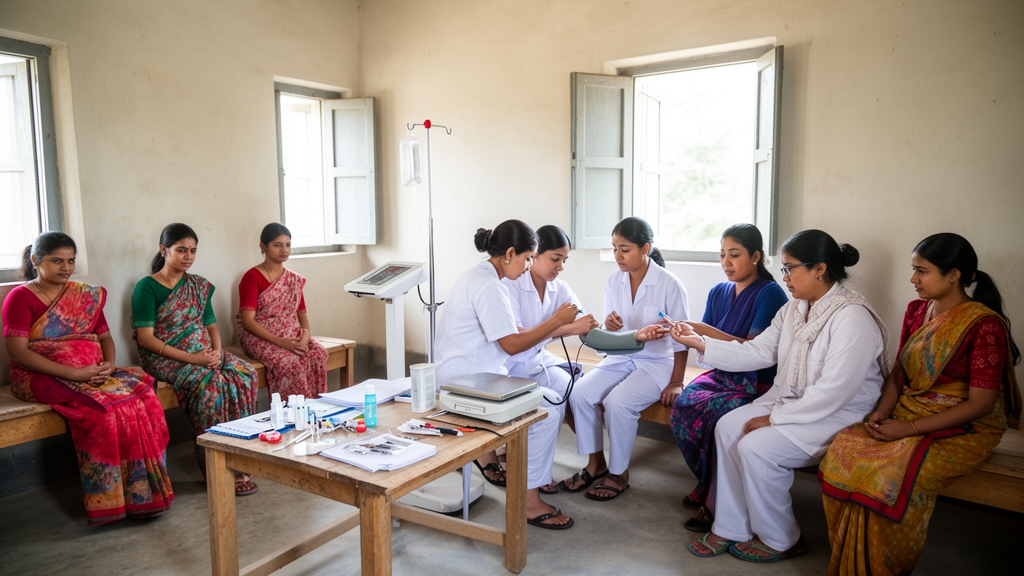
A nationally representative cross-sectional analysis found distinct social and geographic patterns for anemia, excess adiposity and high blood pressure among nonpregnant women aged 20–49 years in Nepal. Using the 2022 Nepal Demographic and Health Survey, researchers estimated weighted prevalence at 32.7% (95% confidence interval [CI], 30.8%–34.6%) for anemia, 34.5% (32.6%–36.4%) for excess adiposity and 11.2% (9.8%–12.5%) for high blood pressure. When the investigators applied the same sociodemographic variables to all three outcomes, excess adiposity and high blood pressure showed strong age patterns, whereas anemia varied most clearly by ethnicity and province. Wealth was also strongly and positively associated with excess adiposity.
The study was a secondary analysis of cross-sectional survey data, examining patterns in a population snapshot rather than testing an intervention or establishing causes. The primary population comprised 5,762 nonpregnant women aged 20–49 years. Outcome-specific eligible samples included 5,692 women for anemia, 5,654 for excess adiposity and 3,088 for high blood pressure. Researchers classified anemia as altitude- and smoking-adjusted hemoglobin below 12.0 g/dL. Excess adiposity was defined as a body mass index of at least 25.0 kg/m², while high blood pressure was defined as systolic blood pressure of at least 140 mmHg, diastolic blood pressure of at least 90 mmHg, or current use of antihypertensive medication.
To compare the outcomes within a common framework, the researchers used survey-weighted logistic models containing the same seven sociodemographic covariates and reported model-standardized prevalence. Survey-weighted quasi-Poisson models provided adjusted prevalence ratios in supplementary analyses. A stacked common-sample model assessed whether covariate patterns differed across the three outcomes. In a common complete-case sample of 3,023 women, the analysis detected overall outcome-by-covariate heterogeneity (P < 0.001). Differences were detected for age, wealth, ethnicity, province and marital status, but not for education or urban-rural residence. These results indicate that the social patterning of the conditions was not identical, while also showing that some characteristics did not produce statistically distinguishable patterns across outcomes.
The findings also showed overlap among the conditions. Among 3,029 women with measurements for all three outcomes, 15.4% had at least two and 1.8% had all three. The study’s conclusion was that public-health planning should not assume that one targeting strategy will identify women with all three conditions. At the same time, the observed overlap does not mean the conditions had identical distributions: excess adiposity and high blood pressure displayed strong age patterns, wealth had a strong positive relationship with excess adiposity, and anemia was distinguished most clearly by ethnicity and province. The analysis therefore supports evaluating the conditions in a shared framework without assuming that they share the same social profile.
Several limitations constrain interpretation. The cross-sectional design permits identification of associations but not causal effects, so differences by age, wealth, ethnicity, province or marital status cannot establish that those characteristics produced the measured conditions. The study also did not report results from a health-care intervention. In addition, hemoglobin measurement alone cannot establish the etiology of anemia, preventing the analysis from determining why anemia was more common in some groups than others. Although the survey provided national estimates for nonpregnant women aged 20–49 years, the outcome-specific sample sizes differed because not every participant had all relevant measurements. The study thus describes the magnitude and social patterning of three conditions in a defined national population, but it does not demonstrate how a common intervention would perform or how the observed relationships developed over time.
Subject of Research: Cross-sectional analysis of anemia, excess adiposity and high blood pressure among nonpregnant women aged 20–49 years in Nepal
Article Title: Social patterning of anemia, excess adiposity, and high blood pressure among nonpregnant women aged 20–49 years in Nepal: a cross-sectional analysis of the 2022 demographic and health survey
Article References: Poudel, M. P., Thapa, R., & Bist, A. (2026). Social patterning of anemia, excess adiposity, and high blood pressure among nonpregnant women aged 20–49 years in Nepal: a cross-sectional analysis of the 2022 demographic and health survey. BMC Public Health. https://doi.org/10.1186/s12889-026-29690-2
Image Credits: AI Generated
DOI: 10.1186/s12889-026-29690-2
Keywords: Nepal, nonpregnant women, anemia, excess adiposity, high blood pressure, 2022 DHS, health inequalities, cross-sectional study, ethnicity, socioeconomic patterns, Social, patterning
Cite Scienmag News
Ophelia Keating. (October 26, 2026). Survey reveals distinct health patterns among nonpregnant women aged 20–49 in Nepal. Scienmag. https://scienmag.com/survey-reveals-distinct-health-patterns-among-nonpregnant-women-aged-20-49-in-nepal/
Ophelia Keating. "Survey reveals distinct health patterns among nonpregnant women aged 20–49 in Nepal." Scienmag, 26 October 2026, https://scienmag.com/survey-reveals-distinct-health-patterns-among-nonpregnant-women-aged-20-49-in-nepal/. Accessed 26 October 2026.
Ophelia Keating. "Survey reveals distinct health patterns among nonpregnant women aged 20–49 in Nepal." Scienmag. October 26, 2026. https://scienmag.com/survey-reveals-distinct-health-patterns-among-nonpregnant-women-aged-20-49-in-nepal/


