


The U.S. Department of Energy’s Oak Ridge National Laboratory, Fermi National Accelerator Laboratory and the Midwest Energy Efficiency Alliance have signed a memorandum of understanding to develop a phased strategy for improving the energy performance of aging buildings at Fermilab Village in Batavia, Illinois. The planned collaboration will use the laboratory’s 114-building community as a real-world setting for building analysis, field measurements, energy modeling, technology demonstrations and evaluation of retrofit options. Its stated aims are to reduce energy use and operating costs, improve occupant comfort and identify practical ways to upgrade older structures, but the announcement describes research and planning rather than completed retrofits or verified savings.
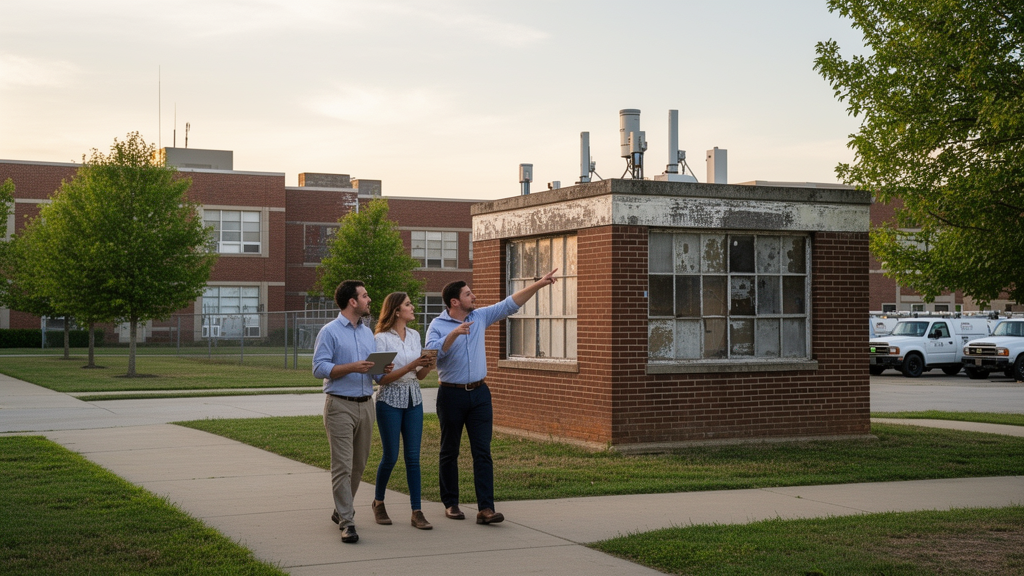
Fermilab Village includes housing, laboratories, offices and support facilities, with some structures more than 100 years old. A number of buildings were adapted from homes and farm buildings that predated the laboratory. Fermilab has identified 81 buildings as potential candidates for analysis. Previous improvement work focused primarily on heating, ventilation and air-conditioning equipment in approximately 30 buildings rather than comprehensive upgrades to building envelopes and other systems. The new effort is intended to develop a broader strategy that can guide phased changes while the village continues to serve its existing research, office, residential and support functions.
Each partner will contribute a different area of expertise. ORNL will provide experience in building science, field testing, sensors, controls and energy modeling, while Fermilab will contribute knowledge of the village’s buildings and operations. MEEA will provide experience in energy-efficiency programs, utility engagement and building-retrofit initiatives. The alliance also plans to work with its network of member companies to identify opportunities to use utility incentives and to support technology validation and piloting. The project therefore combines laboratory research, site-specific operating knowledge and industry participation in an applied program focused on buildings that must continue operating while being evaluated and upgraded.
Initial work will focus on buildings expected to remain in use. Researchers will classify candidate structures by type, size, age, condition, energy performance and building systems, then select representative buildings for more detailed study. Sensors and meters are planned to measure indoor temperature and humidity, energy use, and heating, ventilation and air-conditioning operation. These field measurements will establish a baseline intended to capture seasonal conditions and current building performance. The baseline will provide the reference used to assess existing conditions and later determine how selected retrofits perform.
ORNL researchers will use the field data to develop and calibrate baseline energy models for the buildings under study. The models are intended to represent current performance and identify opportunities for improvement at different levels of retrofit. They will also estimate potential energy and cost savings from technologies developed at ORNL and from commercially available products, giving the team a common basis for evaluating possible measures. Technologies under consideration include building-envelope upgrades, high-performance windows, advanced HVAC systems and controls, and other energy-efficiency measures. At this stage, the modeled savings are prospective estimates rather than measured outcomes.
At the village scale, the team will examine the possibility of treating multiple buildings as an integrated energy system. Options being considered include shared infrastructure, district thermal systems, microgrids, load shifting and controls that coordinate energy use across buildings. Selected strategies could then be demonstrated in representative buildings and evaluated through post-retrofit monitoring. This part of the program goes beyond the assessment of individual properties because the planned analysis will consider shared systems and coordinated controls across the site, although no integrated configuration has yet been selected or installed.
Measurement and verification will be central to the research. After retrofit work, researchers plan to compare actual performance with measured baselines and calibrated simulations. Those comparisons will be used to quantify energy and cost savings, evaluate occupant comfort and indoor conditions, and identify adjustments that may be required to support long-term performance. ORNL researchers estimate that comprehensive retrofit pathways could reduce energy consumption by more than 40 percent. That estimate is preliminary, and the announcement says actual savings will depend on field measurements, the measures selected, available funding, operating conditions and the scope of implementation. It is therefore not a demonstrated reduction in energy use at Fermilab Village.
The collaboration is expected to produce a phased strategy that distinguishes near-term measures, medium-term upgrades and longer-term comprehensive retrofits. Fermilab Director Norbert Holtkamp said the technology demonstrations made possible through the project will allow innovative solutions to be tested and validated at the village, with the potential for broader deployment across industries and communities throughout the region. ORNL associate laboratory director Robert Wagner said combining field measurements with calibrated energy models could help Fermilab compare practical options, understand their costs and benefits, and make informed decisions about improvements implemented over time. MEEA executive director Paige Knutsen said the project would connect research and development with real-world applications in the Midwest and use industry collaboration and utility incentives to support technology validation and piloting.
The work will draw on ORNL’s Building Technologies Research and Integration Center, a Department of Energy applied-energy facility that supports research into grid-flexible solutions, high-performance equipment, building envelopes, industrialized construction, energy storage, multifunctional products and systems integration. Its capabilities include laboratory testing, field demonstrations and whole-building simulation, allowing technologies to be evaluated from early development through real-world validation. The Fermilab project is also intended to provide a model that other national laboratories, research campuses and communities could use when addressing diverse collections of aging buildings. The announcement does not establish the results of that broader effort; its value will depend on the measurements, demonstrations and verified performance obtained at Fermilab Village.
Subject of Research: Planned evaluation and development of phased energy retrofits for aging buildings at Fermilab Village
Article Title: ORNL, Fermilab and MEEA partner to develop retrofit strategy for aging buildings
Article References: ORNL, Fermilab and MEEA partner to develop retrofit strategy for aging buildings. Original publication (Bibliographic details unavailable.)
Image Credits: AI Generated
DOI: Not provided
Keywords: building retrofits, energy efficiency, Fermilab Village, Oak Ridge National Laboratory, energy modeling, building sensors, HVAC systems, building envelopes, district energy systems, measurement and verification, ORNL, Fermilab
Cite Scienmag News
Beatrice Stafford. (October 26, 2026). Three partners plan phased energy retrofits for aging Fermilab Village buildings. Scienmag. https://scienmag.com/three-partners-plan-phased-energy-retrofits-for-aging-fermilab-village-buildings/
Beatrice Stafford. "Three partners plan phased energy retrofits for aging Fermilab Village buildings." Scienmag, 26 October 2026, https://scienmag.com/three-partners-plan-phased-energy-retrofits-for-aging-fermilab-village-buildings/. Accessed 26 October 2026.
Beatrice Stafford. "Three partners plan phased energy retrofits for aging Fermilab Village buildings." Scienmag. October 26, 2026. https://scienmag.com/three-partners-plan-phased-energy-retrofits-for-aging-fermilab-village-buildings/


