


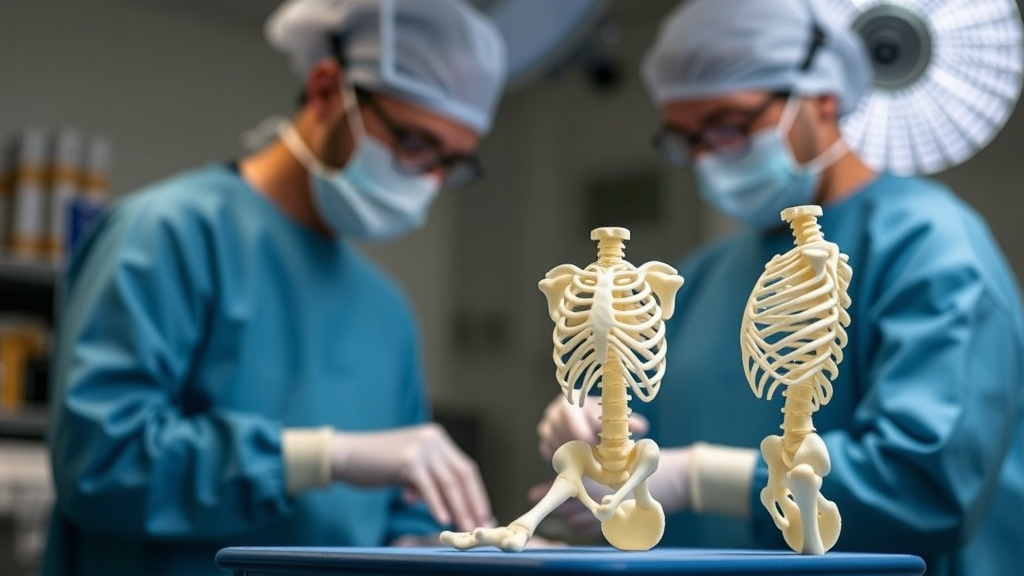
Orthopaedic surgeons who rehearse complex operations on 3D printed replicas of their patients’ bones report a striking phenomenon in the operating theatre: a sense of déjà vu, as though they have already been there before. A qualitative study from Stellenbosch University and Tygerberg Hospital in South Africa has now systematically documented what surgeons actually experience when they use patient-specific printed anatomical models to prepare for surgery, and the findings paint a picture of a technology that may be quietly reshaping how surgeons think, plan and train.
The research, published in Global Surgical Education, the Journal of the Association for Surgical Education, took a phenomenological approach, interviewing ten orthopaedic surgeons at a training hospital who had each used 3D printed models on between three and twelve cases. The team transcribed in-depth, semi-structured interviews and analysed them inductively using ATLAS.ti software, with three researchers coding independently before comparing and refining themes through an iterative process. Two main themes emerged from the data: the perceived benefits of working with printed models, and surgeons’ attitudes toward the technology itself.
The technical backdrop is important. Traditional pre-operative planning in orthopaedics relies on visual interpretation of X-rays, computed tomography and magnetic resonance imaging scans, essentially flat images that the surgeon must mentally translate into three-dimensional anatomy. Yet orthopaedic surgery is fundamentally a discipline of touch. Surgeons depend on haptic perception, the combination of tactile feedback from contact and kinesthetic feedback about how objects move and respond to pressure. When a surgeon must integrate visual information with an imagined sense of touch, the brain’s working memory, the limited-capacity system that holds and manipulates short-term information, can become overloaded, a phenomenon described in education research as cognitive load.
This is where the printed models appear to make their most profound contribution. Every surgeon in the study reported that holding a physical model of the patient’s anatomy positively influenced their preparation. Most described the model as an adjunct to image interpretation, revealing information that was not clearly visible on scans. Several described literally grasping the pathology, with one spine surgeon noting it was far easier to get to grips with exactly what a deformity involved when holding it in hand. A foot and ankle surgeon even placed a model of a deformed foot on the floor to assess how the forefoot related to the ground, a proxy that directly informed the goal of achieving a plantigrade, flat-standing foot.
Beyond perception, the models enabled genuine rehearsal. Several participants reported physically practising a procedure more than once before surgery, trialling different strategies and implant sizes against the patient’s native anatomy. For others, simply handling the model was enough to finalise a plan, with one upper limb surgeon describing how holding the glenoid allowed a physical model to form in the mind. Three of the ten surgeons also found the models valuable for communicating complex pathology to team members and patients, in every case linked to the difficulty of verbalising three-dimensional deformities in words alone.
The benefits carried into the operating theatre. Surgeons consistently described increased confidence and a sense of déjà vu when the real procedure matched the rehearsed one, with one paediatric orthopaedic surgeon calling the combination of mental and physical rehearsal a game changer. Some explicitly reported decreased cognitive load and reduced stress during operations, alongside perceived decreases in theatre time and increases in surgical accuracy, though the researchers caution these impressions may be subjective. Several surgeons used sterilised models inside the theatre as haptic maps, feeling their way through unusual anatomy when visibility was limited, while others described the models as guard rails that helped them detect unintended deviations from the surgical plan early.
The study also surfaced a compelling idea about how the technology might shift surgical practice. The authors suggest that planning with a printed model moves critical decision-making points from the stressful intra-operative environment into the calmer pre-operative phase, reducing the cognitive load a surgeon carries in theatre. For junior surgeons, those critical moments arise even in routine cases; for veterans, they arise only with unfamiliar, highly complex pathology. Notably, seven of the ten surgeons anticipated shorter theatre times and improved accuracy, yet nobody mentioned reductions in blood loss, fluoroscopic use or hospital stay, the objective outcomes that dominate the quantitative literature, hinting that the technology’s most immediate value may be cognitive rather than physiological.
Attitudes toward the technology were strongly positive and forward-looking. Surgeons frequently discussed how models could be modified to make rehearsal more realistic, such as using dual-material printing with elastic connectors to mimic ligaments holding bone fragments together. Most expected the technology to develop further and expressed intentions to proactively engage with it. Several voiced concern that over-regulation could price medical 3D printing out of everyday practice, arguing that a low-cost, do-it-yourself approach should be protected so that models can be made for almost every patient. Two participants said they would even postpone complex surgeries to allow time for a model to be manufactured, and one regretted not doing exactly that after feeling lost during a difficult case.
The findings also carry implications for surgical training. Participants widely viewed the models as a valuable tool for accelerating competence without patient harm, with one spine surgeon predicting that young surgeons would reach proficiency faster without being de-skilled. Others argued the technology raises the bar for the entire field, expanding the scope of what can be operated on competently in millimetre-and-degree measurable outcomes. The recurring overlap between discussions of training and of experienced surgeons preparing for novel cases underscores, the authors note, that surgical practice is a continuous embodied process punctuated by increasingly complicated challenges.
The study has limitations, including its small sample, coverage of only a few orthopaedic sub-specialties and a single-centre setting in a developing country, and the researchers observed that different sub-specialties use models differently, with spine surgeons favouring haptic maps and arthroplasty surgeons trialling implants. Still, the message is clear: as 3D printing becomes cheaper and more accessible, its perceived benefits among surgeons are overwhelmingly cognitive and educational, moving decision-making earlier, lightening mental load in theatre and potentially compressing the long apprenticeship of surgical experience. The authors call for future research linking these perceived benefits to established models of cognitive load and fatigue, and ultimately to measurable patient outcomes.
Subject of Research: Surgeons' experiences and perceived benefits of using 3D printed anatomical models for orthopaedic pre-operative planning and training
Article Title: Orthopaedic surgeons using 3D printed models to prepare for surgery: a qualitative investigation
Article References: Venter, R. G., Vogel, L., Visser, M., & Rabie, S. (2026). Orthopaedic surgeons using 3D printed models to prepare for surgery: a qualitative investigation. Global Surgical Education – Journal of the Association for Surgical Education, 5(1), Article 180. https://doi.org/10.1007/s44186-026-00587-3
Image Credits: AI Generated
DOI: 10.1007/s44186-026-00587-3
Keywords: 3D printing, orthopaedic surgery, pre-operative planning, surgical training, cognitive load, haptic perception, working memory, anatomical models, qualitative research, patient-specific models, surgical education, Orthopaedic
Cite Scienmag News
Courtney Benton. (September 25, 2026). Surgeons Say 3D Printed Bone Models Give Them a Sense of Déjà Vu in the Operating Theatre. Scienmag. https://scienmag.com/surgeons-say-3d-printed-bone-models-give-them-a-sense-of-deja-vu-in-the-operating-theatre/
Courtney Benton. "Surgeons Say 3D Printed Bone Models Give Them a Sense of Déjà Vu in the Operating Theatre." Scienmag, 25 September 2026, https://scienmag.com/surgeons-say-3d-printed-bone-models-give-them-a-sense-of-deja-vu-in-the-operating-theatre/. Accessed 4 October 2026.
Courtney Benton. "Surgeons Say 3D Printed Bone Models Give Them a Sense of Déjà Vu in the Operating Theatre." Scienmag. September 25, 2026. https://scienmag.com/surgeons-say-3d-printed-bone-models-give-them-a-sense-of-deja-vu-in-the-operating-theatre/


