


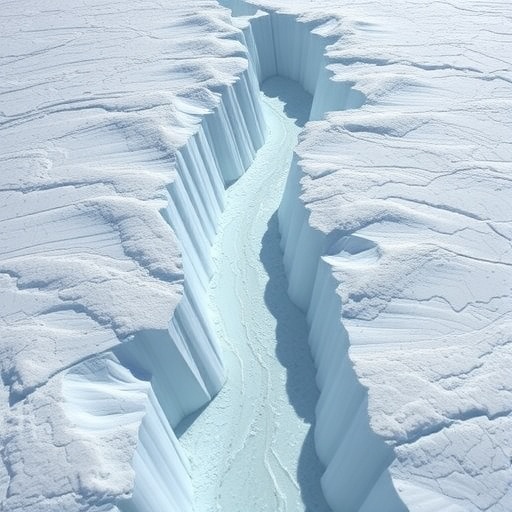
In a groundbreaking development that could reshape our understanding of glacier dynamics, a recent study published in Nature Communications reveals a potent positive feedback loop between surface ablation and crevasse formation that underpins glacier acceleration and heightens the potential for surging events. This intricate interplay of melting and fracturing not only redefines the mechanisms driving glacier motion but also accentuates the urgency of reassessing predictions about glacier behavior in a warming climate.
Glacier surging, a phenomenon characterized by abrupt and significant increases in glacier velocity, has long fascinated glaciologists. Traditionally, such surges have been attributed to subglacial hydrology reconfigurations or internal ice deformation. However, the novel insights put forth by Nanni and colleagues pivot attention towards surface processes — specifically, how melting on the glacier’s exterior catalyzes structural weaknesses leading to crevasse formation, which in turn accelerates ice flow.
The research team utilized high-resolution satellite imagery coupled with ground-based observational data in several glaciated regions known for dynamic ice behavior. By meticulously tracking surface melt patterns and correlating them with crevasse development timelines, they uncovered a compelling sequence: increased surface ablation promotes the initiation and expansion of crevasses, which subsequently propagate and deepen, facilitating ice fracture and flow acceleration through enhanced stress concentration.
This sequence creates a self-reinforcing loop. As crevasses widen and penetrate deeper into the glacier’s body, they expose the ice to more intense melting and infiltration of meltwater. This water percolation weakens the ice structure from within, promoting further surface ablation and crevasse growth. The result is a marked amplification of glacier velocity, potentially culminating in a surge—a rapid and dramatic surge forward.
Importantly, this positive feedback mechanism has significant implications for the stability of polar and mountain glaciers worldwide. Conventional models of glacier flow often emphasize basal sliding and internal deformation but frequently underestimate the role of surface processes in modulating ice dynamics. The empirical observations detailed in this study compel a paradigm shift, highlighting how surface melting and fracturing are as critical as subglacial mechanics in dictating glacier speed changes.
One of the study’s striking outcomes is the detailed temporal mapping of crevasse formation aligned precisely with periods of peak surface melt. This temporal correlation was especially evident during warm summer months, when maximum ablation rates coincide with the explosive development of crevass fields. Such precise timing underscores the sensitivity of glaciers to short-term climatic fluctuations and poses questions about how ongoing climate warming will influence the frequency and intensity of glacier surges.
Further complexity arises as the authors discuss the influence of these processes on glacier mass balance and downstream hydrology. Accelerated glacier movement due to surface-driven acceleration can significantly enhance the delivery of ice and meltwater to proglacial systems, potentially altering sediment transport, river discharge patterns, and ecological habitats. These cascading effects extend the importance of the findings beyond glaciology into broader environmental and societal domains.
To unravel this feedback mechanism, the study employed advanced numerical modeling, integrating physical representations of ice fracturing, meltwater percolation, and stress transfer within the glacier. The models successfully replicated observed velocity surges when coupling surface ablation data with crevasse propagation mechanics, validating the hypothesized feedback loop. This modeling approach heralds a new frontier in glacier simulation, promising more accurate forecasts of glacier responses to climate change.
Crucially, the investigation also sheds light on the spatial heterogeneity of glacier acceleration. Not all sections of the glacier respond uniformly; regions with preexisting weaknesses or specific stress regimes are more susceptible to the feedback-driven acceleration. This spatial nuance is critical for predictive models, as it moves beyond simplistic assumptions of glacier-wide uniform responses toward a more detailed landscape-driven understanding.
The phenomenon is not confined to a single glacier type or environment. The study sampled multiple glaciers ranging from temperate mountain ice masses to polar ice sheets, underscoring the universality of the positive feedback mechanism. However, the intensity and manifestation of the feedback vary, influenced by factors such as latitude, glacier size, and ice thermal regime, emphasizing the necessity for site-specific investigations.
The implications for sea level rise projections are profound. As glacier surges deliver increased ice mass to lower elevation ablation zones or directly into the ocean, the contribution of glaciers to global sea level rise may be substantially underestimated if surface ablation–crevasse feedback processes are ignored in predictive assessments. This revelation calls for an urgent recalibration of global ice loss models to incorporate these newfound dynamics.
Beyond the physical sciences, this research also has potential ramifications for communities depending on glacier-fed water sources. Accelerated glacier motion and enhanced melting may initially boost meltwater availability, but the long-term effects could involve glacier retreat and loss of perennial water reserves, compounding water security concerns for millions of people globally.
Environmental monitoring agencies may soon incorporate these findings to enhance glacier hazard assessments. Surges can trigger downstream flooding and destabilize landscapes, leading to landslides and infrastructure damage. Better understanding and predicting surge triggers via surface ablation and crevasse formation monitoring could provide timely early warnings.
The study additionally prompts questions about feedback processes in related cryospheric phenomena. Could similar mechanisms affect ice shelves, where surface melting and fracturing might facilitate rapid disintegration? Examining parallel processes could extend the framework of positive feedbacks influencing ice dynamics well beyond terrestrial glaciers.
Nanni et al.’s work represents a masterstroke in integrating observational, modeling, and theoretical components to illuminate a critical feedback process previously underestimated in glacier science. It demonstrates the power of multidisciplinary approaches that blend remote sensing, fieldwork, and computational physics to decode Earth’s complex systems.
As climate change marches on relentlessly, studies like this sharpen our detective skills to anticipate and unpack the evolving responses of glaciers, the sentinels of environmental change. The delicate dance between melting ice and fracturing fracture crevasses, now known to drive glacier acceleration, adds another intricate verse to the story of a warming planet.
While the newfound feedback loop offers insights into surge triggers, it raises new avenues for research, especially regarding thresholds and tipping points in glacier systems. Understanding the limits of this mechanism’s influence and its interplay with other factors, such as basal water pressure and ice chemistry, remains a frontier for future exploration.
In conclusion, the observed positive feedback between surface ablation and crevasse formation fundamentally enhances our grasp of glacier acceleration and surging. This feedback loop not only elucidates key processes controlling glacier dynamics in a warming world but also recalibrates risk assessments related to sea level rise, water resources, and natural hazards. Harnessing this knowledge enables scientists, policymakers, and communities to better anticipate and adapt to the shifting cryosphere landscape unveiled by our changing climate.
Cite Scienmag News
Violet Maxwell. (December 18, 2025). Surface Ablation Spurs Crevasse Growth, Glacier Surge. Scienmag. https://scienmag.com/surface-ablation-spurs-crevasse-growth-glacier-surge/
Violet Maxwell. "Surface Ablation Spurs Crevasse Growth, Glacier Surge." Scienmag, 18 December 2025, https://scienmag.com/surface-ablation-spurs-crevasse-growth-glacier-surge/. Accessed 4 September 2026.
Violet Maxwell. "Surface Ablation Spurs Crevasse Growth, Glacier Surge." Scienmag. December 18, 2025. https://scienmag.com/surface-ablation-spurs-crevasse-growth-glacier-surge/


