

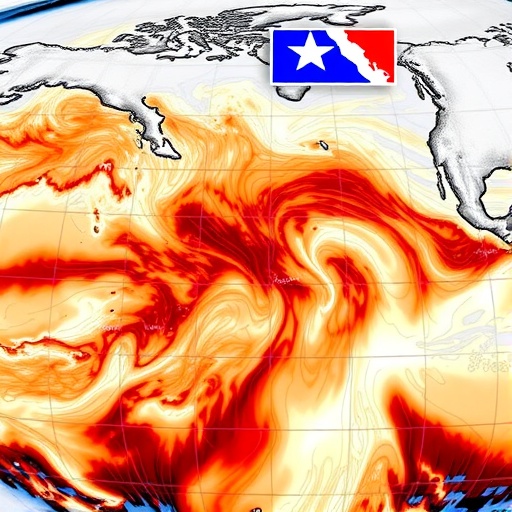
In recent years, climate scientists have turned an increasingly sharp focus toward understanding the multifaceted impacts of extreme El Niño events, colloquially termed “Super El Niños,” on the Earth’s climate system. A groundbreaking study, soon to be published in Nature Communications, by Xue, Geng, Jin, and colleagues, sheds new light on how these intense warming episodes in the equatorial Pacific can catalyze profound regime shifts in global climate patterns. This research is particularly prescient in the context of ongoing anthropogenic climate change, which the authors argue is enhancing the frequency and severity of such disruptive El Niño events, thereby escalating risks worldwide.
El Niño-Southern Oscillation (ENSO) events have long been recognized as a dominant source of interannual climate variability. However, the conventional understanding of ENSO’s influence is now being challenged by evidence suggesting that the most intense El Niño events, the so-called Super El Niños, not only exacerbate seasonal climate anomalies but can also irrevocably shift climate regimes. These shifts involve changes in atmospheric circulation, ocean temperature distributions, and feedback mechanisms, which collectively modulate weather extremes on multiple temporal and geographic scales. Xue and colleagues’ meticulous research uses data-driven analysis combined with advanced climate modeling to trace these complex feedback loops and their implications under escalating global warming scenarios.
At the heart of this research lies a detailed examination of ocean-atmosphere coupling dynamics—how the warming surface waters in the central and eastern Pacific interact with atmospheric patterns to create dramatic changes in weather. The intensified sea surface temperature anomalies characteristic of Super El Niño events drive stronger atmospheric disturbances that propagate beyond the Pacific basin. As a result, teleconnections—climatic influences felt thousands of kilometers away—become more pronounced, altering precipitation and temperature regimes in regions such as Southeast Asia, North and South America, and even parts of Africa. The researchers highlight that these regime shifts can herald persistent droughts, floods, and heatwaves, significantly impacting agriculture, water resource management, and biodiversity.
This study elucidates the mechanistic pathways through which warming oceans contribute to the enhanced magnitude of El Niño events. Enhanced greenhouse gas concentrations lead to an overall increase in ocean heat content, particularly evident in the equatorial Pacific. The intensified thermal gradients bolster the Walker Circulation anomalies and shift the delicate balance of trade winds and convection patterns. The researchers point out a feedback amplification where strengthened wind anomalies promote further ocean warming, creating a vicious cycle that fuels the extraordinary strength of Super El Niños. Importantly, this process underscores the compounding effects of anthropogenic warming and natural variability, rather than attributing changes solely to one or the other.
Furthermore, Xue et al. deploy sophisticated climate models configured to simulate future climate scenarios in which greenhouse gas emissions continue unabated. Their projections indicate a worrying trend: Super El Niño events, which were historically rare, are becoming more frequent by the mid-21st century. This increased recurrence not only heightens the likelihood of extreme weather episodes but also imposes greater uncertainty and volatility on regional climates globally. Importantly, the researchers caution that such shifts challenge existing climate prediction frameworks, calling for more robust forecasting tools capable of incorporating regime change dynamics and their cascading effects.
One of the most striking findings from the study is the interaction between Super El Niño-induced regime shifts and other modes of climate variability such as the Pacific Decadal Oscillation (PDO) and the Indian Ocean Dipole (IOD). The synergy between these oscillations can either exacerbate or modulate the climate impacts of Super El Niños. For instance, overlapping positive phases of PDO and IOD with a Super El Niño event can amplify droughts or floods in impacted areas, multiplying the socio-economic and ecological risks. This interconnectedness implies that understanding and anticipating future climate risks requires a holistic approach that integrates multiple climate drivers and their nonlinear interactions.
The authors also address the profound ecological consequences stemming from these climatic regime shifts. Marine ecosystems, particularly coral reefs in the tropical Pacific, are highly vulnerable to temperature extremes associated with Super El Niños. The heightened sea surface temperatures trigger widespread coral bleaching and mortality, which disrupts marine food webs and undermines fisheries that sustain millions. Additionally, shifts in precipitation patterns affect terrestrial ecosystems, threatening biodiversity hotspots through altered water availability and soil moisture regimes. These ecological impacts have knock-on effects for human communities reliant on natural resources, exacerbating existing vulnerabilities and necessitating urgent adaptive responses.
Another dimension explored is the socioeconomic ramifications of Super El Niño events under climate warming. The study underscores how intensified weather extremes linked to regime shifts compromise food security by disrupting agricultural cycles in major production regions such as South America and Southeast Asia. Flooding and droughts lead to crop failures, price volatility, and food shortages, disproportionately affecting low-income populations with limited adaptive capacity. Moreover, infrastructure and public health systems face escalating strain due to increased disaster risk, including vector-borne diseases proliferating in warmer and wetter conditions. Xue and colleagues emphasize the critical need for integrating climate risk understanding into policy frameworks to bolster resilience.
Methodologically, the study leverages a multi-disciplinary approach combining observational data, paleoclimate reconstructions, and coupled climate system models. These techniques enable the researchers to disentangle natural variability from anthropogenic influences, offering robust attribution of Super El Niño event intensification to human-induced warming. Notably, the incorporation of machine learning algorithms enhances the detection of early warning signals for regime shifts, potentially revolutionizing climate prediction capabilities. Such advances underscore the pivotal role of technology in climate science, providing actionable insights for decision-makers.
In the context of global climate policy, this research delivers an urgent message. The intensification of Super El Niño events under ongoing warming could undermine the achievement of sustainable development goals by amplifying climate hazards and stressors. The authors advocate for accelerated mitigation efforts to curb greenhouse gas emissions and avoid further optimal climate destabilization. Concurrently, they call for enhanced international cooperation to develop adaptive strategies tailored to the foreseeable shifts driven by these extreme ENSO phenomena. These include investments in climate-resilient infrastructure, early warning systems, and ecosystem conservation to reduce vulnerability and foster sustainability.
The findings from Xue et al. also reshape our understanding of ENSO’s role in the Earth’s climate system. Rather than merely acting as a transient seasonal anomaly, Super El Niño events emerge as powerful agents capable of instigating sustained climate regime shifts. This perspective prompts a reevaluation of climate risk assessments that have historically treated ENSO impacts as episodic interruptions rather than potential catalysts for long-term change. By highlighting the pronounced risks associated with these intensified events, the study marks a paradigm shift in climate science, urging renewed vigilance and adaptive innovation.
Moreover, the regional disparities in climate impacts revealed by the research highlight the complexity and unevenness of climate change effects. While some regions may experience increased precipitation and flooding, others confront protracted droughts, creating multifaceted challenges for global food and water security. This spatial heterogeneity underscores the necessity for localized climate impact assessments and tailored adaptation plans. It also points to the interconnectedness of global systems, where disturbances in one region reverberate worldwide through trade, migration, and ecosystem services.
Looking ahead, the research calls for continuous monitoring and enhanced integration of observational networks across the Pacific basin. Such efforts will refine understanding of preconditioning factors for Super El Niño onset and improve lead times for predictive models. There’s also a recognized need for interdisciplinary collaborations merging climatology, oceanography, ecology, and social sciences to fully apprehend the cascading consequences of these regime shifts. Ultimately, this comprehensive approach will strengthen preparedness and reduce the socio-economic toll of climate extremes exacerbated by warming.
In conclusion, the pioneering work of Xue, Geng, Jin, and their team represents a significant advance in climate science by elucidating how Super El Niño events act as pivotal drivers of climate regime shifts under global warming. By integrating sophisticated modeling with empirical data, the study reveals the expanding threat posed by intensified ENSO variability on ecosystems, human societies, and global climate stability. As these regime shifts become increasingly pronounced, a concerted global response is imperative—one that embraces mitigation, adaptation, and innovative scientific discovery to safeguard planetary health and human well-being amidst a warming world.
Subject of Research: Climate dynamics and impacts of Super El Niño events under global warming.
Article Title: Super El Niño events drive climate regime shifts with enhanced risks under global warming.
Article References:
Xue, A., Geng, X., Jin, FF. et al. Super El Niño events drive climate regime shifts with enhanced risks under global warming. Nat Commun (2025). https://doi.org/10.1038/s41467-025-66143-7
Image Credits: AI Generated


