


The search for extraterrestrial life has long captivated humanity, echoing in philosophical inquiries and scientific pursuits alike. The landmark discovery of the first exoplanet in 1995 marked a monumental shift, opening avenues into a universe teeming with possibilities. With more than 5,000 exoplanets confirmed to date, the pursuit remains ongoing, with scientists eager to uncover Earth-like worlds nestled in the habitable zones of Sun-like stars. This quest holds profound implications not only for our understanding of life’s origins but also for our place within the cosmos.
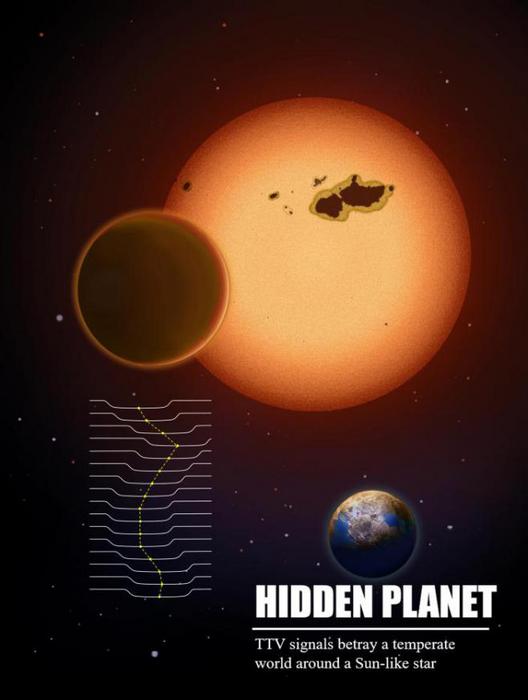
Recently, an international research team led by Yunnan Observatories of the Chinese Academy of Sciences achieved a major breakthrough in exoplanet discovery by utilizing the Transit Timing Variation (TTV) technique. This innovative method was employed for the first time to identify a new super-Earth, which has been designated Kepler-725c. This exoplanet is approximately ten times more massive than Earth and lies within the habitable zone of its host star, Kepler-725, allowing exciting speculation on its potential for supporting life.
Traditionally, the transit method and radial velocity (RV) observations have been the go-to techniques for astronomers seeking to identify low-mass planets in habitable zones. However, both methods face significant challenges, particularly with low-mass planets exhibiting long orbital periods and faint RV signals. These complexities have created barriers, with high precision being necessary for effective detection, and long-term observability becoming increasingly difficult as a result.
The transit method relies on geometric conditions, necessitating a planet’s orbital plane to align exactly with our line of sight—a rather uncommon occurrence for distant exoplanets. When transits do occur, the resulting signals are often subtle and fleeting, increasing the chance for observational errors. Kepler-725c, as a newly discovered non-transiting exoplanet, exhibits an orbital period of 207.5 days and orbits a G9V star, receiving approximately 1.4 times the solar radiation that Earth does, making it a valuable subject for inquiry.
The efficacy of the TTV technique stems from its ability to analyze gravitational interactions between planets within the same system. By carefully studying the TTV signals of Kepler-725b, a gas giant with a shorter orbital period, researchers succeeded in unveiling the mass and orbital characteristics of the elusive Kepler-725c. This approach not only demonstrated the power of the TTV technique but also underscored its ability to discover low-mass celestial bodies situated in habitable zones—previously deemed nearly impossible to detect with existing methods.
Unlike the transit and RV methods, the TTV technique does not rely on an edge-on orbit position or the high-precision RV measurements associated with its host star. This ability makes the TTV method exceptionally well-suited for uncovering small, long-period, non-transiting planets that remain hidden from conventional search modalities. It fills a critical niche within our current arsenal of detection methodologies, presenting a promising pathway toward locating an “Earth 2.0.”
The implications of this discovery extend beyond theoretical discussions, tying into future ambitious missions aimed at finding Earth-like worlds. The European PLATO mission and the Chinese ET (“Earth 2.0”) mission are set to leverage this TTV technique, poised to enhance the capacity for uncovering new exoplanets significantly. These future endeavors welcome the possibility of discovering planets echoing Earth’s properties right at the cusp of habitability.
As scientists collaborate across various institutions—from Germany’s Hamburg Observatory to Xi’an Jiaotong-Liverpool University—the advancing knowledge in planetary science exemplifies the importance of international cooperation. With funding assistance from the National Natural Science Foundation of China and the Yunnan Fundamental Research Project, the research team is on the frontline of exploring new frontiers in exoplanet discovery.
This current wave of excitement around exoplanets evokes inherent questions about our place in the universe. The revelation of Kepler-725c emphasizes the ongoing quest to discover worlds that could potentially harbor life. The realization that we might not be alone in the universe stirs our imagination, each new discovery bringing humanity one step closer to answering the profound question: Are we truly alone?
As we continue to push the boundaries of astronomical research, understanding the complexities of our neighboring worlds remains vital. The methodologies behind discovering exoplanets like Kepler-725c are ushering in a new era of astronomical exploration, making us reflect on what lies in the vast expanse beyond our home planet. The integration of advanced techniques, collaborative efforts, and innovative research heralds profound shifts in our knowledge of the universe.
In conclusion, the discovery of Kepler-725c illuminates new horizons in exoplanet research. It not only enriches our understanding of planetary formation but also ignites discussions on the potential for extraterrestrial life within our grasp. As the field continues to flourish, it beckons humanity to ponder the greater narrative of the cosmos and our role within it.
Keywords
Exoplanet, Kepler-725c, TTV technique, habitable zone, planetary science, Earth-like planets, discovery, international collaboration, astronomy.
Cite Scienmag News
Grant Pearson. (June 3, 2025). Super-Earth Found in Sun-like Star’s Habitable Zone Using TTV Technique, Advancing the Quest for ‘Earth 2.0’. Scienmag. https://scienmag.com/super-earth-found-in-sun-like-stars-habitable-zone-using-ttv-technique-advancing-the-quest-for-earth-2-0/
Grant Pearson. "Super-Earth Found in Sun-like Star’s Habitable Zone Using TTV Technique, Advancing the Quest for ‘Earth 2.0’." Scienmag, 3 June 2025, https://scienmag.com/super-earth-found-in-sun-like-stars-habitable-zone-using-ttv-technique-advancing-the-quest-for-earth-2-0/. Accessed 4 September 2026.
Grant Pearson. "Super-Earth Found in Sun-like Star’s Habitable Zone Using TTV Technique, Advancing the Quest for ‘Earth 2.0’." Scienmag. June 3, 2025. https://scienmag.com/super-earth-found-in-sun-like-stars-habitable-zone-using-ttv-technique-advancing-the-quest-for-earth-2-0/


