


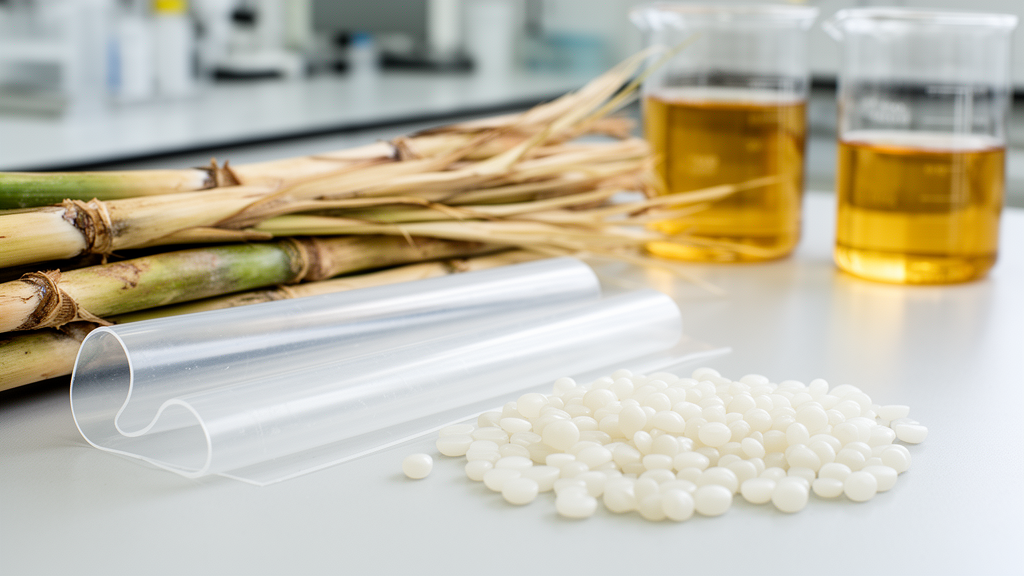
Researchers have developed a reproducible laboratory protocol to produce lignin- and arabinose-free xylan from sugarcane bagasse, demonstrating that chemically and enzymatically modified xylan serves as a superior substrate for bioplastic production compared to untreated xylan. Published in Biotechnology for Sustainable Materials, the study addresses the economic and logistical challenges associated with commercial xylan, which is currently scarce and expensive, by utilizing a widely available agricultural residue. The team, led by Danilo Bueno and Michel Brienzo, investigated how specific modifications to the hemicellulose structure influence both microbial enzyme production and the physical properties of resulting bioplastic films.
The study begins with the extraction of hemicellulose from sugarcane bagasse, a material that represents a significant surplus of industrial agricultural waste. The researchers employed an alkali treatment using 6% hydrogen peroxide to isolate the xylan fraction, achieving a yield of 50% by weight. This initial extraction produced what the team designated as X1, the original untreated xylan. To create the modified variants, the team subjected the original xylan to further chemical and enzymatic treatments. X2 was produced by a second alkaline treatment with hydrogen peroxide, while X3 was treated with laccase, an enzyme that oxidizes phenolic compounds to remove lignin. X4 was generated using α-L-arabinofuranosidase to hydrolyze the arabinose groups attached to the xylan backbone. These modifications were designed to increase the purity of the xylan and enhance its accessibility for enzymatic hydrolysis.
To verify the effectiveness of these modifications, the researchers utilized Fourier Transform Infrared Spectroscopy, or FTIR, to analyze the chemical composition of the xylan samples. The FTIR spectra revealed that the alkaline treatment for X2 was the most effective at removing lignin, as indicated by the absence of the characteristic lignin band at 1510 cm⁻¹. In contrast, the laccase-treated X3 showed partial delignification, with the lignin band still present but reduced compared to the original X1. These spectral analyses confirmed that both chemical and enzymatic methods could alter the structural integrity of the xylan, although the alkaline treatment resulted in the most significant removal of the aromatic skeleton associated with lignin.
The modified xylans were then evaluated as substrates for the production and activity of xylanase, an enzyme produced by the fungus Aspergillus versicolor. The researchers measured xylanase activity in purified enzyme assays and during a ten-day microbial growth period. In the purified enzyme assays, both the original X1 and the laccase-treated X3 substrates induced a statistically similar xylanase activity of 624 IU/mL. However, the doubly treated X2 substrate showed significantly lower activity, at only 70 IU/mL. The researchers hypothesized that the severe alkaline treatment used for X2 may have damaged the integrity of the xylan molecule, thereby hindering the enzyme’s ability to act on the substrate.
During the ten-day growth experiment, the laccase-treated X3 substrate demonstrated high-quality induction of xylanase production. At 192 hours of cultivation, the xylanase activity reached 3120 IU/mL, which was statistically similar to the 3150 IU/mL observed with the original X1 substrate. The X2 substrate, however, remained the least effective, peaking at 540 IU/mL after 240 hours. These results indicate that xylan treated with laccase is a high-quality substrate compared to original xylan, whereas total lignin removal through a second alkaline treatment did not yield the expected outcome in terms of maximum xylanase activity. The study highlights that the presence of residual lignin in the original xylan does not necessarily impede enzyme production, provided the lignin is not removed through methods that alter the polymerization degree of the xylan.
Beyond enzyme production, the primary application of the modified xylans was the fabrication of bioplastic films. The researchers formulated four types of bioplastics, designated B1 through B4, corresponding to the four xylan variants. Each formulation included 5% total polysaccharides, comprising the specific xylan variant, starch, and 20% glycerol by weight of the polysaccharides. A key innovation in this study was the addition of 0.5% bis-acrylamide, a cross-linking agent not previously reported in xylan-based bioplastic formulations. The bioplastics were prepared by gelatinizing the mixture at 80 °C for two minutes and drying the resulting films at 30 °C for 24 hours. This methodology aimed to create sustainable, potentially biodegradable materials with improved mechanical and physical properties.
The physical properties of the bioplastics were evaluated for opacity, moisture content, solubility, and tensile stress. The original xylan-based bioplastic, B1, exhibited an opacity of 3.2%, a moisture content of 7%, and a solubility of 15%. In comparison, the bioplastics made from lignin-free xylans, B2 and B3, showed lower opacity values of 2% and 2.3%, respectively. The reduction in opacity is attributed to the removal of lignin, which is known to contribute to the brown coloration of the films. These findings indicate that the chemical composition of the xylan directly influences the visual clarity of the final bioplastic product.
Moisture content and solubility were also significantly affected by the xylan modifications. The original bioplastic B1 had a moisture content of 7%, whereas the modified bioplastics B2, B3, and B4 all exhibited a moisture content of 4%. Similarly, the solubility of B1 was 15%, while the modified variants showed lower solubility values, ranging from 12.3% to 14%. The researchers noted that the presence of residual lignin in B1 contributed to higher moisture retention and water solubility. The addition of bis-acrylamide likely played a role in reducing solubility, as cross-linking agents are known to decrease the solubility of hemicellulose in liquid and enhance water resistance.
Mechanical strength, measured as tensile stress, was another critical parameter evaluated in the study. The original bioplastic B1 displayed a tensile stress of 1.7 MPa, which was lower than the values observed for the modified variants. The laccase-treated bioplastic B2 achieved the highest tensile stress of 2.5 MPa, followed by B3 at 2.3 MPa and B4 at 1.8 MPa. The researchers explained that residual lignin in the original xylan makes the bioplastic more mechanically vulnerable due to the tendency of lignin to form aggregates, which can weaken the film structure. In contrast, the removal of lignin and arabinose resulted in a more cohesive and resistant material. Starch, included in all formulations, acted as a reinforcing agent, contributing to the overall mechanical integrity of the bioplastics.
The study also examined the role of specific components in the bioplastic formulations. Glycerol, a common plasticizer, was used to enhance the flexibility and elongation of the films. While glycerol helps improve water resistance by reducing internal hydrogen bonds, it can also reduce mechanical strength if used in excess. The researchers found that the combination of modified xylan, starch, and bis-acrylamide produced a material that was cohesive, non-brittle, and malleable. The use of bis-acrylamide as a cross-linker was a novel aspect of this study, as it had not been previously reported in the context of xylan-based bioplastics. This addition contributed to the improved water resistance and mechanical properties observed in the modified bioplastics.
Comparisons with existing literature revealed that the bioplastics produced in this study performed favorably. The opacity of the original bioplastic B1 was close to values reported in previous studies, such as the 3% opacity reported by Macedo et al. (2022) and the 2.54% reported by Abe et al. (2022). However, the moisture content of all bioplastics in this study was lower than the 13.34% reported in previous work. In comparison with literature data from Macedo et al. (2022), bioplastic X2 showed tensile stress higher than 2.35 MPa, whereas all other bioplastics in this study showed tensile stress lower than 2.35 MPa. These comparisons suggest that the protocol developed in this study offers a viable alternative to commercial xylan, with the potential to produce bioplastics of higher quality.
The researchers acknowledge several challenges and prospects for the future application of xylan-based bioplastics. One of the major hurdles is the large-scale production of these materials and ensuring their cost-effectiveness compared to conventional petroleum-based plastics. The extraction of xylan from lignocellulosic biomass must be performed with high yield and low residual lignin content to avoid structural breaks in the polymer. The study suggests that the large availability of Brazilian lignocellulosic biomass feedstock, resulting from the country’s agro-industrial production, could support the scaling of this technology. Additionally, the use of 3D-filament printing methods, which have been successfully applied to waste plastics, could offer a pathway for the industrial production of xylan-based bioplastics.
The removal of lignin and arabinose leads to bioplastics with lower opacity, moisture, and solubility, as well as higher tensile strength. The development of a low-cost, reproducible protocol for xylan production addresses the scarcity and high cost of commercial xylan, offering a sustainable alternative for the production of value-added bioproducts. While further research is needed to establish the technical and economic feasibility of these bioplastics for industrial applications, the findings of this study provide a strong foundation for the development of sustainable, eco-friendly materials derived from agricultural waste.
Subject of Research: Production of bioplastics with chemical and enzymatic modificated xylan (lignin- and arabinose-free) from sugarcane bagasse
Article Title: Production of bioplastics with chemical and enzymatic modificated xylan (lignin- and arabinose-free) from sugarcane bagasse
Article References: Bueno, D., & Brienzo, M. (2025). Production of bioplastics with chemical and enzymatic modificated xylan (lignin- and arabinose-free) from sugarcane bagasse. Biotechnology for Sustainable Materials, 2(1), Article 2. https://doi.org/10.1186/s44316-024-00024-9
Image Credits: AI Generated
DOI: 10.1186/s44316-024-00024-9
Keywords: Production, bioplastics, chemical, enzymatic, modificated, xylan, lignin-, arabinose-free, sugarcane, bagasse, scientific research
Cite Scienmag News
Gregory Coleman. (November 9, 2026). Sugarcane Xylan Modifications Yield Improved Bioplastics. Scienmag. https://scienmag.com/sugarcane-xylan-modifications-yield-improved-bioplastics/
Gregory Coleman. "Sugarcane Xylan Modifications Yield Improved Bioplastics." Scienmag, 9 November 2026, https://scienmag.com/sugarcane-xylan-modifications-yield-improved-bioplastics/. Accessed 9 November 2026.
Gregory Coleman. "Sugarcane Xylan Modifications Yield Improved Bioplastics." Scienmag. November 9, 2026. https://scienmag.com/sugarcane-xylan-modifications-yield-improved-bioplastics/




