


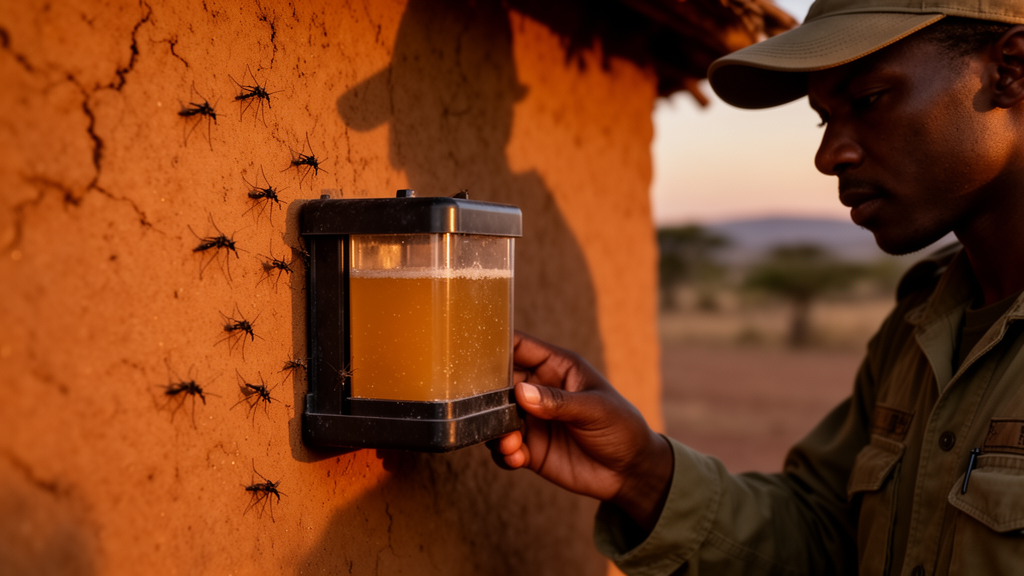
A new class of mosquito-killing technology that lures the insects to a poisoned sugar meal has failed to deliver measurable protection against malaria in three large-scale Phase III trials, according to an individual participant data meta-analysis published in PLOS Global Public Health. The study, led by Ruth A. Ashton of Tulane University and colleagues, pooled data from cluster-randomized trials of the Westham Sarabi v1.2 attractive targeted sugar bait, or ATSB, conducted in Kenya, Mali, and Zambia. Across nearly 7,000 person-years of follow-up among children, the researchers found no statistically significant reduction in clinical malaria incidence in communities where the bait stations were deployed, a result that has sent ripples through a vector control field hungry for tools that work beyond the walls of the bedroom.
The promise of ATSB technology rests on a simple but elegant biological insight: both male and female mosquitoes need regular sugar meals to survive, and they obtain them by feeding on plant nectar. Unlike bed nets and indoor residual spraying, which target mosquitoes when they bite people indoors, sugar baits can intercept mosquitoes at any point in their outdoor activity. The Sarabi bait station combines an attractant mixture that mimics the scent of favored nectar sources with a low concentration of dinotefuran, a neonicotinoid insecticide, at just 0.11 percent of the active ingredient. When a mosquito lands and feeds, the insecticide kills it. Because the dose is embedded in a bait rather than sprayed on walls or soaked into nets, developers hoped the approach would sidestep the resistance problems that have eroded the effectiveness of pyrethroid-based tools across much of sub-Saharan Africa.
The three trials were among the most ambitious evaluations of an outdoor vector control product ever attempted. In each study site, bait stations were mounted on the exterior walls of residential structures at a rate of two per house, and clusters of villages were randomized to receive the intervention or to serve as controls. The meta-analysis combined individual participant data from all three trials, a design that allows investigators to harmonize outcome definitions and reanalyze the evidence at the level of individual children and individual mosquitoes rather than relying on aggregated trial summaries. The primary epidemiological outcome was clinical malaria incidence in children, measured across 6,981 person-years of follow-up. The primary entomological outcome was parity, an indicator of whether dissected female mosquitoes had completed egg-laying cycles, assessed in 19,443 Anopheles mosquitoes.
The headline finding was sobering. When the trial arms were compared directly, there were no statistically significant differences between intervention and control communities in any of the six outcomes examined: clinical malaria incidence, Plasmodium falciparum infection prevalence, and four entomological measures covering dominant vector species parity, abundance, landing rate, and sporozoite positivity, the last being the proportion of mosquitoes carrying the infective stage of the malaria parasite. For a product that had advanced to Phase III testing, the stage at which regulatory and policy decisions are typically informed, the absence of an effect on either human infection or mosquito survival represents a decisive negative result.
Yet the meta-analysis was not without a glimmer of possibility. In a post-hoc analysis, the investigators examined whether the spatial density of bait stations, adjusted for coverage, was related to malaria incidence. Here they found statistically significant evidence of a dose-response relationship: for every increase of 10 bait stations per hectare in spatial density, clinical malaria incidence fell by an estimated 19 percent, with an incidence rate ratio of 0.81 and a 95 percent confidence interval of 0.74 to 0.89, a result with a p-value below 0.001. Crucially, this relationship held only when the bait stations were in good condition, suggesting that damaged or degraded baits may have contributed to the overall null result. The authors are careful to note that threshold spatial densities, the point at which protection might begin, could not be determined from the available data.
This dose-response signal raises a provocative possibility: the trials may have deployed the product at densities too low to interrupt transmission, rather than the technology being inherently ineffective. Two bait stations per residential structure translates into very different spatial densities depending on settlement patterns, house spacing, and land use. In dispersed rural settlements, the effective density of baits across the landscape may fall far below what would be needed to kill a meaningful fraction of the mosquito population. Mosquitoes, after all, must encounter and feed on a bait for the device to work, and if baits are sparse relative to the natural sugar sources scattered across the environment, the probability of lethal encounters may be negligible. The finding suggests that deployment approaches or dosing strategies may exist under which ATSB tools could be efficacious, even if the current trials did not demonstrate them.
The negative result also carries important methodological lessons for the field. The authors highlight recommendations for future cluster-randomized trials of vector control interventions, including comprehensive baseline data collection to identify cluster outliers and sites with differences in vector bionomics, the ecological and behavioral characteristics of local mosquito populations. Malaria vectors are not uniform across Africa: some species bite predominantly outdoors, others indoors; some rest in houses after feeding, others remain outside; some feed on cattle, others exclusively on humans. If trial clusters differ systematically in these traits, the apparent effect of an intervention can be diluted or distorted. The meta-analysis also recommends collecting a limited set of entomological outcomes in all trial clusters to ensure adequately powered and balanced analysis of effects on mosquitoes, rather than concentrating entomological sampling in a subset of sites.
The stakes of this research are considerable. Malaria still kills hundreds of thousands of people each year, most of them young children in sub-Saharan Africa, and progress against the disease has stalled in many endemic countries. The mainstay tools, insecticide-treated bed nets, indoor residual spraying, and, more recently, chemoprevention and vaccines, all share a common limitation: they protect people indoors or through direct drug or vaccine action. Residual transmission, the malaria that persists despite high coverage of these tools, is increasingly attributed to mosquitoes that bite outdoors or early in the evening, behaviors that bed nets cannot address. An effective outdoor killing method has long been viewed as a critical missing piece of the elimination toolkit, which is why the ATSB concept attracted substantial investment and why its Phase III failure matters.
There are also ecological and safety dimensions that shaped the product’s design and will shape any future iterations. Because sugar baits attract non-target insects, including pollinators, developers have worked to restrict access to the bait station and to use insecticides at low concentrations. The dinotefuran dose in the Sarabi station is deliberately minimal, and the bait is contained within a station that mosquitoes must enter to feed. Any scale-up strategy that increases spatial density, as the dose-response analysis might suggest, would need to re-examine these trade-offs carefully, balancing the theoretical gains in mosquito mortality against the environmental footprint of deploying many more insecticide-containing devices per hectare.
For now, the meta-analysis stands as a rigorous, transparent accounting of a promising technology that did not perform as hoped under real-world trial conditions. The pooled dataset, spanning three countries, three vector ecologies, and nearly 20,000 dissected mosquitoes, provides one of the most detailed pictures ever assembled of how an outdoor vector control tool behaves at scale. Whether the 19 percent reduction per 10 bait stations per hectare reflects a genuine biological dose-response or an artifact of residual confounding will require new trials specifically designed to test higher deployment densities. Until then, the study serves as both a cautionary tale about the difficulty of translating laboratory promise into population-level protection and a roadmap for how the next generation of outdoor malaria interventions should be tested.
Subject of Research: Phase III trials and meta-analysis of attractive targeted sugar baits for outdoor malaria vector control in Kenya, Mali, and Zambia
Article Title: Outdoor attractive targeted sugar bait Phase III trials for malaria control in Kenya, Mali, and Zambia: An individual participant data meta-analysis
Article References: Ashton, R. A., McDermott, D. P., Kane, F., Sarrassat, S., Harris, A., Fornadel, C., Wagman, J., Chanda, J., Littrell, M., ter Kuile, F. O., Samuels, A. M., Ochomo, E., Churcher, T. S., Biggs, J., Staedke, S. G., Doumbia, S., Kleinschmidt, I., Yukich, J., & Eisele, T. P. (2026). Outdoor attractive targeted sugar bait Phase III trials for malaria control in Kenya, Mali, and Zambia: An individual participant data meta-analysis. PLOS Global Public Health, 6(10), e0006513. https://doi.org/10.1371/journal.pgph.0006513
Image Credits: AI Generated
DOI: 10.1371/journal.pgph.0006513
Keywords: malaria, vector control, attractive targeted sugar baits, ATSB, mosquitoes, Anopheles, Plasmodium falciparum, cluster-randomized trials, meta-analysis, Kenya, Mali, Zambia
Cite Scienmag News
Phoebe Ingram. (October 10, 2026). Sugar Bait Traps Fail to Curb Malaria in Landmark Three-Country Trial. Scienmag. https://scienmag.com/sugar-bait-traps-fail-to-curb-malaria-in-landmark-three-country-trial/
Phoebe Ingram. "Sugar Bait Traps Fail to Curb Malaria in Landmark Three-Country Trial." Scienmag, 10 October 2026, https://scienmag.com/sugar-bait-traps-fail-to-curb-malaria-in-landmark-three-country-trial/. Accessed 10 October 2026.
Phoebe Ingram. "Sugar Bait Traps Fail to Curb Malaria in Landmark Three-Country Trial." Scienmag. October 10, 2026. https://scienmag.com/sugar-bait-traps-fail-to-curb-malaria-in-landmark-three-country-trial/


