


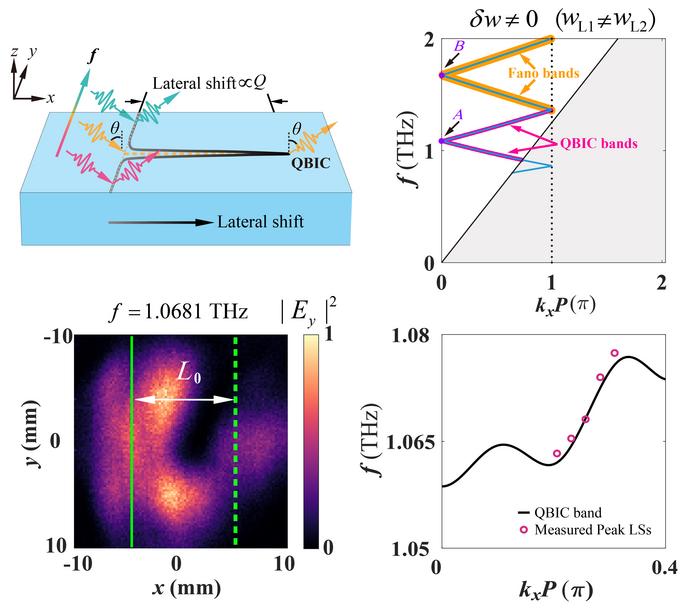
In a groundbreaking study, a team of researchers from Singapore and China has uncovered significant insights into the behavior of quasi-bound states in the continuum (QBIC) within terahertz frequency ranges. These phases are known for their extraordinary quality factors (Q factors), yet most investigations have primarily focused on their momentum-space characteristics. The results presented are poised to enhance our understanding of these states by experimentally demonstrating their influence on real-space phenomena, specifically abrupt lateral beam shifts (LSs) that occur when examining terahertz waves.
This novel research involves the use of a specially designed compound grating waveguide that exhibits a folded Brillouin zone. Within this intricate structure, the researchers managed to establish a QBIC band wherein all states effectively become QBICs. This formation is crucial, as it allows the team to manipulate light in a new and innovative way. When the QBICs were excited at certain incident angles, the team observed these abrupt lateral beam shifts. Remarkably, these shifts vanished almost instantaneously when the excitation frequency strayed from the established QBIC band, showcasing the precision and unique characteristics of these quasi-bound states.
Prof. Baile Zhang from Nanyang Technological University, along with Dr. Yang Long and Prof. Feng Wu from Guangdong Polytechnic Normal University, spearheaded this research. Their objective was clear—to provide a deeper understanding of QBICs beyond the traditional momentum-space descriptions that have dominated this field. The implications of their findings are vast, particularly when considering the potential applications of QBICs in technologies requiring precise manipulation of terahertz radiation.
While QBICs have generally been studied within theoretical frameworks, this research employs real-space imaging techniques to observe these lateral shifts directly. Using terahertz imaging technology, the research team documented how these shifts occur at different angles, providing a comprehensive mapping of the QBIC band. Through their experiments, they recorded a maximum lateral shift of 41.16 times the wavelength at a frequency of 1.0774 THz. This figure is staggering—it represents approximately 3.35 times larger than any previously reported lateral shift in the terahertz range, marking a significant advancement in the field.
The implications of these findings extend beyond academic curiosity. The ability to induce and control lateral beam shifts at terahertz frequencies opens new pathways for the development of advanced sensing technologies. The researchers highlight the potential for utilizing QBICs to design next-generation sensors and wavelength division multiplexers, which could revolutionize how we approach telecommunications and imaging applications. The capacity to manipulate light with such precision could lead to significant improvements in device performance and functionality.
As the team looks to the future, they emphasize the exciting possibilities that their findings present. Prof. Zhang notes that this study offers a fresh perspective on QBICs, while Dr. Long highlights the innovative characterizations of QBIC bands that could emerge from their work. Furthermore, the researchers suggest that these techniques could stimulate further investigations into other complex wave phenomena, potentially leading to unforeseen breakthroughs in various scientific domains.
In conclusion, the significant observations made regarding abrupt lateral beam shifts from terahertz quasi-bound states in the continuum bring forth a new chapter in optical research. With this pioneering work published in the esteemed Science Bulletin, the researchers hope their findings will inspire additional studies and spur advancements in technologies reliant on terahertz radiation. As they continue to explore the intersections of fundamental physics and practical applications, the outlook for utilizing QBICs in scientific and industrial settings appears brighter than ever.
The quest to understand these complex wave interactions continues, and as new experiments are conducted, the scientific community eagerly anticipates the unveiling of further revelations regarding the intriguing nature of quasi-bound states in the continuum and their impact on the manipulation of light and its applications across various fields.
Keywords
Terahertz, quasi-bound states in the continuum, lateral beam shifts, grating waveguide, imaging technology, photonic devices, sensing, wave phenomena, optical research.
Cite Scienmag News
Grant Pearson. (April 9, 2025). Sudden Lateral Beam Deflections Induced by Terahertz Quasi-Bound States in the Continuum. Scienmag. https://scienmag.com/sudden-lateral-beam-deflections-induced-by-terahertz-quasi-bound-states-in-the-continuum/
Grant Pearson. "Sudden Lateral Beam Deflections Induced by Terahertz Quasi-Bound States in the Continuum." Scienmag, 9 April 2025, https://scienmag.com/sudden-lateral-beam-deflections-induced-by-terahertz-quasi-bound-states-in-the-continuum/. Accessed 4 September 2026.
Grant Pearson. "Sudden Lateral Beam Deflections Induced by Terahertz Quasi-Bound States in the Continuum." Scienmag. April 9, 2025. https://scienmag.com/sudden-lateral-beam-deflections-induced-by-terahertz-quasi-bound-states-in-the-continuum/


