


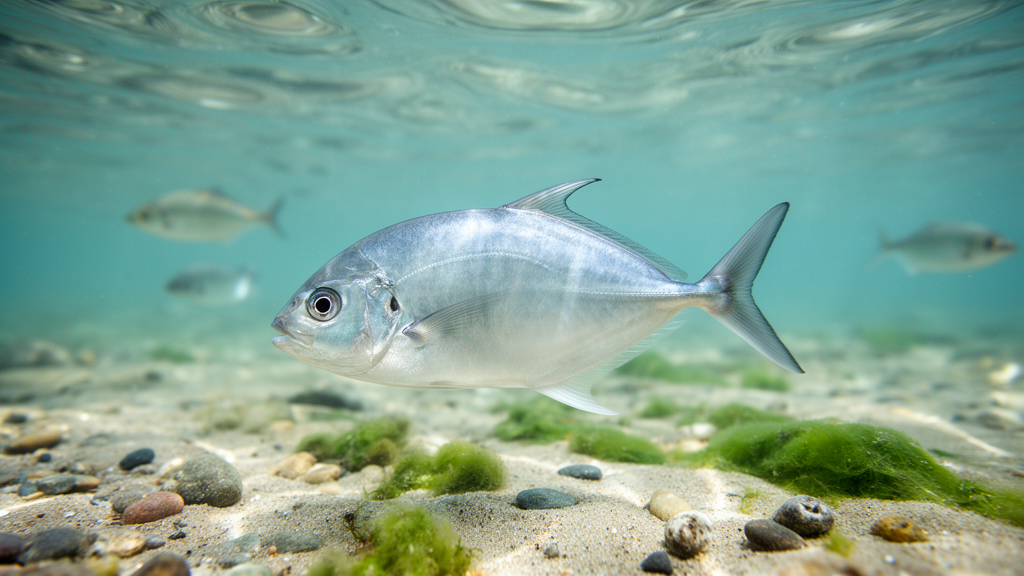
In the summer of 2024, fishermen working the shallow southeastern waters of the Caspian Sea began hauling in something they had never seen before: a mullet that looked subtly different from the familiar grey mullets of the region. Local reports of an unrecognized fish in the catch composition prompted researchers to investigate, and the results have now confirmed a remarkable discovery. A subtropical species, the abu mullet (Planiliza abu), native to the warm waters of the Persian Gulf and the Sea of Oman in southern Iran, has established itself in the southern Caspian basin, more than 1,000 km north of its previously known distribution range. The finding, published in Acta Ichthyologica et Piscatoria, documents the first record of an established population of this species in the Caspian Sea and marks a striking northward range expansion toward a cold temperate climate.
The Caspian Sea, the world’s largest enclosed inland water body, is no stranger to alien species. In recent decades, researchers have documented an increasing occurrence of introduced organisms, including the notorious comb jelly (Mnemiopsis leidyi), several exotic fishes such as European eel, three-spined stickleback, and the golden and leaping grey mullets, the oriental shrimp, alien diatoms, and barnacles. At least seven alien fish species currently inhabit the southern Caspian waters, and a total of 28 alien species have been documented from the southern Caspian basin across marine and freshwater habitats. The appearance of any new alien species in this closed water body is considered a threat to ecosystem biodiversity, structure, and function, as the whole Caspian ecoregion is strongly sensitive to the ecological and socioeconomic impacts caused by introduced organisms.
The family Mugilidae, the grey mullets, is already represented in the southern Caspian Sea by three species: the golden grey mullet (Chelon auratus), the leaping mullet (Chelon saliens), and the grey mullet (Mugil cephalus). These were introduced into the Caspian Sea from the Black Sea between 1930 and 1934. The grey mullet is considered not to have adapted to the lower salinity of the Caspian Sea, and its introduction is thought to have been unsuccessful. In contrast, the golden grey mullet and the leaping mullet support active fisheries, with annual catches amounting to several hundred tonnes in southern Caspian waters. The abu mullet, however, was never before observed in northern Iran, despite the Caspian basin having undergone many ichthyological studies.
To identify the mystery fish, researchers collected 65 specimens using gillnets of various mesh sizes from two southeastern Caspian localities: the mouth area of Gorgan Bay and the estuary of the Gorganroud River, one of the principal rivers in northern Iran, at a depth of about 1 m during late summer and early autumn 2024. The specimens were preserved in 10% formalin and transferred to the laboratory, where 48 morphometric and 14 meristic traits were recorded for comparison with published data. The morphometric measurements were standardized according to established methods to remove size-dependent variation and emphasize shape differences among individuals. Sex was determined by examination of gonads under magnification, and the gonadosomatic index and condition factor were calculated for all specimens.
The examined specimens exhibited the diagnostic characteristics of Planiliza abu in agreement with descriptions from its native range in the Indian Ocean, Sea of Oman, and Persian Gulf. Externally, the fish is moderately elongated and slightly compressed, with a pale greenish dorsal surface and silvery flanks and abdomen. It bears large eyes, a terminal mouth with a single row of peg-like teeth on the upper lip, and an invisible lateral line. The species possesses two separated dorsal fins: the first with four unbranched spines and no branched rays, the second with 2–3 unbranched and 5–8 branched rays. The number of scales along the longitudinal series ranged from 45 to 50, and gill rakers from 46 to 58. Crucially, the number of pyloric caeca was consistently four in all examined individuals, a reliable diagnostic feature distinguishing the species from other Caspian mullets. No significant sexual differences were observed in meristic characteristics.
Statistical analysis revealed moderate sexual dimorphism in shape. Independent t-tests indicated significant differences between males and females in ten transformed morphometric variables, including predorsal distances, prepelvic and preanal lengths, and several fin-length proportions. The most pronounced differences were associated with body depth and fin-length proportions. In contrast, no significant differences were detected for any meristic features. Females ranged in size from 140 to 180 mm total length with a mean of about 155 mm, whereas males ranged from 135 to 170 mm with a mean of about 150 mm. Females appeared larger than males in both length and weight, and age readings from opercula revealed two age groups, 3+ and 4+, with the majority of specimens belonging to the 3+ age class.
Several biological indicators suggest the population is thriving. The Fulton condition factor of the collected specimens varied between 0.80 and 1.42 in females and between 0.87 and 1.20 in males, with means slightly exceeding the standard value of 1 in both sexes, indicating good body condition. The gonadosomatic index of females ranged from 1.13 to 10.09, and in males from 0.42 to 6.14, with the highest values observed in September and October. Based on these peak values, researchers infer that the spawning period of the abu mullet may extend into late summer and early autumn in this region, a timing that has not been reported in other populations of the species across Iraq, Iran, and Turkey. The observed sex ratio was slightly biased towards males, in contrast to southern populations where females are generally more abundant, a pattern that might be related to environmental conditions unfavorable for females in the southeastern Caspian region.
Field surveys near the southeastern Caspian coast, where the species was first observed, indicated that its distribution has extended into nearby inland waters as well. The abu mullet was recorded in the Voshmgir Dam Lake and the Adjigol Wetland, two freshwater ecosystems with salinity of 3 ppt or less, located about 15 km apart and approximately 70 km from the sea. The species was also accidentally observed in a section of the Gorganroud River about 35 km from its estuary. Questionnaires administered to 50 local fishermen indicated a considerable abundance of the species in catches during summer and autumn 2024, although both mullet species showed a decrease in autumn, with the abu mullet exhibiting a sharper decline. Further long-term monitoring is required to confirm seasonal trends.
How the species reached the Caspian remains uncertain. Physical barriers, including mountain ranges and hydrological separation, prevent natural dispersal from the subtropical aquatic ecosystems of southern Iran to the Caspian basin, so researchers cannot ascertain the path of introduction from the species’ natural range. Inter-basin transfer of fish by aquaculture activities is considered the most likely path of transmission. Notably, there have been unconfirmed reports of the transfer of grey mullet fry from the Persian Gulf in southern Iran to the Caspian Sea in northern Iran, and researchers hypothesize that the introduction of the abu mullet may be associated with such fry transfers. The considerable occurrence rate in mullet catches, good body condition, large size, and age of the collected specimens allow the authors to confidently state that the species has established a self-sustaining population in the sea, with the potential to successfully adapt to Caspian environmental conditions.
The implications of this subtropical species’ arrival in a cold temperate basin are significant. The southern Caspian Sea has a variant of the Mediterranean climate, and the Caspian Sea is considered one of the most threatened water bodies in the world, facing climate change, pollution, overfishing, and seawater level decline that dries out coastal wetlands. Given the species’ known preference for estuarine habitats, researchers expect it to expand into southern Caspian rivers, potentially increasing in both abundance and distribution in the coming years. During field observations in November, when water temperatures drop considerably, only a few specimens were recorded, which may indicate that the species can tolerate the relatively cold conditions of the region. Ongoing investigations are expected to reveal additional occurrences of the abu mullet in the Iranian waters of the Caspian Sea, and further surveys are needed to determine the continued expansion of its geographical distribution and to assess its possible impacts on the biodiversity of Caspian fish communities.
}`{
Subject of Research: First record and range expansion of the subtropical abu mullet (Planiliza abu) in the southern Caspian Sea basin
Article Title: New geographical records of subtropical abu mullet, Planiliza abu ( Actinopterygii , Mugiliformes , Mugilidae ), in the southern Caspian basin: Evidence of occurrence and range expansion of a subtropical fish species within the Caspian area
Article References: Gholjaei, B., Patimar, R., Jafaryan, H., Raeisi, H., & Bahalkeh, A. (2026). New geographical records of subtropical abu mullet, Planiliza abu (Actinopterygii, Mugiliformes, Mugilidae), in the southern Caspian basin: Evidence of occurrence and range expansion of a subtropical fish species within the Caspian area. Acta Ichthyologica et Piscatoria, 56, 203-212. https://doi.org/10.3897/aiep.56.165790
Image Credits: AI Generated
Keywords: abu mullet, Planiliza abu, Caspian Sea, range expansion, invasive species, Mugilidae, Iran, Gorgan Bay, biodiversity, aquaculture introduction, subtropical fish, geographical
Cite Scienmag News
Patricia Pace. (October 17, 2026). Subtropical abu mullet appears in the Caspian Sea, over 1,000 km north of its native range. Scienmag. https://scienmag.com/subtropical-abu-mullet-appears-in-the-caspian-sea-over-1000-km-north-of-its-native-range/
Patricia Pace. "Subtropical abu mullet appears in the Caspian Sea, over 1,000 km north of its native range." Scienmag, 17 October 2026, https://scienmag.com/subtropical-abu-mullet-appears-in-the-caspian-sea-over-1000-km-north-of-its-native-range/. Accessed 17 October 2026.
Patricia Pace. "Subtropical abu mullet appears in the Caspian Sea, over 1,000 km north of its native range." Scienmag. October 17, 2026. https://scienmag.com/subtropical-abu-mullet-appears-in-the-caspian-sea-over-1000-km-north-of-its-native-range/


