


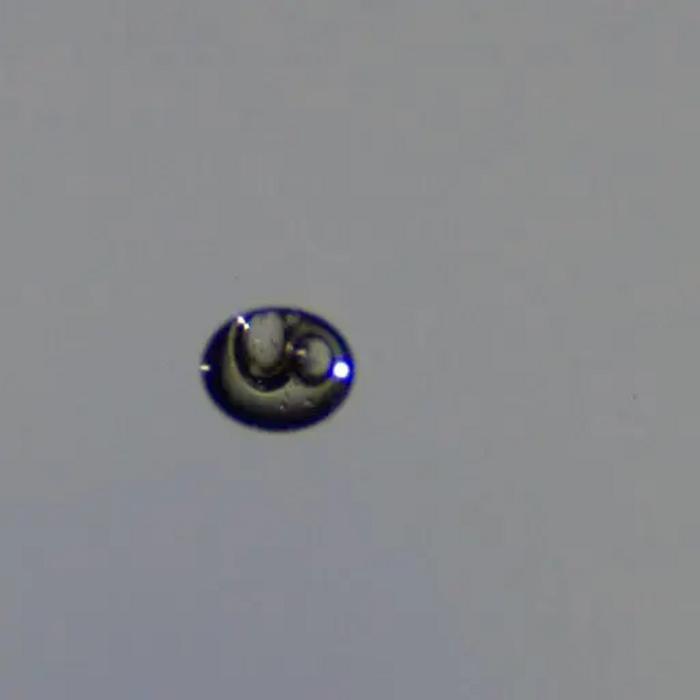
By studying how bubbles form in a drop of biodiesel, researchers at the University of Gothenburg can help future engines get the most energy out of the fuel.

Credit: Yogeshwar Nath Mishra/GU
By studying how bubbles form in a drop of biodiesel, researchers at the University of Gothenburg can help future engines get the most energy out of the fuel.
In an internal combustion engine, the fuel is distributed in small droplets in injection valves to maximise combustion.
In the engine, the fuel droplets are pressurised to turn into gas and burn. When gas is formed, bubbles form inside the droplets and it is these that the researchers at the University of Gothenburg have studied using femtosecond lasers.
Less emissions
“The bubbles have a significant impact on the atomisation of biodiesel in engines. Therefore, our research is very important to address fundamental questions about the efficiency of the biodiesel engine,” says Dr. Yogeshwar Nath Mishra, who led the study at the University of Gothenburg together with Professor Dag Hanstorp.
Researchers are trying to understand how and when the bubbles form in the fuel droplets. In the long term, this knowledge could lead to the development of a more efficient engine that burns more fuel than today, resulting in less environmentally harmful emissions.
“Research on biodiesel is crucial in our transition from fossil fuels to combat climate change. In engines, bubbling affects fuel combustion and contributes to the formation of larger droplets that do not evaporate and burn completely, leading to increased emissions,” says Dr. Yogeshwar Nath Mishra.
The droplet is levitated acoustically
Studying bubble formation in engine injection valves is difficult because of their structure, with narrow channels in metal bodies. But with the latest technology, physicists can set up an experiment in the lab that allows them to study the process in a millimetre-sized drop of biodiesel. First, a fuel droplet is levitated, i.e. trapped in the air, using a standing sound wave.
“We then energise the droplet with our femtosecond laser, which focuses light energy at a point inside the droplet for a very short time, 100 femtoseconds, 10-13 seconds. This forms the gas bubbles, the number, growth and fine distribution of which are studied using a high-speed camera,” explains Dag Hanstorp, Professor of Physics at the University of Gothenburg.
Many applications
The results, published in Nature Scientific Reports, have provided significant insights into the phenomenon of bubble formation that are not only useful in the development of more efficient fuels and combustion engines.
“Bubble formation is important in industries such as chemical engineering for example carbonated drinks, ultrasonic imaging, boiling processes for heat transfer and processes such as gas release from water bodies and cloud formation. But what we have achieved is basic research. There is still a lot of development to be done before it can be used,” says Dag Hanstorp.
Video clip: How bubbles form in a drop of biodiesel.
Journal
Scientific Reports
Method of Research
Experimental study
Article Title
Bubble dynamics and atomization of acoustically levitated diesel and biodiesel droplets using femtosecond laser pulses
Article Publication Date
9-Apr-2024
Cite Scienmag News
Bethany Barker. (May 15, 2024). Studying bubbles can lead to more efficient biofuel motors. Scienmag. https://scienmag.com/studying-bubbles-can-lead-to-more-efficient-biofuel-motors/
Bethany Barker. "Studying bubbles can lead to more efficient biofuel motors." Scienmag, 15 May 2024, https://scienmag.com/studying-bubbles-can-lead-to-more-efficient-biofuel-motors/. Accessed 4 September 2026.
Bethany Barker. "Studying bubbles can lead to more efficient biofuel motors." Scienmag. May 15, 2024. https://scienmag.com/studying-bubbles-can-lead-to-more-efficient-biofuel-motors/

