


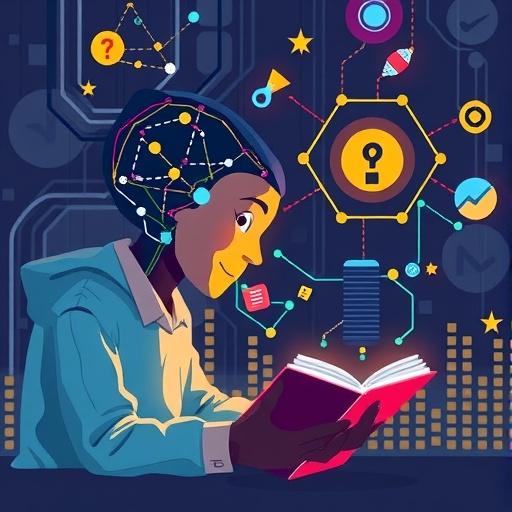
In a groundbreaking study emerging from Dartmouth College, researchers have unveiled the transformative potential of artificial intelligence (AI) in revolutionizing medical education through personalized learning experiences. This pioneering work, led by Professor Thomas Thesen and co-author Soo Hwan Park, demonstrates how AI-driven platforms can tailor educational support to individual students on an unprecedented scale, all while fostering significant trust in the technology among learners.
The focal point of their research is NeuroBot TA, an AI teaching assistant meticulously crafted for students enrolled in the Neuroscience and Neurology course at Dartmouth’s Geisel School of Medicine. Unlike conventional chatbots that draw from vast, uncurated datasets, NeuroBot TA employs an innovative retrieval-augmented generation (RAG) technique. This method grounds AI responses in rigorously vetted course materials including textbooks, lecture notes, and clinical guidelines, dramatically improving the accuracy and reliability of information dispensed to students.
The RAG approach addresses one of the fundamental challenges facing current generative AI systems: hallucination. Hallucination refers to AI’s tendency to fabricate plausible but incorrect information. By anchoring answers exclusively to validated sources, NeuroBot TA minimizes this risk, enhancing students’ confidence in the assistant’s guidance. This marks a critical advancement in AI integration within sensitive learning environments such as medical education, where misinformation can have dire consequences.
The Dartmouth team conducted an observational study involving 190 medical students across two academic cohorts in fall 2023 and 2024, carefully monitoring their interactions with NeuroBot TA. Survey results revealed a clear preference among students for the curated knowledge base NeuroBot offered compared to general-purpose AI chatbots. About one-quarter of respondents emphasized the platform’s trustworthiness, dependability, and rapid response times, particularly valuing its assistance during exam preparations. Nearly half acknowledged the tool as a valuable study aid, underlining AI’s practical utility.
Professor Thesen highlights that this research represents a significant leap toward precision education—fine-tuning instruction to the unique needs and contexts of individual learners. He envisions AI-driven tools like NeuroBot TA as scalable solutions capable of preserving educational quality even in resource-constrained settings where instructor availability and classroom sizes are limiting factors. Not only does this democratize access to personalized learning, but it also augments traditional pedagogical models with data-driven interactivity.
Yet, the study also surfaces notable challenges inherent in the deployment of AI educational assistants. Despite the increased trust in RAG-based AI outputs, student usage patterns predominantly involved fact-checking and brief inquiries rather than engaging in deep, reflective learning dialogues. This usage bias risks relegating AI tools to surface-level utility. Furthermore, some students expressed frustration over NeuroBot’s limited knowledge scope, an intentional design choice to ensure accuracy but potentially at odds with users’ desire for comprehensive information.
An intriguing and somewhat troubling insight relates to cognitive vulnerabilities: many medical students lack the expertise to reliably detect when AI-generated information—even from curated sources—may be subtly inaccurate or incomplete. This underscores a critical pedagogical imperative to integrate AI literacy training alongside technology adoption, equipping learners to critically evaluate AI contributions rather than passively accept them.
Looking ahead, Thesen and Park are actively exploring hybrid AI architectures that maintain the core reliability of RAG while incrementally broadening the range of accessible content. Such systems aim to balance accuracy with exploratory learning, guiding students through increasingly complex educational pathways without sacrificing trustworthiness. These developments are poised to transform the educational landscape by providing interactive, context-sensitive AI tutors aligned with cognitive science principles.
Complementing NeuroBot TA is another innovative AI tool developed in the same laboratory: AI Patient Actor. This platform simulates realistic patient interactions, enabling medical students to hone communication and diagnostic competencies within a risk-free environment. Immediate feedback mechanisms foster iterative improvement, enhancing clinical skills vital for future practitioners. AI Patient Actor has gained adoption both within Dartmouth’s medical curriculum and at institutions globally, signaling the growing role of AI in experiential learning domains.
Future updates to NeuroBot TA aspire to incorporate advanced teaching methodologies such as Socratic tutoring and spaced retrieval practice. Instead of simply delivering answers, the AI would facilitate critical thinking by prompting students with targeted questions and periodic assessments, thereby promoting deeper comprehension and long-term knowledge retention. Such metacognitive strategies could revolutionize how learners interact with AI, balancing task efficiency with meaningful educational outcomes.
Professor Thesen underscores the necessity for new pedagogical frameworks that integrate AI without diminishing the fundamental processes of learning. “There is an illusion of mastery when we outsource cognitive tasks to AI,” he notes. “Effective education must ensure students remain active learners rather than passive recipients of information.” The challenge moving forward lies in harnessing AI’s capabilities to enrich education while safeguarding and enhancing the learner’s cognitive engagement and autonomy.
This Dartmouth study, published in npj Digital Medicine in November 2025, offers compelling evidence that curated, retrieval-augmented AI systems can achieve both high utility and high trust in demanding educational settings. As medical education grapples with surging enrollments and stretched resources, such innovations promise to deliver personalized, reliable, and scalable learning solutions with profound implications for healthcare training worldwide.
- https://dx.doi.org/10.1038/s41746-025-02022-1
- https://geiselmed.dartmouth.edu/
- https://home.dartmouth.edu/news/2024/01/geisel-professor-harnesses-ai-act-patient
References:
Thesen, T., Park, S.H. “A generative AI teaching assistant for personalized learning in medical education.” npj Digital Medicine, 2025. DOI: 10.1038/s41746-025-02022-1
Keywords: Artificial intelligence, Generative AI, Adaptive systems, Machine learning, Medical education, Neuroscience, Educational technology, Personalized learning, Cognitive psychology, Educational software, Online education, Teaching
Cite Scienmag News
Cassandra Pierce. (November 12, 2025). Study Shows AI Enables Personalized Learning on a Large Scale. Scienmag. https://scienmag.com/study-shows-ai-enables-personalized-learning-on-a-large-scale/
Cassandra Pierce. "Study Shows AI Enables Personalized Learning on a Large Scale." Scienmag, 12 November 2025, https://scienmag.com/study-shows-ai-enables-personalized-learning-on-a-large-scale/. Accessed 4 September 2026.
Cassandra Pierce. "Study Shows AI Enables Personalized Learning on a Large Scale." Scienmag. November 12, 2025. https://scienmag.com/study-shows-ai-enables-personalized-learning-on-a-large-scale/


