

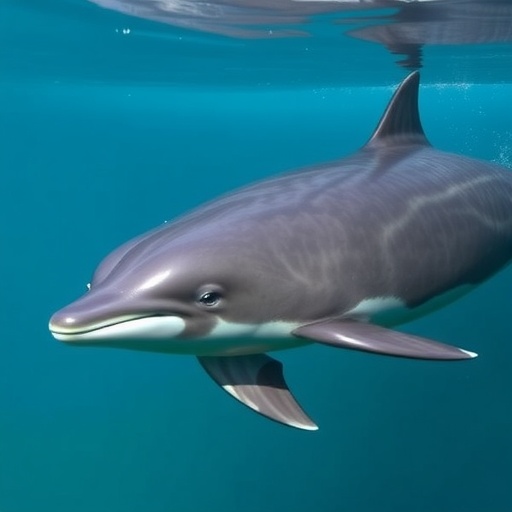
For decades, the narrow-ridged finless porpoise (Neophocaena asiaeorientalis) has been categorized as a predominantly solitary marine mammal, presumed to engage mainly in interactions between mother and offspring without notable social behavior beyond this dyad. However, new observational evidence from Ise Bay, Japan, challenges these long-standing assumptions, revealing intricate social dynamics that include allomaternal behavior—interactions between infants and adults other than their biological mothers. This research not only overturns a paradigm about the species’ social structure but also expands the utility of drone technology in marine mammal ethology.
Traditionally, mammalian infants rely heavily on maternal care immediately post-birth, as the mother typically provides nourishment, protection, and social learning opportunities essential for survival. In various social mammals, allomaternal care—where individuals other than the mother assist in offspring care—plays an important role, especially in group-living species. This phenomenon provides benefits such as increased infant survival rates and enhanced reproductive efficiency for the mother. In terrestrial mammals, this behavior often occurs among related females, particularly younger or nulliparous females, who gain maternal experience.
Finless porpoises, as odontocetes (toothed whales), have been assumed to diverge from this pattern, exhibiting pronounced social isolation. Prior to this study, observations suggested their social groups are limited, largely consisting of transient mother-infant pairs or rare cooperative aggregations for feeding or transit. The new findings, led by Associate Professor Mai Sakai of Kindai University’s Marine Mammal Research Laboratory, reveal more complex and flexible social interactions suggesting the presence of allomaternal care in what was thought to be a simple social system.
Using consumer-grade drones, Sakai’s research team conducted aerial behavioral observations over 34 days across multiple months in 2023. The drone technology enabled non-invasive and detailed tracking of finless porpoise movements and interpersonal proximity with unprecedented precision. The criteria for identifying allomaternal behavior involved documenting infants engaged in prolonged parallel swimming—a social swimming behavior—alongside multiple adults that were not the infants’ mothers. The study recorded at least four instances where one infant interacted sequentially with two adults, highlighting a dynamic social environment rather than strict maternal exclusivity.
Parallel swimming, a behavior characterized by coordinated swimming in the same direction at close range, is a significant social indicator among many cetaceans. The investigation found that infants positioned themselves laterally alongside adults during these sessions, a formation theorized to reduce hydrodynamic drag and conserve energy by leveraging the adult’s wake. This suggests that infants not only seek social contact but may also gain biomechanical and energetic advantages through association with adults beyond their mothers, signaling a potential adaptive function of social swimming in this species.
Interestingly, the study noted instances of adults initiating contact with infants, possibly representing allomaternal females gaining experience before their own reproductive events. Although the sex of the interacting adults was not definitively determined, the implications are substantial. Such interactions resemble “allosuckling” or handling by young, non-reproductive females witnessed in other social mammals. This behavior may contribute to social learning, infant protection, and the formation of social bonds independent of strict kin relationships.
Despite these occurrences, the proportion of time infants spent swimming parallel to any single adult, other than their mothers, was relatively low—typically less than 40%. This contrasts with observations in other delphinid species, where mother-infant pairs display more persistent and exclusive affiliations. Dr. Sakai interprets this as evidence of a comparatively weaker mother-calf bond in narrow-ridged finless porpoises, possibly reflecting an evolutionary adaptation to their coastal, highly turbid habitats where prolonged maternal dependence may be less feasible or necessary.
The implications of these findings extend well beyond behavioral ecology, touching on conservation strategies for this vulnerable species. Previously, the presumed solitary nature of finless porpoises complicated rehabilitation efforts following calf orphaning or abandonment. Recognizing that non-maternal adults engage socially and may provide care opens doors for more effective interventions, utilizing allomaternal individuals in captive or semi-wild rehabilitation programs. This fundamentally changes the framework for managing juvenile survival in conservation contexts.
Moreover, the successful deployment of cost-effective drone platforms highlights a non-invasive, scalable methodology for observing elusive marine mammals in complex environments. Traditional boat-based surveys face limitations due to disturbance risks and visibility constraints in turbid waters. Drones afford closer and longer-duration monitoring while minimizing stress-related bias in behavior, setting a precedent for future ethological and conservation-oriented studies in marine biology.
These discoveries prompt us to reconsider the social ecology of species traditionally thought to be solitary or exhibit rudimentary social structures. The narrow-ridged finless porpoise exemplifies a transitional social strategy—individuals capable of both solitary and socially flexible behaviors, tailored to environmental and developmental demands. Further research is necessary to dissect the cost-benefit dynamics for all involved parties: mothers, calves, and non-maternal adults. Such studies are critical for understanding the evolution of sociality in marine mammals and guiding adaptive management approaches.
Summarizing, the nuanced social interactions comprising changing partners during parallel swimming among neonatal and adult finless porpoises challenge entrenched notions of species’ solitude. This emerging social complexity has profound implications for ecological theory, conservation practice, and technological advancement in wildlife research methodologies. As this area of inquiry progresses, it is anticipated that broader patterns of social adaptability in other “solitary” species will come to light, refining our comprehension of mammalian social evolution in aquatic environments.
In reflecting on these findings, Associate Professor Mai Sakai emphasized the potential developmental and social benefits of allomaternal behaviors, positing these interactions as compensatory mechanisms for the modest maternal bonds in the species. Continued longitudinal studies leveraging drone technology and detailed behavioral analysis will be indispensable in uncovering the full spectrum and ecological significance of these interactions, ultimately informing both academic understanding and practical conservation efforts for the narrow-ridged finless porpoise.
Subject of Research: Animals
Article Title: Observations of Changing Partners During Parallel Swimming Behavior Between Neonatal and Adult Finless Porpoises (Neophocaena asiaeorientalis) in Ise Bay, Japan
News Publication Date: 21-Oct-2025
Web References: https://doi.org/10.3106/ms2024-0055
References: Sakai, M., Noro, S., Yagi, G., Terada, T., et al. (2025). Observations of Changing Partners During Parallel Swimming Behavior Between Neonatal and Adult Finless Porpoises (Neophocaena asiaeorientalis) in Ise Bay, Japan. Mammal Study. DOI: 10.3106/ms2024-0055
Image Credits: Assistant Professor Genfu Yagi from Mie University, Japan
Keywords: Ethology, Organismal biology, Ecology, Marine biology, Conservation biology, Endangered species, Mammals, Wildlife management, Life sciences


