


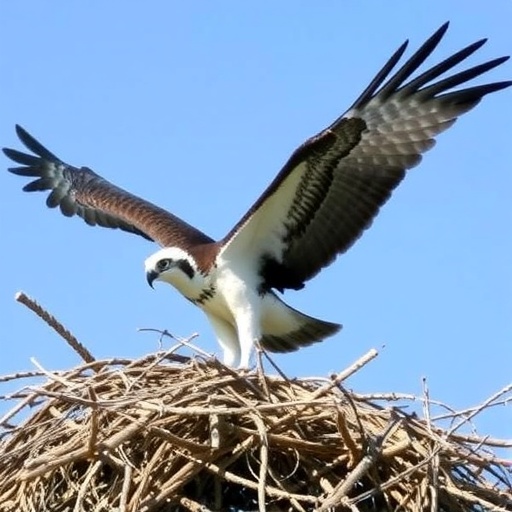
A small number of unusually adventurous ospreys may hold the key to restoring the species across Europe, according to a new study from Bournemouth University. These “pioneering pairs” appear willing to establish nests far from existing osprey colonies, creating new breeding centres that can accelerate population recovery. Their behaviour challenges the assumption that recovering wildlife populations expand gradually from established strongholds and suggests that a handful of long-distance settlers can reshape the geography of an entire species.
The study analysed an exceptional 54-year dataset documenting the recolonisation of ospreys in northern Scotland. Researchers examined where nests were built, how close breeding pairs were to one another and how settlement patterns changed over time. Their aim was to understand the spatial mechanics of recovery: whether new ospreys tended to cluster around existing birds or whether some individuals moved into apparently empty areas and established entirely new subpopulations. The results revealed a striking pattern. Most ospreys settled near other members of their species, but a small minority travelled more than 20 kilometres from all known neighbouring nests before breeding.
This tendency to settle near members of the same species is known as conspecific attraction. It is common in many animals because established colonies can signal the presence of suitable habitat, food, nesting sites and relatively safe conditions. For ospreys, the presence of experienced breeders may also provide social information about the best locations to raise chicks. Yet this behaviour can slow geographic expansion when a species is returning to parts of its former range. If nearly every individual chooses to nest near an existing population, the frontier of recovery advances only gradually, even when large areas of suitable habitat remain unoccupied.
The researchers also considered natal philopatry, the tendency of animals to return to or breed near their birthplace. This behaviour is particularly pronounced in male ospreys, which often establish breeding territories close to where they hatched. Conspecific attraction and natal philopatry can reinforce one another, producing dense local populations but limiting dispersal over longer distances. Pioneering pairs break this pattern. By moving beyond the established breeding range and reproducing in a new location, they create a biological foothold from which future expansion can proceed. Their descendants may then return to the same area, while other birds are drawn to the new colony.
The pattern has important implications because it resembles the way populations of invasive species spread through landscapes. In both cases, most individuals remain near established populations, while a small number make long-distance movements that generate new population centres. These rare dispersal events can have an outsized effect on the speed and direction of expansion. Ecologists describe such processes using spatial population models that track not only birth and death rates but also the distribution of individuals across a landscape. The Scottish osprey data suggest that recovery models should pay close attention to the “fat tail” of dispersal—the relatively uncommon movements that cover much greater distances than typical journeys.
For conservationists, the finding offers a practical strategy. Artificial nests can be installed in suitable but unoccupied habitats to make distant areas more attractive to prospecting ospreys. These structures provide a visible nesting option for birds searching for territories and may help compensate for the absence of older nests or established colonies. Another approach is translocation, in which young birds are moved from a healthy population to a carefully selected release site. If the birds later return to breed in that landscape, conservationists can effectively create pioneering individuals rather than waiting for rare natural dispersal events.
A major example is now unfolding in Poole Harbour, Dorset. Beginning in 2017, the Roy Dennis Wildlife Foundation and Birds of Poole Harbour carried out a five-year translocation project involving young ospreys from northern Scotland. Chicks approximately seven weeks old were moved to hacking cages in Dorset, where they completed their development before being released. The temporary cages allowed the young birds to imprint on the surrounding landscape during a critical stage of development. When mature, ospreys typically return to the region they associate with their early life, making the technique a way to establish future breeders in a new part of the country.
The project produced a landmark result in 2022, when the first breeding pair in southern England for 175 years raised two chicks. The male, known as 022, had been translocated from Scotland, while the female, CJ7, had travelled from a population approximately 200 kilometres away and was attracted to remain in the area by the presence of the translocated birds. Their return to breed demonstrated how managed movement and natural dispersal can work together. The pair has since returned to the same nest each year, and this summer produced four chicks for the third consecutive year. The young birds are expected to remain dependent on their parents until migrating in early September.
The Dorset population is already showing signs of the process described in the new study. A second pair has begun breeding away from Poole Harbour, and the first osprey born in the new population has gone on to breed in the East Midlands. These movements may form the beginnings of additional subpopulations, gradually reducing the distance between Dorset and the nearest established population at Rutland Water. Conservation teams are also monitoring four young males that are old enough to explore potential nesting areas and seek mates. Artificial nests have been constructed in neighbouring counties, including Devon and Hampshire, with plans for more installations across suitable parts of southern England.
The researchers emphasise that translocation is not an instant solution. Ospreys take several years to reach breeding age, and success depends on habitat quality, food availability, migration survival and the arrival of compatible mates. Nevertheless, the study indicates that conservation programmes can accelerate recovery by targeting the spatial process itself. Britain’s osprey population collapsed after centuries of hunting and egg collecting, and the species disappeared as a breeding bird by 1916. Recovery began after a pair returned naturally to Loch Garten in Scotland in 1954, followed by decades of protection and monitoring. The new findings show that rebuilding a species is not simply a matter of increasing numbers; it also requires helping those numbers reach the places where they can establish lasting populations. By identifying, supporting or replicating pioneering movements, conservationists may be able to speed the return of ospreys across the United Kingdom and other parts of Europe where the birds remain absent from much of their historical range.
News Publication Date: 13-Aug-2026
Web References: Bournemouth University; Birds of Poole Harbour; The Roy Dennis Wildlife Foundation; Journal of Animal Ecology
References: Journal of Animal Ecology, DOI: 10.1111/1365-2656.70322
Cite Scienmag News
Margaret Porter. (August 13, 2026). Study reveals how pioneering osprey pairs drive population recovery. Scienmag. https://scienmag.com/study-reveals-how-pioneering-osprey-pairs-drive-population-recovery/
Margaret Porter. "Study reveals how pioneering osprey pairs drive population recovery." Scienmag, 13 August 2026, https://scienmag.com/study-reveals-how-pioneering-osprey-pairs-drive-population-recovery/. Accessed 3 September 2026.
Margaret Porter. "Study reveals how pioneering osprey pairs drive population recovery." Scienmag. August 13, 2026. https://scienmag.com/study-reveals-how-pioneering-osprey-pairs-drive-population-recovery/


