


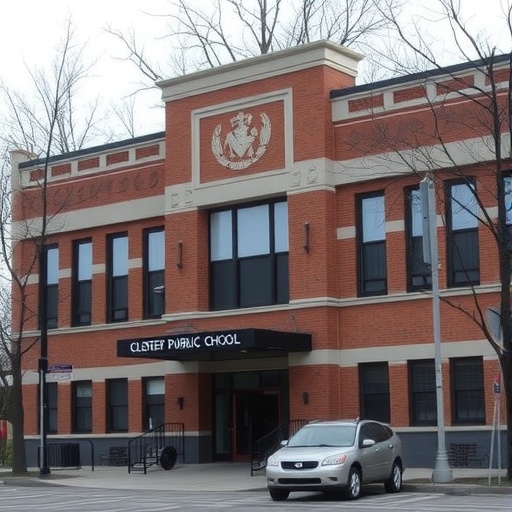
In 2013, Chicago undertook the unprecedented closure of 49 elementary schools, marking the largest mass public school shutdown in United States history at that time. Although the immediate fallout of this decision was framed primarily in terms of educational access and academic consequences for displaced students, emerging research now underscores a profound and disturbing collateral impact: a measurable escalation in gun violence within affected neighborhoods. This revelation comes from a groundbreaking study conducted collaboratively by scholars at the University of Chicago and the Johns Hopkins Bloomberg School of Public Health, which meticulously analyzed crime data to unearth the wider societal repercussions of school closures beyond the classroom.
Drawing upon comprehensive datasets sourced from the Chicago Police Department, the researchers employed advanced quasi-experimental difference-in-differences analytical methodologies to compare neighborhoods adjacent to shuttered schools with demographically and socioeconomically similar communities where schools remained operational. Their analysis revealed a nearly 10% increase in shootings in neighborhoods surrounding closed schools in the years following 2013, a statistically significant uptick that was corroborated by concurrent rises in weapons violations and firearm-related assaults and batteries. Notably, these surges were predominantly observed on Chicago’s South and West sides, areas historically marked by economic disadvantage and systemic marginalization.
Central to the research findings was the recognition that the closure of schools precipitated not only the loss of educational institutions but also the fracturing of community hubs that serve as vital social infrastructures. While official city and school district plans promised the repurposing of the closed school buildings into community centers, housing, or commercial spaces, by 2023, more than half of these facilities—26 out of 49—remained vacant. The researchers observed a further intensification of gun violence in neighborhoods surrounding these long-vacant structures, with a 10.2% increase in shootings, suggesting that the persistence of derelict public buildings may exacerbate local crime rates and erode communal resilience.
Thomas Statchen, a medical student at the University of Chicago Pritzker School of Medicine and the lead author of the study, emphasized the multifaceted role that school buildings play in their communities. Beyond their educational function, schools act as critical public spaces where intergenerational social networks are cultivated through extracurricular activities, community events, and informal social gatherings. The removal of such spaces, he argued, disrupts these networks and impacts neighborhood functionality in complex ways that manifest as increased firearm violence. This conceptualization aligns with broader sociological theories about the social determinants of health and violence, which highlight the importance of cohesive community relationships in mitigating crime.
Expanding upon this theme, the study invoked prior research led by Statchen published earlier in 2026 in JAMA Network Open, which examined how elevated eviction rates in Chicago neighborhoods correspond with heightened incidents of gun violence. That investigation used data from the Chicago Department of Public Health to demonstrate that evictions undermine social cohesion and community resilience, serving as a parallel disruption analogous to school closures. Taken together, these studies illustrate the cascading effects of structural upheavals in low-income communities, where the loss of anchor institutions precipitates a compounding erosion of social capital, safety, and well-being.
Elizabeth Tung, MD, MS, Associate Professor of Medicine at the University of Chicago and a co-author on both studies, eloquently framed the closure of schools as akin to “evicting an entire community of social networks.” This metaphor captures the profound sense of dislocation experienced by residents who lose access not just to physical buildings, but to the symbolic and practical anchors around which their social lives revolve. Tung’s insights draw attention to how the spatial and relational dimensions of community are intimately intertwined, with the dissolution of gathering spaces translating to tangible increases in violence and social instability.
The unique timing and scope of the 2013 Chicago school closures created a rare natural experiment that researchers leveraged to dissect temporal trends in firearm violence. By analyzing police data spanning from 2010 to 2019, the team could chart trajectories of gun-related incidents before and after the closures, applying rigorous statistical controls to isolate the impact attributable specifically to school shutdowns. This methodological approach allowed for credible estimates of the counterfactual—what violence rates might have looked like had schools remained open—thus delivering robust evidence of the causal link between school closures and surges in neighborhood shootings.
The demographic composition of the affected student population also adds a critical dimension to the study’s implications. The closures disproportionately impacted low-income students of color, particularly Black children, amplifying existing inequities in both educational opportunity and community safety. Prior research has documented the adverse short-term academic effects on students displaced by school closures, including disruptions in learning continuity and school engagement. However, this new evidence extends the narrative, illuminating how educational policy decisions reverberate into broader social domains, exacerbating vulnerabilities in communities already struggling with systemic disenfranchisement.
Importantly, the authors of the study stress that the outcomes linked to school closures are not inevitable but contingent upon the response of policymakers and local stakeholders. Mudia Uzzi, PhD, MSc, Bloomberg Assistant Professor of American Health at Johns Hopkins and senior author of the study, called for proactive, collaborative strategies to co-develop and implement concrete reuse plans for closed school buildings from the outset. Uzzi underscored that since these closures tend to occur in under-resourced neighborhoods, the compounded losses necessitate reparative approaches that prioritize community well-being and equitable access to public assets. Without such measures, the physical and social voids left behind risk perpetuating cycles of violence and deprivation.
This research thereby contributes a crucial empirical foundation for rethinking urban educational policy and community development strategies. It challenges stakeholders to transcend narrow cost-benefit analyses centered exclusively on school budgets or academic metrics, instead foregrounding the integral role of schools as multidimensional community anchors. By documenting the measurable spike in firearm violence following mass school closures, the study implores municipal leaders, educators, and public health officials to recognize the broader social ecosystem of which schools are a vital part and to design interventions that bolster community resilience in tandem with educational infrastructure.
As cities nationwide grapple with economic constraints and demographic shifts, the lessons from Chicago’s 2013 school closures serve as a cautionary tale. Policymakers must rigorously assess the potential unintended consequences of closing public schools and weigh them against the purported benefits. Thoughtful integration of community stakeholders, investment in repurposing strategies that prioritize social cohesion, and sustained monitoring of neighborhood violence metrics constitute necessary components of responsible governance aimed at safeguarding vulnerable populations.
Overall, this pioneering study, published in Social Science & Medicine on August 1, 2026, elucidates a critical but often overlooked dimension of urban education policy—the interplay between school infrastructure and public safety. By leveraging robust quantitative methods and contextualized sociological insights, it offers an invaluable resource for scholars, public health practitioners, and city planners working to foster safer, healthier, and more equitable urban environments.
News Publication Date: August 1, 2026
Web References:
Social Science & Medicine Article
Cite Scienmag News
Courtney Benton. (June 17, 2026). Study Finds Increased Gun Violence in Neighborhoods Surrounding Closed Public Schools in Chicago. Scienmag. https://scienmag.com/study-finds-increased-gun-violence-in-neighborhoods-surrounding-closed-public-schools-in-chicago/
Courtney Benton. "Study Finds Increased Gun Violence in Neighborhoods Surrounding Closed Public Schools in Chicago." Scienmag, 17 June 2026, https://scienmag.com/study-finds-increased-gun-violence-in-neighborhoods-surrounding-closed-public-schools-in-chicago/. Accessed 4 September 2026.
Courtney Benton. "Study Finds Increased Gun Violence in Neighborhoods Surrounding Closed Public Schools in Chicago." Scienmag. June 17, 2026. https://scienmag.com/study-finds-increased-gun-violence-in-neighborhoods-surrounding-closed-public-schools-in-chicago/


