


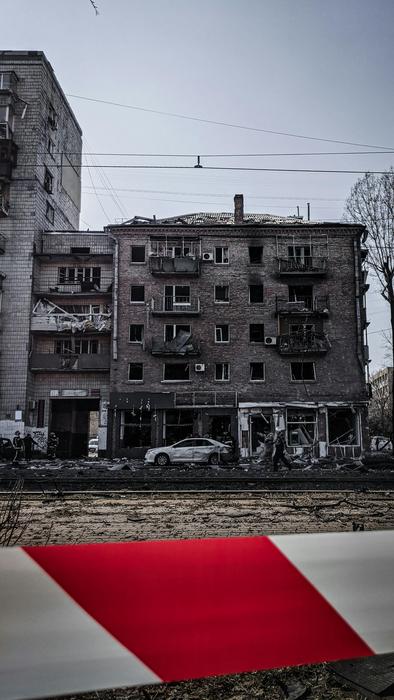
Researchers from the International Blast Injury Research Network at the University of Southampton conducted a survey to understand how the mental health of displaced Ukrainians has been affected by the ongoing war. Their findings, published in PLOS Global Public Health, describe high levels of post-traumatic stress disorder (PTSD) and generalized anxiety among both refugees and people displaced within Ukraine.

Credit: Photo by Алесь Усцінаў
Researchers from the International Blast Injury Research Network at the University of Southampton conducted a survey to understand how the mental health of displaced Ukrainians has been affected by the ongoing war. Their findings, published in PLOS Global Public Health, describe high levels of post-traumatic stress disorder (PTSD) and generalized anxiety among both refugees and people displaced within Ukraine.
Since the Russian invasion of Ukraine began in February 2022, at least 13 million people have been displaced from their homes. Both exposure to war and displacement—specifically loss of community, housing and economic resources—affect mental health. These impacts tend to be magnified among the elderly, those caring for children, and otherwise vulnerable populations.
Between April and July of 2022, the researchers surveyed over 8,000 participants, all of whom were either refugees or people displaced within Ukraine. The participants answered questions about their current circumstances, their mental health, and their exposures to blasts—explosions caused by bombs or other military actions.
Nearly 8 out of 10 participants who remained in Ukraine and more than half of refugees reported blast exposure. Almost 70 percent of all survey participants reported anxiety, with people remaining in Ukraine reporting higher anxiety and more frequent flashbacks to traumatic events compared to refugees. Flashbacks are a symptom of PTSD and can range from fleeting, intrusive memories to minutes-long episodes where a person feels they are reliving the traumatic events—in this study, the frequency of flashbacks was correlated to blast exposure.
Overall, this study suggests displaced people remaining in Ukraine face poorer mental health outcomes compared to refugees, likely because of their ongoing exposure to war. However, refugees still face considerable mental health challenges. The researchers emphasize, “Mental health and psychosocial support must be prioritized within humanitarian relief.”
The authors add: “Exposure to blast events can be incredibly distressing. Our survey of 8300 Ukrainian respondents show that almost 70% reported witnessing a blast event during the first 4 months of Russia’s full-scale invasion in 2022. Most worryingly, many respondents who were blast-exposed reported adverse mental health outcomes, including symptoms of PTSD.”
#####
In your coverage please use this URL to provide access to the freely available article in PLOS Global Public Health: https://journals.plos.org/globalpublichealth/article?id=10.1371/journal.pgph.0002623
Citation: Brackstone K, Head MG, Perelli-Harris B (2024) Effects of blast exposure on anxiety and symptoms of post-traumatic stress disorder (PTSD) among displaced Ukrainian populations. PLOS Glob Public Health 4(4): e0002623.
Author Countries: UK
Funding: This research was funded by small grants kindly provided from Public Policy@Southampton (MH, KB, BPH), the Clinical Informatics Research Unit, University of Southampton (KB, MH), and the ESRC Centre for Population Change (BPH). The funders had no role in study design, data collection and analysis, decision to publish, or preparation of this manuscript.
Competing Interests: The authors have declared that no competing interests exist.
Journal
PLOS Global Public Health
Method of Research
Survey
Subject of Research
People
Article Publication Date
11-Apr-2024
COI Statement
Competing Interests: The authors have declared that no competing interests exist.
Cite Scienmag News
Glenn Wilkins. (April 11, 2024). Study finds increased anxiety and PTSD among people who remained in Ukraine. Scienmag. https://scienmag.com/study-finds-increased-anxiety-and-ptsd-among-people-who-remained-in-ukraine/
Glenn Wilkins. "Study finds increased anxiety and PTSD among people who remained in Ukraine." Scienmag, 11 April 2024, https://scienmag.com/study-finds-increased-anxiety-and-ptsd-among-people-who-remained-in-ukraine/. Accessed 4 September 2026.
Glenn Wilkins. "Study finds increased anxiety and PTSD among people who remained in Ukraine." Scienmag. April 11, 2024. https://scienmag.com/study-finds-increased-anxiety-and-ptsd-among-people-who-remained-in-ukraine/

