


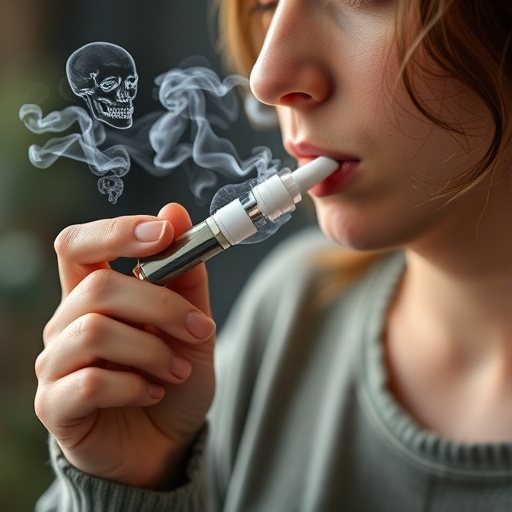
For millions of people who vape, the most revealing question may not be how often they use an electronic cigarette, but whether they feel able to stop when they intend to. A nationally representative survey of 1,002 US adults who use e-cigarettes has found that nearly one in four—23 percent—said their vaping was frequently uncontrolled. Yet only 4 percent reported that this loss of control frequently produced consequences. The contrast points to a hidden stage of nicotine dependence: a person may repeatedly vape more than they wish without yet experiencing obvious disruption to work, relationships, finances or health. The study, published in the Journal of Behavioral Medicine, is among the first to examine “uncontrolled vaping” as a distinct behavioral and psychological phenomenon rather than treating vaping simply as a yes-or-no habit. Its authors argue that the experience deserves closer monitoring because it could identify people at elevated risk of developing stronger dependence or struggling to quit.
The research team, led by Shayna Farris and colleagues at the University of North Carolina at Chapel Hill and the University of Maryland, surveyed adults recruited to reflect the US population of e-cigarette users. The investigators applied survey weights so that the results better represented the broader population, rather than allowing the composition of the online sample to determine the estimates. Participants answered questions about whether their vaping exceeded their intentions, what consequences followed, how they perceived the health risks of e-cigarettes, whether people around them encouraged them to cut down, and whether they intended to quit. The researchers then used linear regression, a statistical method that estimates how strongly several characteristics are associated with an outcome while accounting for other measured variables. Because the study captured responses at one point in time, it can reveal patterns and correlations but cannot establish that any particular factor causes uncontrolled vaping.
The distinction between uncontrolled behavior and its consequences is scientifically important. Addiction is not defined only by dramatic harm; it can also involve impaired control, persistent urges and repeated use despite a desire to reduce it. In this study, participants’ perception that vaping was frequently uncontrolled was much more common than frequent negative consequences. That gap may reflect the relatively portable and discreet nature of e-cigarettes. Unlike combustible cigarettes, many vaping devices can be used rapidly and repeatedly in settings where smoking is prohibited, sometimes without a clear beginning or end to a session. Nicotine delivery can therefore become woven into ordinary activities—commuting, working, socializing or scrolling on a phone. A user may recognize that they are reaching for the device more often than planned even if the pattern has not yet led to an unmistakable crisis. In behavioral terms, perceived loss of control may function as an early-warning signal that appears before dependence becomes visibly disruptive.
Age emerged as one of the clearest correlates. Younger adults reported both more frequent perceptions that their vaping was uncontrolled and more frequent consequences from uncontrolled use. The finding does not prove that youth itself causes loss of control, but it is consistent with the way nicotine dependence can develop during periods when habits, reward systems and social routines are still changing. Younger adults may also be more exposed to products designed for rapid, convenient use, as well as to social settings in which vaping is normalized. Nicotine acts primarily by binding to nicotinic acetylcholine receptors in the brain, triggering the release of neurotransmitters including dopamine in reward-related circuits. Repeated exposure can strengthen associations between nicotine and environmental cues, making ordinary moments—waking, taking a break or being with friends—capable of provoking an urge. The resulting cycle is not simply a matter of weak willpower: it involves learned cues, withdrawal relief and reinforcement of repeated dosing.
Another strong marker was how soon participants vaped after waking. People who used an e-cigarette shortly after getting up reported higher levels of both uncontrolled vaping and its consequences, with the associations reaching high statistical significance. Time to first cigarette has long been used as a behavioral indicator of nicotine dependence because it captures the urgency of obtaining nicotine after overnight abstinence. Applying a similar logic to e-cigarettes, early-morning vaping may indicate that nicotine is being used to relieve withdrawal symptoms or restore a desired internal state after several hours without it. During abstinence, dependent users can experience irritability, restlessness, difficulty concentrating and strong cravings; vaping soon after waking may represent an attempt to reverse those effects. The new findings suggest that this simple behavioral measure may help researchers and clinicians identify adults whose vaping is more tightly governed by dependence than by occasional preference. It is not, however, a diagnostic test on its own.
Perceptions of risk were also linked to uncontrolled use, producing a seemingly paradoxical result: participants who believed vaping carried greater health risks were more likely to report that their use was uncontrolled and more likely to report consequences. The association may reflect what behavioral scientists call cognitive dissonance—the tension between recognizing a behavior as risky and continuing to perform it. Alternatively, people who have already experienced unpleasant effects or difficulty cutting down may have revised their risk perceptions upward. Because the survey was cross-sectional, the researchers cannot determine which direction the relationship runs. It is also possible that heavier users have encountered more health information, symptoms or conversations that make risks more salient. The finding nonetheless challenges the assumption that awareness alone reliably produces behavior change. Knowing that nicotine vaping may be harmful can coexist with dependence, and in some cases may sharpen a person’s recognition that their behavior is no longer under full voluntary control.
Social signals were associated with the same pattern. Adults were more likely to report uncontrolled vaping when friends or family members had discussed limiting their own use, when other people had told them to cut down, or when they expressed an intention to quit. These factors may be interpreted in two ways. They could indicate that social pressure and quit intentions help motivate restraint, or they could identify people whose vaping has already become noticeable enough to prompt concern. Either way, the results show that uncontrolled vaping is embedded in a social environment. Nicotine use is influenced not only by pharmacology but also by observation, conversation and expectations about what constitutes acceptable behavior. A request from a partner to stop vaping may expose a conflict between immediate nicotine reinforcement and longer-term goals. The researchers’ emphasis on ongoing surveillance reflects this complexity: future studies will need to follow people over time to discover whether social cues precede attempts to limit vaping, arise because of escalating use, or do both.
When participants were asked why they tried to limit their vaping, three motives stood out: cost, concern about health effects and a desire not to become dependent. Financial pressure may be especially potent because frequent vaping can turn a product often marketed as inexpensive or convenient into a recurring household expense. Health concerns provide a more direct long-term motive, while fear of dependence reflects a desire to preserve autonomy before the habit becomes harder to change. These motives may help shape public-health interventions, but they also reveal a challenge for messaging. A warning that simply repeats that vaping is dangerous may have limited impact if a person already accepts that premise yet cannot reduce use. Effective cessation support may need to address cravings, withdrawal, routines and high-risk cues, while helping people translate a general intention to quit into concrete behavioral steps. Existing research has begun testing text-message programs and medications for vaping cessation, but the current study does not evaluate any treatment.
The findings arrive as e-cigarette use remains a moving target for public-health researchers. Devices, nicotine concentrations, flavors and regulations change rapidly, complicating comparisons across surveys and years. Some adults use e-cigarettes while trying to move away from combustible cigarettes, whereas others vape without a history of smoking or use both products. The present study focused on adults who vape and was designed to characterize their experiences, not to settle the broader debate over the relative risks of cigarettes and e-cigarettes. Its results also rely on self-reported perceptions and consequences, which may be affected by memory, interpretation or reluctance to disclose behavior. The sample’s online format, despite weighting, may not perfectly represent every person who vapes. Even with those limitations, the 23 percent estimate makes the central message difficult to ignore: loss of control is common enough to warrant routine measurement. Tracking it could give researchers a more sensitive indicator of emerging dependence than consumption frequency alone.
For individuals who vape, the study suggests that repeatedly using more than intended, reaching for a device soon after waking, or feeling unable to follow through on plans to cut down should not be dismissed as harmless habits. For clinicians and policymakers, it points toward a need to ask not only whether someone vapes, but how much control they feel they have over the behavior and what happens when they try to limit it. The researchers’ call for continued surveillance is ultimately a call to treat vaping as a dynamic behavior rather than a static category. A person can move from experimentation to routine use, from routine use to dependence, and from dependence to attempted cessation—sometimes without a dramatic event marking the transition. By identifying that transition while it is still experienced mainly as an internal struggle, public-health programs may have a better chance of offering support before financial costs, health concerns or social conflict become the price of stopping.
Cite Scienmag News
Glenn Wilkins. (August 26, 2026). Study examines widespread uncontrolled vaping and associated factors among US adults. Scienmag. https://scienmag.com/study-examines-widespread-uncontrolled-vaping-and-associated-factors-among-us-adults/
Glenn Wilkins. "Study examines widespread uncontrolled vaping and associated factors among US adults." Scienmag, 26 August 2026, https://scienmag.com/study-examines-widespread-uncontrolled-vaping-and-associated-factors-among-us-adults/. Accessed 3 September 2026.
Glenn Wilkins. "Study examines widespread uncontrolled vaping and associated factors among US adults." Scienmag. August 26, 2026. https://scienmag.com/study-examines-widespread-uncontrolled-vaping-and-associated-factors-among-us-adults/


