


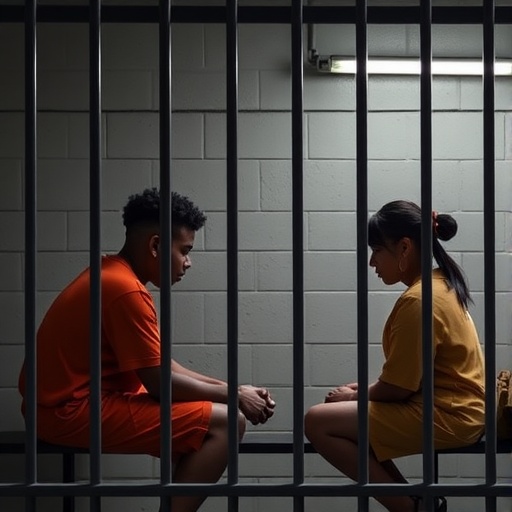
A recent study conducted by researchers at Florida Atlantic University (FAU), alongside a consortium of collaborators from prominent institutions, reveals critical flaws in the mental health screening tools widely used within juvenile correctional facilities in the United States. These tools, designed to identify depression and suicidality among incarcerated youth, demonstrate inconsistent reliability and validity, especially across different ethnic groups. Such disparities raise pressing concerns regarding their fairness and efficacy, underscoring the urgent need for reforms in mental health assessment practices within the juvenile justice system.
The mental health challenges faced by incarcerated youth in the U.S. are staggering in both prevalence and severity. Approximately 70% of these individuals suffer from a diagnosable mental disorder, with depression rates ranging from 10% to 25% for moderate to severe symptoms. Additionally, around 30% of incarcerated youth report suicidal ideation, while an alarming 12% have attempted suicide. Compounding these distressing statistics, nearly one-quarter endure solitary confinement – a practice strongly correlated with increased suicide risk. These sobering realities emphasize the vital role that accurate mental health screening must play at the point of intake.
Standard national guidelines advocate for comprehensive mental health screenings within juvenile detention settings to identify those in immediate need of care and to flag individuals at future risk for serious psychological deterioration. Early detection and intervention are paramount to preventing the escalation of mental health conditions, ensuring better long-term functioning and reducing suicide rates. Amid these recommendations, tools such as the Massachusetts Youth Screening Instrument – Second Version (MAYSI-2) and the Active Peer Support Screening Form (APS-SF) have become staples of assessment procedures, given their brevity and ease of administration.
Despite their widespread utilization, the psychometric integrity of these screening instruments has not been exhaustively scrutinized within the context of adjudicated youth, particularly when considering ethnic diversity. Reliability refers to the consistency of the tools’ measurements, while validity encompasses their ability to accurately capture the intended constructs — in this case, depression and suicidality. The FAU-led research team set out to assess both convergent validity (the extent to which the instruments correlate with other established measures of the same constructs) and divergent validity (their capacity to distinguish between related but separate conditions) across varied demographic cohorts.
Their comprehensive analysis, recently published in the peer-reviewed journal Behavioral Disorders, reveals significant gaps in the performance of these screening tools. Notably, the data reflect weaker validity scores for African American youth compared to their white counterparts. Quantitatively, depression-related measures scored approximately 0.1 points lower, while suicidality metrics were nearly 0.2 points lower among African American youth. These findings suggest that the tools are less adept at detecting mental health issues within minority populations, raising profound questions about cultural sensitivity and potential biases inherent in the assessments.
Such discrepancies carry tangible consequences. Since juvenile justice systems rely heavily on these screening outcomes to make critical decisions — from initiation of therapeutic interventions to placement and safety precautions — any systemic inaccuracies may perpetuate inequities. Misclassification or under-identification of mental health needs risks leaving vulnerable youth without necessary care, thereby exacerbating their distress and endangering their well-being. The study’s authors highlight this dilemma, stressing that failing to acknowledge and address these assessment inadequacies contradicts the rehabilitative philosophy foundational to juvenile corrections.
Dr. Joseph Calvin Gagnon, the lead investigator and chair of FAU’s Department of Special Education, articulates the gravity of these findings: “Accurate and equitable mental health screening stands at the core of effective rehabilitation. Our research indicates that current tools fall short in providing an unbiased evaluation for all youth, thereby hampering our ability to ensure safety and deliver appropriate treatment.” His cautionary remarks underscore the ethical imperatives surrounding mental health assessment, particularly in high-stakes environments like juvenile detention centers.
Beyond identifying validity concerns, the research advocates for enhancing screening methodologies. Given that instruments like the MAYSI-2 are brief questionnaires, there is a pressing need to augment these with multidimensional approaches—including systematic observations, comprehensive clinical interviews, and input from family members or caregivers. Integrating these diverse data sources could mitigate limitations linked to self-report biases or cultural misunderstandings inherent in standardized tools.
The study also calls attention to the necessity for larger, more demographically varied sample populations in future research. Expanding participant pools would not only improve the statistical power of psychometric evaluations but also facilitate development of culturally responsive adaptations or entirely novel screening instruments tailored to the heterogeneous populations within juvenile justice systems.
Moreover, the implications of these findings resonate beyond the confines of correctional psychology. They intersect with broader discussions surrounding justice, equity, and healthcare accessibility. Mental health assessments that insufficiently account for cultural and ethnic factors risk perpetuating systemic disparities. This study, therefore, contributes to an increasing body of evidence urging the field toward ethical reformulations that embrace fairness alongside accuracy.
The FAU study’s publication underlines a call to action for policymakers, clinicians, and juvenile justice administrators alike. Investing in valid and culturally sensitive screening tools is not simply a clinical imperative but a societal one, aiming to protect the mental health and future potential of thousands of at-risk adolescents. Addressing these challenges is paramount to ensuring that the juvenile justice system fulfills its rehabilitative mission rather than inadvertently compounding vulnerabilities.
Funded by the Institute of Education Sciences (IES), this collaborative work spans multiple institutions, including the University of Kansas, University of Florida, Georgia State University, and the University of North Carolina-Charlotte. Their collective expertise bridges clinical psychology, education, criminology, and behavioral science, lending robustness to the study’s multifaceted approach.
As the juvenile justice system grapples with these revelations, it becomes clear that relying solely on currently prevalent mental health screening tools without ongoing validation and cultural calibration may undermine efforts to safeguard vulnerable youth. The research published by FAU and collaborators sheds critical light on a key component of juvenile corrections, advocating for meaningful reform that aligns with both scientific rigor and social justice.
News Publication Date: 11-Jul-2025
Web References:
- Florida Atlantic University: www.fau.edu
- DOI Link: https://doi.org/10.1177/01987429251349130
References:
Gagnon, J.C., Quan, J., Daley, M.L., Huggins-Manley, C., Houchins, D.E., Lane, H.B., McCray, E.D., Lambert, R.G. (2025). Convergence, Divergence, and Predictive Validity in Depression and Suicidality Screening Tools with Adjudicated Youth Across Ethnicity. Behavioral Disorders. doi:10.1177/01987429251349130
Cite Scienmag News
Glenn Wilkins. (August 11, 2025). Study Calls for Overhaul of Mental Health Screening in Incarcerated Youth. Scienmag. https://scienmag.com/study-calls-for-overhaul-of-mental-health-screening-in-incarcerated-youth/
Glenn Wilkins. "Study Calls for Overhaul of Mental Health Screening in Incarcerated Youth." Scienmag, 11 August 2025, https://scienmag.com/study-calls-for-overhaul-of-mental-health-screening-in-incarcerated-youth/. Accessed 5 September 2026.
Glenn Wilkins. "Study Calls for Overhaul of Mental Health Screening in Incarcerated Youth." Scienmag. August 11, 2025. https://scienmag.com/study-calls-for-overhaul-of-mental-health-screening-in-incarcerated-youth/


