Middle school students who repeatedly revised a scientific explanation about the health of a local stream became markedly better at connecting scientific ideas with data to justify their claims, according to a new study published in Disciplinary and Interdisciplinary Science Education Research. The research, led by Ann M. Novak with David F. Treagust, tracked sixty seventh-grade students over a six-week period as they built four successive versions of an explanation about stream water quality, and it offers a detailed picture of how classroom scaffolding can push learners from reporting numbers toward genuine scientific reasoning.
The study sits within the framework of three-dimensional learning, an approach grounded in the Framework for K–12 Science Education that asks students to combine disciplinary core ideas, science and engineering practices, and crosscutting concepts. The authors argue that knowing scientific facts is not enough; what matters is usable knowledge, the kind learners can apply in new situations. In their design, reasoning within a scientific explanation has two parts: understanding the scientific ideas themselves, and connecting those ideas to data using crosscutting concepts such as cause and effect, systems, and patterns, so that the data actually counts as evidence for a claim.
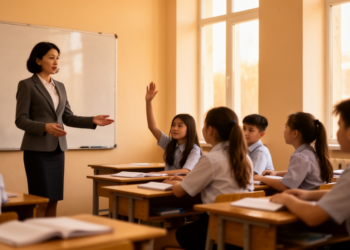
The instructional context was a project-based water quality unit that the first author has taught for more than 25 years. Students investigated a local stream, guided by two driving questions: how healthy the stream is for freshwater organisms, and how people’s actions on land might affect it. They collected four water quality measures over six weeks. The first explanation was written after measuring stream pH and temperature, before any formal instruction in the explanation framework. The second used the same data but came after students were introduced to the claim, evidence, and reasoning framework. Conductivity data entered the third explanation, written three weeks later, and dissolved oxygen data the fourth, written five weeks after that. Each measure carried its own set of scientific ideas, so the researchers treated each one as a new situation in which students had to apply what they had learned.
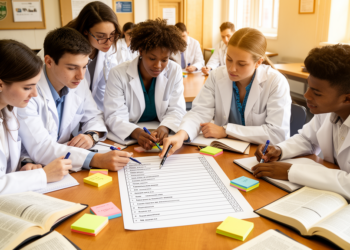
Support came from what the authors call synergistic scaffolds: scaffolded guide sheets whose detail faded over time, small-group work, whole-class discussions of the data, and individual electronic teacher feedback on the second and third explanations delivered through track changes. Students also used National Water Quality Standards to judge their results. Notably, the evidence itself grew more complicated as the unit progressed. The first two measures, pH and temperature, pointed to a healthy stream, but the conductivity results were poor, and the dissolved oxygen results were mixed, forcing students to confront evidence that contradicted their earlier claims.
To measure progress, the researchers scored the reasoning and claim portions of every explanation with a rubric verified by three water quality experts, achieving 88 percent inter-rater reliability before disagreements were negotiated to full agreement. Four research questions guided the analysis, using repeated-measures ANOVA and regression analyses on scores ranging from 51 to 58 participants. The first question asked whether students connected scientific ideas with data and made more such connections over time. The answer was clearly yes: mean connection scores rose after each iteration, with statistically significant differences across all four explanations for pH and temperature, and a significant paired-sample difference for conductivity between the third and fourth explanations.
A case study of one student, Elise, illustrates the trajectory. In her first temperature explanation she defined thermal pollution and reported her results but made no connections between scientific ideas and her data, earning zero points for connections. After the framework was introduced, her second explanation included many scientific ideas about the causes and consequences of thermal pollution, but she simply restated background material without tying it to her stream section, earning one of two possible points. Teacher feedback prompted her to relate erosion and heated surfaces to her own stream section. By the third explanation she had integrated the ideas with her evidence, discussing algae and nearby rooftops and parking lots in the context of her measurements, and earned full credit. The authors describe this progression as three forms of conceptual change: accretion as students added ideas, conceptual differentiation as they refined them, and conceptual integration as they reorganized the ideas into a coherent explanatory system.
The second research question examined whether students, once experienced, made more connections when analyzing entirely new data. Here too the results were statistically significant. When students first wrote about conductivity in the third explanation, they made significantly more connections than they had for pH and temperature in the second explanation, and dissolved oxygen connections in the fourth explanation were significantly greater than pH connections had been. Elise’s conductivity reasoning, bouncing between observations such as dead leaves, animal droppings, and fertilized grass and the scientific ideas of nitrogen and phosphorus and the death cycle that depletes oxygen, exemplified how most students transferred their learning to a new measure. The authors interpret this as evidence that students were prepared for future learning, extending earlier instruction to novel contexts.
The third research question probed whether understanding of scientific ideas supports the making of connections. Regression analyses for each water quality measure showed that connections depended on the level of scientific understanding, with statistical significance for every measure. The strongest single predictor was the fourth pH explanation, accounting for 56.5 percent of the variance with a beta coefficient of 0.757, followed by the third temperature explanation at 38.9 percent. When all measures within each explanation were pooled, the third explanation predicted 63.8 percent of the variance. The more relationships students saw among scientific ideas, the more connections they made to their data.
The fourth question, however, revealed a striking limitation. Neither scientific ideas nor connections predicted the claims students made in their final explanation. When the researchers examined what students actually based their claims on, pH dominated: pH scientific ideas predicted claims in the first explanation, temperature connections in the second, and pH connections in the third and fourth. When contradictory conductivity results arrived, the proportion of students making appropriate claims fell from 80 percent in the second explanation to 40 percent in the third. Some students adjusted their claims; others kept their original positive claim despite the new evidence; and a third group simply presented two contradictory claims side by side. Even by the final explanation, just over half of the students had not successfully adjusted their claims to reflect all four measures, though all students had made progress toward deeper understanding.
The authors suggest several possible explanations for this struggle, including the difficulty of letting go of prior ideas, the challenge of treating the stream as one integrated system rather than separate sub-systems, and students’ inexperience with revising their own work. They note that students were not asked to critique each other’s claims, and that reflection on claims was one task among many. The study’s limitations are candidly acknowledged: all participants came from a single college-preparatory school in a university community, there was no comparison group, and the teacher who developed and taught the curriculum was also the researcher. Even so, the findings carry a clear message for science educators. Combining an evolving explanation with sustained teacher feedback and fading scaffolds can help adolescents develop usable scientific knowledge and dramatically improve their reasoning, but helping students revise their claims when new evidence contradicts their thinking remains an open problem, and one the authors identify as a priority for future research, including studies of peer feedback, guided self-editing, and artificial intelligence as a feedback tool.
Subject of Research: How middle school students develop scientific reasoning by building and revising evidence-based explanations of stream water quality
Article Title: Developing deep knowledge by connecting scientific ideas with data through reasoning to support claims
Article References: Novak, A. M., & Treagust, D. F. (2026). Developing deep knowledge by connecting scientific ideas with data through reasoning to support claims. Disciplinary and Interdisciplinary Science Education Research, 8(1), Article 20. https://doi.org/10.1186/s43031-026-00164-0
Image Credits: AI Generated
DOI: 10.1186/s43031-026-00164-0
Keywords: scientific reasoning, science education, water quality, claim evidence reasoning, three-dimensional learning, project-based learning, crosscutting concepts, conceptual change, scaffolding, middle school, evolving explanation, teacher feedback
Cite Scienmag News
Courtney Benton. (October 29, 2026). Students Learn to Turn Water Data Into Evidence Through Evolving Explanations. Scienmag. https://scienmag.com/students-learn-to-turn-water-data-into-evidence-through-evolving-explanations/
Courtney Benton. "Students Learn to Turn Water Data Into Evidence Through Evolving Explanations." Scienmag, 29 October 2026, https://scienmag.com/students-learn-to-turn-water-data-into-evidence-through-evolving-explanations/. Accessed 31 October 2026.
Courtney Benton. "Students Learn to Turn Water Data Into Evidence Through Evolving Explanations." Scienmag. October 29, 2026. https://scienmag.com/students-learn-to-turn-water-data-into-evidence-through-evolving-explanations/