

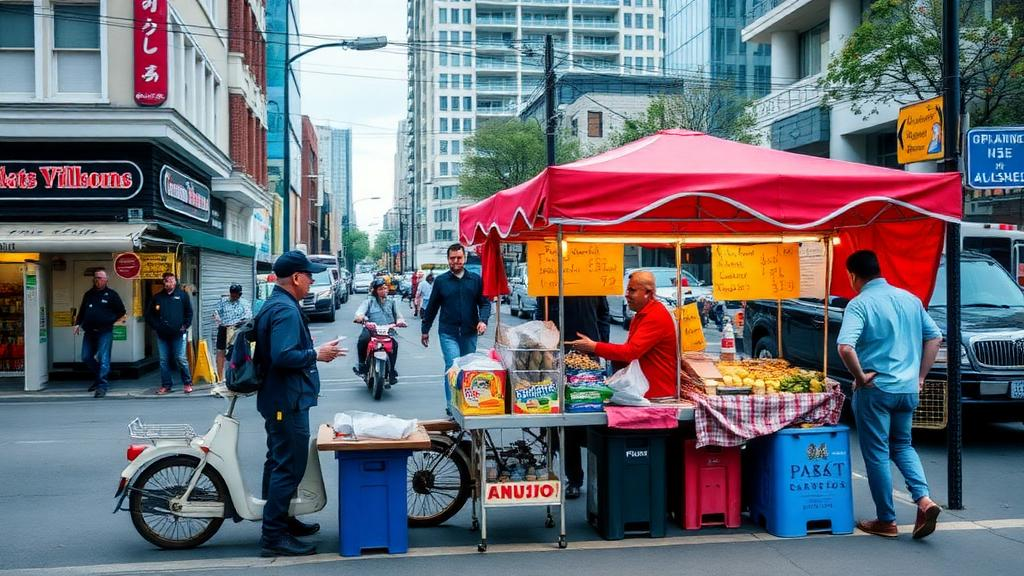
On a 310-metre stretch of road in Ratnapura, Sri Lanka, a team of researchers has uncovered something that city planners around the world have long overlooked: the informal street vendors who occupy the pavements are not marginal actors surviving at the edges of the urban economy. They are the most connected, most central, and most indispensable nodes in the entire economic network of the street. The study, published in Frontiers in Sociology, applied social network analysis to the daily interactions along Church Road and found that street vendors scored highest on every measure of network centrality, outperforming formal shop owners, schools, buyers, and even the municipal council itself.
The research team, led by Oshini Kularathne of the University of Moratuwa with colleagues at the University of Münster, focused on Church Road, a vital commercial corridor in the provincial capital of Sabaragamuwa Province. Ratnapura is a regional transport hub that draws more than 100,000 daily commuters, and Church Road links the Colombo-Ratnapura Main Road at Clock Tower Junction to Good Shed Road near the bus stand. Approximately 70 to 80 per cent of the vendors on this road operate informally, setting up their portable stalls, known locally as Thattuwa, in front of permanent shops or on pedestrian paths. The road is also home to formal institutions including St. Peter’s Church, St. Paul’s Church, and St. Aloysius College, making it an ideal setting to examine how informal and formal economic actors interact within shared urban space.
To capture these interactions, the researchers combined systematic observations conducted across three daily time periods with semi-structured interviews involving 30 participants, comprising 21 street vendors and 9 shop owners, recruited through snowball sampling. This method was chosen because the actors in the street vending economy form a hidden population that cannot be identified through conventional sampling strategies. Data collection continued until saturation was reached, meaning the final interviews confirmed relationship patterns already identified rather than revealing new categories. The qualitative data were then coded using Håkansson’s Economic Network Model, a framework originally developed to study inter-organizational business relationships, which decomposes each economic tie into three empirically codable layers: activity links covering technical and operational tasks, resource ties covering shared tangible and intangible assets, and actor bonds covering the relational quality between parties.
The coding revealed four distinct types of relationships between street vendors and formal urban actors. Direct relationships involve straightforward interaction, such as a formal textile shop allowing an umbrella seller to keep his vending structure in front of the shop and eat meals inside. Indirect relationships emerge as by-products of other activities, exemplified by a reed and rushware seller whose presence near a school creates a safer environment for children. Uni-directional relationships involve one-way flows of benefit, such as a vendor trading under the shade of a school wall without reciprocation. Bi-directional relationships are reciprocal and mutually beneficial, as when a vendor serves the daily needs of waiting parents while their presence simultaneously boosts the vendor’s business.
Once these coded relationships were translated into a node-and-edge dataset, the researchers constructed a social network diagram consisting of 12 nodes and 22 edges, where nodes represented actors such as street vendors, formal vendors, buyers, schools, pedestrians, gem traders, and the Ratnapura Municipal Council, and edges represented coded relationships weighted by directionality. The network was analysed using Social Network Visualizer software, with three centrality measures computed to evaluate the structural importance of each actor.
The results were striking. Street vendors achieved the highest degree centrality with a value of 31, indicating the largest number of direct connections to other actors, followed by formal vendors at 14 and St. Aloysius College and parents at 12 each. On betweenness centrality, which identifies actors occupying bridging positions between otherwise disconnected parts of the network, street vendors scored 62.5 while eight other nodes scored zero, meaning they were never on the path connecting other actors. On closeness centrality, which measures how near a node is to all others along shortest paths, street vendors again led with a value of 29, ahead of formal vendors at 15. Street vendors were thus simultaneously the most connected, the most bridging, and the most proximate actors in the network.
These quantitative findings align with the qualitative evidence gathered during observation and interviews. Street vendors connect daily with goods distributors, interact with a popular tea shop, store their merchandise overnight at designated locations such as Nawathena, pay a daily fee of 50 rupees to the municipal council, and serve gem traders who gather at Clock Tower Junction. Formal shop owners acknowledged that the presence of vendors attracts customers who perceive the area as offering abundant and affordable goods, generating indirect benefits for the permanent businesses. Vendors also assist formal shops with loading and unloading goods, navigate buyers to formal premises, and provide shade for parents and schoolchildren waiting outside the college.
The study’s findings contribute novel insights to social network analysis research by demonstrating patterns of socio-economic relationships between street vendors and formal urban actors that had not previously been disaggregated into structural types. The researchers note that their results align with studies from Bandung City in Indonesia and the Peruvian Amazon, which similarly found street vendors embedded in dense webs of commercial and social ties, while contradicting earlier Sri Lankan research that emphasized contestation of public space, suggesting that cooperative and contested relations vary considerably depending on the specific urban setting.
The implications for urban planning and policy are significant. The researchers argue that street vendors should be recognized as legitimate stakeholders in urban governance rather than merely as unauthorized users of public space. Because vendors occupy central positions within urban economic networks, interventions such as relocation or eviction may have cascading effects on formal businesses, customers, and suppliers. The informal economy contributes roughly 40 per cent of global GDP and provides two-thirds of global employment, and the study’s authors contend that acknowledging and incorporating informal networks can aid in formulating policies that foster inclusive and robust urban economic development, consistent with the Sustainable Development Goals on poverty reduction, economic prosperity, inequality reduction, and inclusive cities.
The authors acknowledge limitations, including the dependence on a single geographic area and a comparatively limited number of participants, which may not fully encompass the range of street vending dynamics. They recommend further research across multiple urban contexts, broader quantitative studies to provide statistical foundations for targeted policies, and investigation of how technology and digital platforms influence the street vending industry. Nevertheless, the underlying socio-economic relationships between street vendors, formal vendors, and urban users identified in Ratnapura are likely relevant to cities across the Global South with comparable spatial and economic conditions, where recurring daily activity patterns and vending concentrations around transport hubs, schools, and markets shape the temporal dynamics of informal trading.
Subject of Research: Urban Sociology
Article Title: Interdependent urban economies: a network analysis of socio-economic relationships between street vendors and formal businesses in Ratnapura, Sri Lanka
Article References: Kularathne, O., Meetiyagoda, L., Sooriyagoda, K., & Akalanka, N. (2026). Interdependent urban economies: a network analysis of socio-economic relationships between street vendors and formal businesses in Ratnapura, Sri Lanka. Frontiers in Sociology, 11, Article 1882601. https://doi.org/10.3389/fsoc.2026.1882601
Image Credits: AI Generated
DOI: 10.3389/fsoc.2026.1882601
Keywords: street vendors, social network analysis, informal economy, urban planning, Ratnapura, Sri Lanka, Håkansson Economic Network Model, centrality measures, urban sociology, Global South, Interdependent, urban
Cite Scienmag News
Scienmag. (October 15, 2026). Street Vendors Are the Hidden Hubs Holding Urban Economies Together. https://scienmag.com/street-vendors-are-the-hidden-hubs-holding-urban-economies-together/
Scienmag. "Street Vendors Are the Hidden Hubs Holding Urban Economies Together." Scienmag, 15 October 2026, https://scienmag.com/street-vendors-are-the-hidden-hubs-holding-urban-economies-together/. Accessed 15 October 2026.
Scienmag. "Street Vendors Are the Hidden Hubs Holding Urban Economies Together." Scienmag. October 15, 2026. https://scienmag.com/street-vendors-are-the-hidden-hubs-holding-urban-economies-together/


