


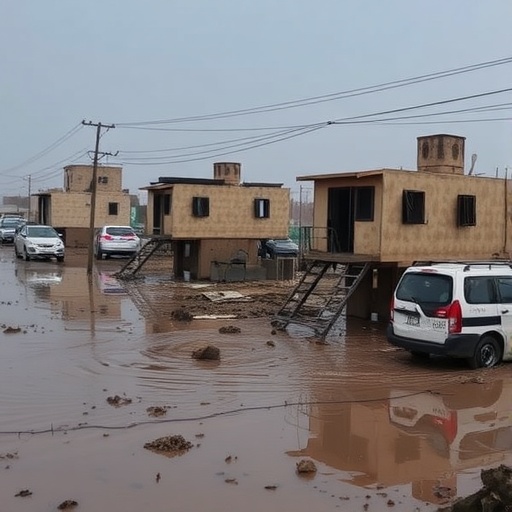
In late 2025, Storm Daniel unleashed catastrophic flooding across Libya, leaving a trail of destruction that exposed critical vulnerabilities in urban infrastructure and disaster response systems. A recent study published in npj Urban Sustainability by Fawzy, Heggy, Szabo, and colleagues presents a comprehensive analysis of the drivers behind this hydrological disaster and underscores the urgency for a state-of-the-art rapid assessment system to mitigate future risks.
Storm Daniel was characterized by an unprecedented convergence of climatic factors, including intense rainfall exceeding historical norms for the region. This was compounded by Libya’s unique topography – marked by arid landscapes with sparse vegetation, which typically limits water infiltration and promotes surface runoff. The combination of these elements resulted in flash floods that overwhelmed urban drainage systems, infrastructure, and flood defenses that were neither designed nor maintained for such extreme weather events.
The researchers detail how the storm’s aftermath unmasked systemic weaknesses in urban planning and water management. One of the most striking technical findings was the inadequate capacity of stormwater infrastructure to handle surges in volumetric flow rates, a consequence of rapid urban expansion without commensurate upgrades to critical physical systems. Moreover, sedimentation and debris accumulation further impaired water channels, amplifying flooding severity.
Through hydrodynamic modeling and remote sensing data, the study illustrates the spatiotemporal dynamics of flood propagation, revealing key flood hotspots where the combination of geomorphology and anthropogenic factors created bottlenecks. These insights highlight the necessity for integrating advanced geospatial technologies and sensor networks into urban flood monitoring frameworks.
The implications of the flooding extend beyond immediate physical damage. Severe disruptions to critical services such as water supply, electricity, and healthcare markedly affected resilience and recovery trajectories in affected communities. The authors argue that current disaster response protocols are ill-equipped to provide timely, data-driven decision support during fast-evolving crises like Storm Daniel.
To address these challenges, the article advocates for developing a rapid assessment system leveraging artificial intelligence, real-time hydrometeorological data, and community-based reporting mechanisms. Such a system would enable early warnings, dynamic risk assessments, and efficient resource deployment. Importantly, it calls for a multidisciplinary approach, uniting climatologists, urban planners, engineers, and policymakers to build adaptive, sustainable urban environments.
This study not only sheds light on the complex interplay of natural and anthropogenic factors fueling extreme flood events in arid urban landscapes but also serves as a clarion call for innovative solutions. As climate change continues to intensify weather extremes globally, Libya’s experience exemplifies the imperative of proactive resilience-building in vulnerable urban centers.
With its technical rigor and forward-looking recommendations, the work by Fawzy et al. sets a new benchmark in urban sustainability research, underscoring the transformative potential of rapid assessment technologies in safeguarding lives and infrastructure against future hydrometeorological disasters.
Cite Scienmag News
Sloane Callahan. (July 8, 2026). Storm Daniel Flooding in Libya Highlights Urgent Need for Rapid Assessments. Scienmag. https://scienmag.com/storm-daniel-flooding-in-libya-highlights-urgent-need-for-rapid-assessments/
Sloane Callahan. "Storm Daniel Flooding in Libya Highlights Urgent Need for Rapid Assessments." Scienmag, 8 July 2026, https://scienmag.com/storm-daniel-flooding-in-libya-highlights-urgent-need-for-rapid-assessments/. Accessed 3 September 2026.
Sloane Callahan. "Storm Daniel Flooding in Libya Highlights Urgent Need for Rapid Assessments." Scienmag. July 8, 2026. https://scienmag.com/storm-daniel-flooding-in-libya-highlights-urgent-need-for-rapid-assessments/


