


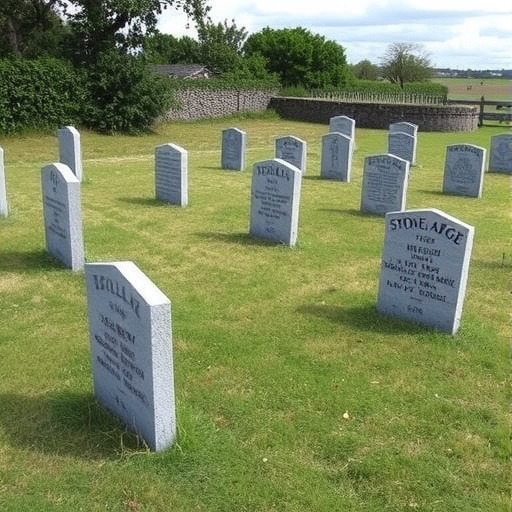
In the quiet landscape of Gotland, Sweden, a groundbreaking genetic study has unveiled surprising insights into the social fabric of a 5,500-year-old hunter-gatherer community. Archaeologists and geneticists at Uppsala University have unraveled complex family relationships buried beneath the soil of the Ajvide grave site, one of Scandinavia’s most significant Stone Age locations. The findings challenge conventional assumptions about kinship structures in prehistoric burial practices and highlight the intricate awareness these early people had about extended family lineage.
The Ajvide site holds 85 known graves, with several containing multiple individuals. Among these, four graves became the focus of intensive DNA analysis, revealing nuanced familial connections that extend beyond immediate family units. Contrary to the long-held belief that people buried together were usually parents and children or siblings, the genetic data indicate that many individuals buried in close proximity were second or third-degree relatives, such as cousins, great-aunts, and half-siblings.
One of the most striking discoveries came from a grave containing a young woman in her twenties, flanked on both sides by two children—a boy and a girl aged about four and a year and a half, respectively. Genetic testing confirmed that the children were full siblings but not her offspring. Instead, she seemed to be related as their aunt or half-sister, a finding that reflects sophisticated recognition of extended family bonds within their social organization. This configuration suggests burial rituals were carefully designed to maintain these wider family connections, providing a glimpse into their societal values.
Another grave contained the remains of a young individual and an adult male placed alongside her, but likely moved from another location. Genetic evidence clarified their relationship: the adult male was the girl’s biological father. This individual grave, containing two generations, provides valuable insight into how family members might have been grouped together within burial practices, emphasizing paternal lineage acknowledgment and possibly migration or relocation of graves within the community.
In a third burial, two children—a boy and a girl—were interred side by side, but genetic analysis reflected a more distant familial bond, characterized as third-degree relatives. This likely equates to cousins, implying that even non-sibling children were carefully grouped and recognized in death. Such practices suggest that the social fabric of this hunter-gatherer community extended beyond the nuclear family, with kinship bonds that fostered extended family connections over time.
The fourth examined grave consisted of a girl and a young woman buried together, also determined to be third-degree relatives. The relationship may have been that of a great-aunt and niece or cousins, further reinforcing the pattern of extended family recognition in burial customs. These findings collectively underscore that co-burial rituals in this Neolithic hunter-gatherer culture were deeply intertwined with a sophisticated understanding of genetic relatedness, going beyond what was previously anticipated.
This pilot genetic study, the first of its kind among Scandinavian Neolithic hunter-gatherers, leverages advances in archaeogenetics that enable researchers to extract and analyze ancient DNA from skeletal remains, such as teeth and bone fragments. These genetic techniques allow identification of biological sex by detecting sex chromosomes, and kinship is established by measuring the proportional sharing of genetic material. First-degree relatives share roughly 50% of their DNA, second-degree around 25%, and third-degree relatives about 12.5%. These precise metrics form the backbone of interpretation for ancient family structures.
One of the most remarkable aspects of this research is its contribution to understanding social organization long before written history and formalized agriculture. While much of Europe had transitioned by this period into farming societies, the hunter-gatherers of Gotland maintained a distinct cultural and genetic identity. Their burial rites, incorporating extensive kinship awareness, suggest complex social rules and familial obligations that informed their rituals around death and memory.
The Ajvide site is especially notable for its preservation, which offers rare opportunities to study ancient hunter-gatherer populations who usually left minimal genetic and archaeological traces. This research expands the scope of prehistoric cultural understanding, moving beyond simplistic perspectives of hunter-gatherer groups as small, isolated units to reveal a networked community bound by extended family ties.
The interdisciplinary nature of the study—combining archaeology, genetics, and anthropology—exemplifies the evolving field of archaeogenetics, which brings new life to ancient remains far removed in time. Continuing investigations at Ajvide, which involve more than 70 individuals, promise to provide even deeper insights into the life histories, social dynamics, and ritual landscapes of this enigmatic Stone Age people.
By clarifying the kinship patterns visible in co-burials, this research challenges outdated assumptions about prehistoric burial practices and emphasizes the importance of genetic relatedness in ritual behavior. It reveals that the Neolithic hunter-gatherers at Ajvide were fully cognizant of their familial lineage and intentionally reflected these relationships in their mortuary customs.
Moreover, these findings have broader implications for understanding how kinship and social identity were constructed in prehistoric societies, illuminating the role of extended family networks in community cohesion and cultural continuity. As research develops, it may reshape interpretations of social complexity in prehistoric contexts across Northern Europe and beyond.
Groundbreaking studies like this underscore the power of genetics to reveal the social landscapes of ancient peoples, weaving together stories from mere fragments of bone to craft a narrative of kinship, memory, and community in a distant era.
News Publication Date: 18-Feb-2026.
Web References:
Proceedings of the Royal Society B Biological Sciences, DOI: 10.1098/rspb.2025.0813
Cite Scienmag News
Juliet Wilcox. (February 18, 2026). Stone Age Graves on Gotland Reveal Ancient Family Ties. Scienmag. https://scienmag.com/stone-age-graves-on-gotland-reveal-ancient-family-ties/
Juliet Wilcox. "Stone Age Graves on Gotland Reveal Ancient Family Ties." Scienmag, 18 February 2026, https://scienmag.com/stone-age-graves-on-gotland-reveal-ancient-family-ties/. Accessed 3 September 2026.
Juliet Wilcox. "Stone Age Graves on Gotland Reveal Ancient Family Ties." Scienmag. February 18, 2026. https://scienmag.com/stone-age-graves-on-gotland-reveal-ancient-family-ties/


