


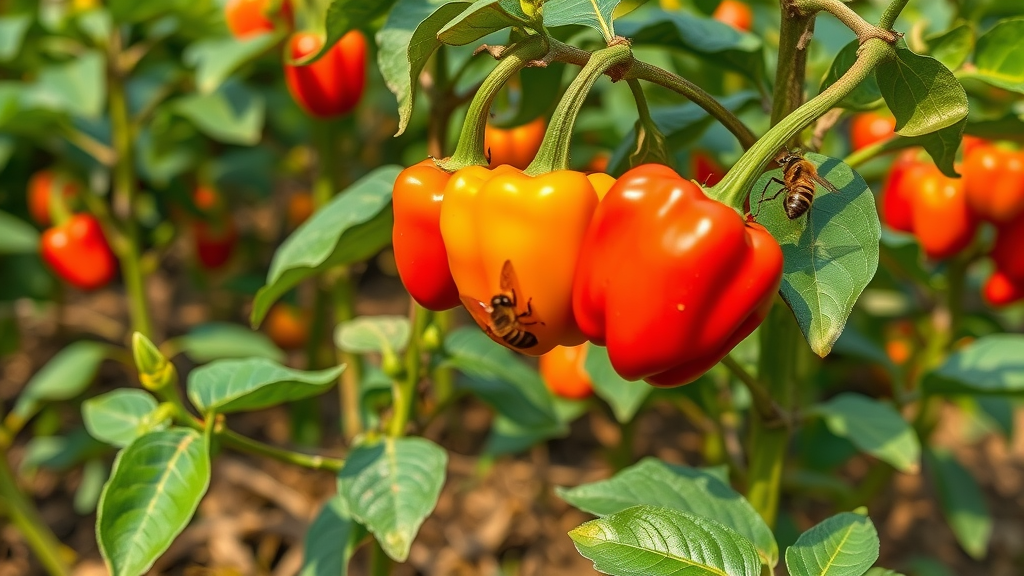
A tiny, stingless bee may hold the key to bigger, better chili harvests in eastern India. A new field study from West Bengal has documented, for the first time in detail, the community of insects that visit the flowers of chili pepper (Capsicum frutescens L.) in the region, and has tested whether managed colonies of the stingless bee Tetragonula pagdeni Schwarz can push yields higher. The results, published in The Science of Nature, show that chili pepper in this part of India is heavily dependent on animal pollination, and that supplementing natural pollination with managed stingless bee colonies significantly improved both the quantity and the quality of the crop. At a time when pollinator declines are raising alarms about global food production, the findings point to a practical, locally adapted tool that farmers can deploy to safeguard and boost one of the world’s most valuable spice crops.
The research team, led by Ujjwal Layek of Rampurhat College together with Trisha Bhandari and Prakash Karmakar of Vidyasagar University and Joydeb Maji of Siliguri College, set out to fill a basic knowledge gap. Although chili pepper is cultivated across millions of smallholder plots in South and Southeast Asia, the wild pollinators serving the crop in West Bengal had never been systematically catalogued. At the same time, stingless bees of the tribe Meliponini, which are already managed for honey production in parts of tropical Asia and Latin America, had received comparatively little attention as commercial pollinators for Indian vegetable crops. The researchers therefore designed the study around two linked questions: which insects actually visit chili flowers in the field, and how much does deliberate pollination by the stingless bee T. pagdeni improve fruit set, fruit weight and overall yield.
Chili pepper flowers present a genuine challenge for pollinators. Like several other members of the nightshade family, including tomato and eggplant, Capsicum species release their pollen through poricidal anthers, small pollen sacs that open through tiny pores at the tips rather than splitting freely along their length. This means that pollen is not simply sitting on the flower surface waiting to be brushed off by any passing insect. Instead, effective pollination usually requires buzz pollination, a behaviour in which a bee grasps the flower and rapidly vibrates its flight muscles, shaking pollen out of the pores in a fine jet that lands on the bee’s body. Not all flower visitors can perform this trick. Butterflies and wasps, however frequently they may sip nectar, generally cannot extract pollen efficiently from poricidal anthers, which makes the identity and behaviour of the bee community particularly important for this crop.
Across the study fields in West Bengal, the researchers recorded a diverse assemblage of floral visitors. Bees dominated the visitor community, and this group included honeybees, a range of solitary ground-nesting and stem-nesting species, and stingless bees. Butterflies and wasps also appeared at the flowers, adding to the visible bustle around the plants, but the analysis of pollination performance told a more selective story. The most abundant and, crucially, the most effective pollinators turned out to be four bee species: the sweat bee Lasioglossum cavernifrons, the nomiine bees Nomia (Hoplonomia) elliotii and Nomia strigata, and the stingless bee Tetragonula pagdeni. These species combined high visitation frequency with the ability to handle the flowers in a way that actually transferred pollen, a distinction that the authors emphasise as central to understanding pollination service.
That distinction matters because visitation alone can be a misleading measure of pollination value. Previous work in pollination ecology has shown that a flower can be visited many times without being effectively pollinated if the visitors fail to contact the reproductive structures or cannot release pollen from specialized anthers. By evaluating both abundance and pollination efficiency, the study was able to rank the visitor community in terms of real contribution to fruit production rather than mere foot traffic. The result was a clear hierarchy in which a handful of bee species carried most of the pollination load, while other frequent visitors contributed little. For farmers and land managers, this kind of ranking is actionable information: conserving the specific habitats and nesting resources that support the key species is likely to matter far more than attracting a generally diverse but functionally shallow visitor community.
The study also quantified just how dependent chili pepper is on its pollinators. The crop exhibited a high degree of pollinator dependence for yield, echoing earlier findings from southern India, where researchers reported that chili fruit set relies strongly on wild pollinators. In crops with poricidal dehiscence and limited capacity for self-pollination without mechanical assistance, this dependence is not surprising, but documenting it rigorously in a new region strengthens the case for pollinator-centred management. Where pollinators are scarce, chili plants can set fewer and poorer fruits, and the shortfall is not easily compensated by fertilizer or irrigation. Pollination, in other words, is a yield-limiting input in its own right, and the West Bengal data place it firmly on the list of factors that farmers must manage deliberately.
The most striking practical result came from the experiments with managed stingless bee colonies. When T. pagdeni colonies were placed in the chili fields as supplementary pollinators, the treatment significantly enhanced both the quality and the quantity of the yield compared with plots that relied on natural pollination alone. Stingless bees are well suited to this role in several respects. They are small enough to work efficiently inside the modest flowers of Capsicum, they forage persistently over relatively short distances, they can be kept in hives close to or within cropping areas, and, as their name suggests, they lack the painful sting that makes honeybee management daunting for many smallholders. Their colonies also store honey and pollen, giving farmers a secondary product alongside the pollination service.
The West Bengal findings fit into a growing body of evidence that stingless bees can serve as effective managed pollinators for Solanaceous and other tropical crops. Earlier studies have documented yield benefits from stingless bee pollination in greenhouse chili in Malaysia, in tomato and chili in Indonesia, and in fennel and watermelon in earlier field studies by members of the same Indian research group. The new work extends this record to Capsicum frutescens under open-field conditions in eastern India and identifies a native stingless bee species already present in the regional fauna. Using a locally native pollinator carries ecological advantages as well: it avoids some of the risks that introduced honeybees can pose to native pollinator communities, and it ties crop pollination directly to the conservation of indigenous bee populations.
The authors frame managed stingless bee pollination as a promising approach for yield optimisation within sustainable agricultural systems, and the implications reach beyond chili. Global assessments have estimated that a large share of the world’s food crop production depends, at least in part, on animal pollination, and that pollinator decline threatens both yields and farm incomes. In India, where smallholder vegetable and spice production underpins rural livelihoods and domestic food supply, low-cost pollination interventions could deliver outsized benefits. Meliponiculture, the keeping of stingless bees, is already a traditional practice in parts of the country, and the new results suggest a route by which that tradition could be integrated with vegetable farming to mutual advantage: hives positioned in chili fields gain forage, while the crop gains pollination and the farmer gains yield.
There are, of course, practical questions that remain. Scaling up stingless bee pollination will require reliable colony multiplication, farmer training in hive management, and attention to the landscape factors, such as pesticide exposure and habitat loss, that threaten wild pollinators in the first place. The study’s authors note that understanding the diversity of pollinators is essential for optimising crop yields amid ongoing pollinator decline, and their catalogue of West Bengal’s chili flower visitors provides exactly the baseline data that conservation and management planning require. For now, the message from the fields of West Bengal is clear and encouraging: the smallest bees in the community, the ones that cannot sting, may be among the most valuable allies a chili farmer has, and putting them to work could turn a pollination deficit into a harvest surplus.
Subject of Research: Pollinator diversity and stingless bee pollination of chili pepper in West Bengal, India
Article Title: Flower visitors of chili pepper (Capsicum frutescens L.) in West Bengal and assessing yield enhancement by stingless bee (Tetragonula pagdeni Schwarz) pollination
Article References: Layek, U., Bhandari, T., Maji, J., & Karmakar, P. (2026). Flower visitors of chili pepper (Capsicum frutescens L.) in West Bengal and assessing yield enhancement by stingless bee (Tetragonula pagdeni Schwarz) pollination. The Science of Nature, 113(5), Article 115. https://doi.org/10.1007/s00114-026-02167-3
Image Credits: AI Generated
DOI: 10.1007/s00114-026-02167-3
Keywords: chili pepper, stingless bees, Tetragonula pagdeni, pollination, crop yield, plant-pollinator interaction, meliponiculture, West Bengal, supplementary pollination, pollinator decline, sustainable agriculture, Capsicum frutescens
Cite Scienmag News
Julie Wynn. (September 20, 2026). Stingless Bees Supercharge Chili Pepper Yields in West Bengal Fields. Scienmag. https://scienmag.com/stingless-bees-supercharge-chili-pepper-yields-in-west-bengal-fields/
Julie Wynn. "Stingless Bees Supercharge Chili Pepper Yields in West Bengal Fields." Scienmag, 20 September 2026, https://scienmag.com/stingless-bees-supercharge-chili-pepper-yields-in-west-bengal-fields/. Accessed 4 October 2026.
Julie Wynn. "Stingless Bees Supercharge Chili Pepper Yields in West Bengal Fields." Scienmag. September 20, 2026. https://scienmag.com/stingless-bees-supercharge-chili-pepper-yields-in-west-bengal-fields/


