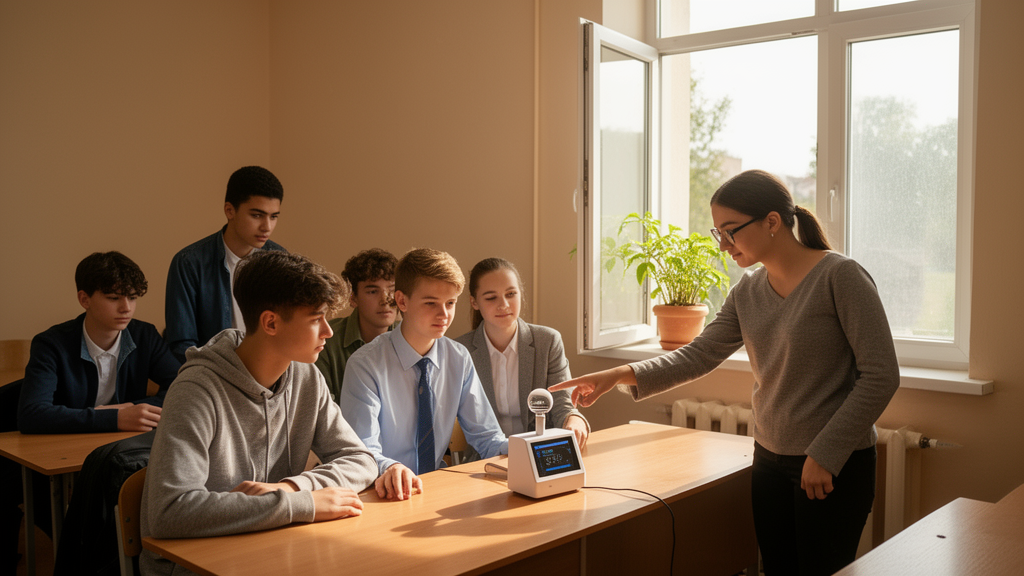
A short, hands-on STEM programme on indoor air quality produced immediate gains in students’ self-reported knowledge and behaviour-related responses across schools in Nepal, Malaysia, Indonesia and Guangxi, China, according to a new cross-national study published in Aerosol and Air Quality Research.
The research, led by Wen-Jing Deng, Jiayue Sun and Wingkei Ho with John Chi-Kin Lee, used a one-group quasi-experimental design to examine pre-test to post-test changes immediately after the programme. The analytic sample comprised 1,027 paired primary and secondary school students from Grades 1 to 9, drawn from 11 schools across the four regions.
Students in all four regions reported statistically significant immediate increases in self-reported perceived indoor air quality knowledge and in behaviour-related response scores following the programme, with all Holm-adjusted p values below 0.001. The largest changes were seen in perceived knowledge, where the mean item-score change ranged from 0.48 in Guangxi, China to 1.39 in Nepal. Changes in behaviour scores ranged from 0.33 to 0.75.
Not every dimension moved equally. Changes in attitudes and expectations were smaller, and the attitude change observed in Guangxi, China was not statistically significant. The authors suggest that short-term, practice-based STEM education on indoor air quality was associated with immediate increases in perceived knowledge and behaviour-related responses, but was less likely to produce immediate shifts in more stable affective and longer-term dimensions.
To go beyond simple pre-post comparisons, the researchers applied longitudinal generalized estimating equation (GEE) models to test whether the magnitude of change differed across regions over time. The overall interaction between time and region was statistically significant for all four dimensions, with the strongest evidence observed for perceived knowledge.
The study’s authors are careful to flag the limits of the design. Because the sampling was purposive and full metric invariance was not achieved, comparisons of the magnitude of score changes across regions should be regarded as exploratory. The one-group design also means the findings describe within-student changes before and after the programme rather than effects verified against a control group.
Indoor air quality has major implications for health and everyday environmental exposure, yet the authors note that it remains insufficiently examined in environmental education, particularly in cross-national research on multidimensional learning outcomes.
The article was published as open access on 20 September 2026 and is currently shared as a peer-reviewed, accepted manuscript that carries a permanent DOI and remains subject to further editorial edits before the final Version of Record. The study had recorded 77 accesses at the time of writing.
The authors conclude that context-sensitive, practice-based indoor air quality education holds potential value for environmental learning, and that sustained interventions are needed to support longer-term attitudinal and behavioural change among students.
Subject of Research: Cross-national evaluation of a STEM-based indoor air quality education programme on students' knowledge, behaviour and attitudes
Article Title: Cross-national Evaluation of STEM-Based Indoor Air Quality (IAQ) Education for Sustainable Development
Article References: Deng, W.-J., Sun, J., Ho, W., & Lee, J. C.-K. (2026). Cross-national Evaluation of STEM-Based Indoor Air Quality (IAQ) Education for Sustainable Development. Aerosol and Air Quality Research. https://doi.org/10.1007/s44408-026-00168-5
Image Credits: AI Generated
DOI: 10.1007/s44408-026-00168-5
Keywords: indoor air quality, STEM education, environmental education, quasi-experimental study, Nepal, Malaysia, Indonesia, China, students, pre-post comparison, GEE models, sustainable development
Cite Scienmag News
Russell Cooper. (October 28, 2026). STEM Lessons Boost Students’ Indoor Air Quality Knowledge in Four Countries. Scienmag. https://scienmag.com/stem-lessons-boost-students-indoor-air-quality-knowledge-in-four-countries/
Russell Cooper. "STEM Lessons Boost Students’ Indoor Air Quality Knowledge in Four Countries." Scienmag, 28 October 2026, https://scienmag.com/stem-lessons-boost-students-indoor-air-quality-knowledge-in-four-countries/. Accessed 30 October 2026.
Russell Cooper. "STEM Lessons Boost Students’ Indoor Air Quality Knowledge in Four Countries." Scienmag. October 28, 2026. https://scienmag.com/stem-lessons-boost-students-indoor-air-quality-knowledge-in-four-countries/