


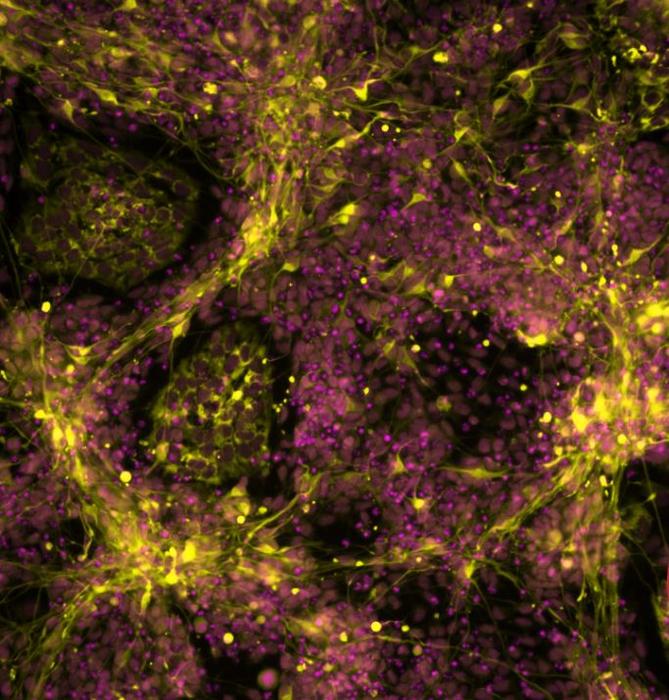
Scientists have discovered a new insight into the genetic pathway of childhood cancer, offering new hope for tailored treatments.

Credit: Image recorded by Dr. Ingrid Saldana
Scientists have discovered a new insight into the genetic pathway of childhood cancer, offering new hope for tailored treatments.
Researchers from the University of Sheffield have created a stem cell model designed to investigate the origins of neuroblastoma, a cancer primarily affecting babies and young children.
Neuroblastoma is the most common childhood tumour occurring outside the brain, affecting the lives of approximately 600 children in the European Union and the United Kingdom each year.
Until now, studying genetic changes and their role in neuroblastoma initiation has been challenging due to the lack of suitable laboratory methods. A new model developed by researchers at the University of Sheffield, in collaboration with the St Anna Children’s Cancer Research Institute in Vienna, replicates the emergence of early neuroblastoma cancer-like cells, giving an insight into the genetic pathway of the disease.
The research, published in Nature Communications, sheds light on the intricate genetic pathways which initiate neuroblastoma. The international research team found that specific mutations in chromosomes 17 and 1, combined with overactivation of the MYCN gene, play a pivotal role in the development of aggressive neuroblastoma tumours.
Childhood cancer is often diagnosed and detected late, leaving researchers with very little idea of the conditions that led to tumour initiation, which occurs very early during foetal development. In order to understand tumour initiation, models which recreate the conditions that lead to the appearance of a tumour are vital.
The formation of neuroblastoma usually starts in the womb when a group of normal embryonic cells called ‘trunk neural crest (NC)’ become mutated and cancerous.
In an interdisciplinary effort spearheaded by stem cell expert Dr Ingrid Saldana from the University of Sheffield’s School of Biosciences and computational biologist Dr Luis Montano from the St Anna Children’s Cancer Research Institute in Vienna, the new study found a way in which to use human stem cells to grow trunk NC cells in a petri dish.
These cells carried genetic changes often seen in aggressive neuroblastoma tumours. Using genomics analysis and advanced imaging techniques, the researchers found that the altered cells started behaving like cancer cells and looked very similar to the neuroblastoma cells found in sick children.
The findings offer new hope for the creation of tailored treatments that specifically target the cancer while minimising the adverse effects experienced by patients from existing therapies.
Dr Anestis Tsakiridis, from the University of Sheffield’s School of Biosciences and lead author of the study, said: “Our stem cell-based model mimics the early stages of aggressive neuroblastoma formation, providing invaluable insights into the genetic drivers of this devastating childhood cancer. By recreating the conditions that lead to tumour initiation, we will be able to understand better the mechanisms underpinning this process and thus design improved treatment strategies in the longer term.
“This is very important as survival rates for children with aggressive neuroblastoma are poor and most survivors suffer from side effects linked to the harsh treatments currently used, which include potential hearing, fertility and lung problems”.
Dr. Florian Halbritter, from St. Anna Children’s Cancer Research Institute and second lead author of the study, said: “This was an impressive team effort, breaching geographic and disciplinary boundaries to enable new discoveries in childhood cancer research.”
This research supports the University of Sheffield’s cancer research strategy. Through the strategy, the University aims to prevent cancer-related deaths by undertaking high quality research, leading to more effective treatments, as well as methods to better prevent and detect cancer and improve quality of life.
Journal
Nature Communications
Method of Research
Computational simulation/modeling
Subject of Research
Human embryos
Article Title
A human neural crest model reveals the developmental impact of neuroblastoma-associated chromosomal aberrations
Article Publication Date
3-May-2024
Cite Scienmag News
Nathaniel Bowman. (May 14, 2024). Stem cells provide new insight into genetic pathway of childhood cancer. Scienmag. https://scienmag.com/stem-cells-provide-new-insight-into-genetic-pathway-of-childhood-cancer/
Nathaniel Bowman. "Stem cells provide new insight into genetic pathway of childhood cancer." Scienmag, 14 May 2024, https://scienmag.com/stem-cells-provide-new-insight-into-genetic-pathway-of-childhood-cancer/. Accessed 3 September 2026.
Nathaniel Bowman. "Stem cells provide new insight into genetic pathway of childhood cancer." Scienmag. May 14, 2024. https://scienmag.com/stem-cells-provide-new-insight-into-genetic-pathway-of-childhood-cancer/

