


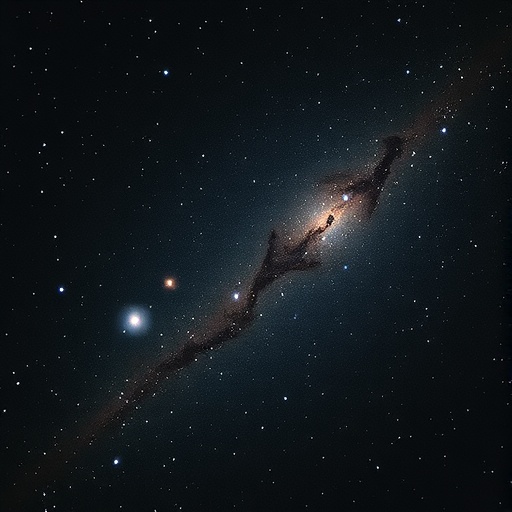
In a groundbreaking revelation that reshapes our understanding of one of the night sky’s most iconic star clusters, a team of astronomers has uncovered that the familiar Pleiades constellation—often referred to as the Seven Sisters—is merely the luminous heart of an immense and sprawling stellar complex. This complex, now named the Greater Pleiades Complex, extends across nearly 2,000 light-years and comprises over 3,000 stars, significantly enlarging the scale and scope of what was once thought to be a modest cluster. These findings have been achieved through a novel combination of data from NASA’s Transiting Exoplanet Survey Satellite (TESS), the European Space Agency’s Gaia spacecraft, and the extensive Sloan Digital Sky Survey (SDSS).
The Pleiades cluster has held a special place in human culture and observation since antiquity. Its seven most visible stars have been used to navigate, tell stories, and benchmark astronomical observations for millennia. However, the intricate cosmic relationships underpinning this cluster have remained elusive. The new study provides compelling evidence that the Pleiades is only the central, densest concentration within a much broader familial group of stars that originated from the same primordial stellar nursery. This discovery challenges long-standing conceptions and opens new pathways for tracing stellar origins and their evolutionary pathways.
Stars are born from vast molecular clouds, composed of gas and dust, that collapse under gravity to ignite nuclear fusion in their cores. Star formation typically occurs in bursts, producing groups or clusters of stars in close proximity. These nascent clusters remain gravitationally bound for a period ranging from millions to hundreds of millions of years. However, over time, processes such as cosmic winds, intense radiation, and supernova explosions expel the surrounding star-forming material, causing clusters to gradually disperse into their host galaxies. Identifying the membership and origin of these dispersed stars presents a substantial challenge, particularly after over 100 million years, when typical clustering signatures have faded.
The key innovation by the research team lies in their innovative use of stellar rotation rates as a temporal and genealogical marker. It is well established that stars gradually slow their rotation as they age, owing to magnetic braking and stellar wind interactions. By combining precise measurements of stellar rotation from TESS, which primarily seeks exoplanets via transit detection but also monitors minute brightness variations due to starspots, with Gaia’s exceptional astrometric data, which captures stellar positions and movements with unprecedented precision, the researchers developed a rotation-based chronometer. This method enables the identification of stars that share a common birth origin, even when spatial clustering is no longer apparent.
Moreover, the incorporation of chemical abundance data from the SDSS provided another crucial layer of verification. Stars forged from the same molecular cloud exhibit chemically homogeneous signatures, and this spectral fingerprinting confirmed that the Greater Pleiades Complex stars share remarkably similar elemental compositions. This chemical tagging, together with kinematic and rotational data, allowed the team to disentangle the complex web of stellar relationships and confidently extend the boundaries of the cluster far beyond previous estimates.
This multidisciplinary approach revealed that the Greater Pleiades Complex encompasses at least five distinct stellar populations, three of which were previously identified but never linked into a single structure. The two additional groups identified represent new members of this stellar family, bridging gaps and illuminating the dynamic history of star formation in this region of the Milky Way. Collectively, these stars trace their common ancestry to a gargantuan star-forming region that existed roughly 100 million years ago.
The implications of this discovery are profound. By redefining the spatial and temporal extent of the Pleiades, astronomers gain a richer context for modeling how star clusters evolve, dissipate, and integrate into galactic populations. Furthermore, this work demonstrates the transformative power of combining heterogeneous datasets—kinematics, rotation, and chemistry—to decode complex astrophysical histories that were previously inscrutable.
On a broader scale, the methodology pioneered here heralds a new era in stellar archaeology, allowing researchers to age-date vast populations of stars scattered throughout our galactic neighborhood. Such advances will not only refine our understanding of the Milky Way’s structure and stellar demographics but also enhance the search for exoplanet-hosting stars with shared evolutionary histories.
Looking forward, this technique could be extended to study other prominent clusters and associations, potentially unveiling a network of interconnected stellar families. This network, woven from the remnants of ancient molecular clouds, encapsulates the lifecycle of star birth and migration across the galaxy, offering invaluable insights into the dynamics that shape the cosmos.
The study exemplifies how coordinated ground- and space-based observations, combined with sophisticated analytical frameworks, push the frontier of astrophysics. The era of viewing star clusters as isolated entities is giving way to a more nuanced understanding of their embeddedness within vast, complex stellar ecosystems.
Ultimately, the Greater Pleiades Complex serves as a stellar testament to the interconnectedness of cosmic structures. The stars we have long admired individually are, in essence, siblings separated by space but united by their shared origins. This revelation enriches not only our scientific knowledge but also the cultural and poetic narratives inspired by the glittering tapestry of the night sky.
News Publication Date: 12-Nov-2025
Web References:
DOI: 10.3847/1538-4357/ae0724
Keywords
Greater Pleiades Complex, Pleiades cluster, stellar rotation, TESS, Gaia, Sloan Digital Sky Survey, stellar archaeology, star clusters, stellar evolution, molecular clouds, star formation, galactic structure
Cite Scienmag News
Bethany Barker. (November 12, 2025). Stellar siblings: The Pleiades emerge from a colossal star-forming event. Scienmag. https://scienmag.com/stellar-siblings-the-pleiades-emerge-from-a-colossal-star-forming-event/
Bethany Barker. "Stellar siblings: The Pleiades emerge from a colossal star-forming event." Scienmag, 12 November 2025, https://scienmag.com/stellar-siblings-the-pleiades-emerge-from-a-colossal-star-forming-event/. Accessed 4 September 2026.
Bethany Barker. "Stellar siblings: The Pleiades emerge from a colossal star-forming event." Scienmag. November 12, 2025. https://scienmag.com/stellar-siblings-the-pleiades-emerge-from-a-colossal-star-forming-event/


