


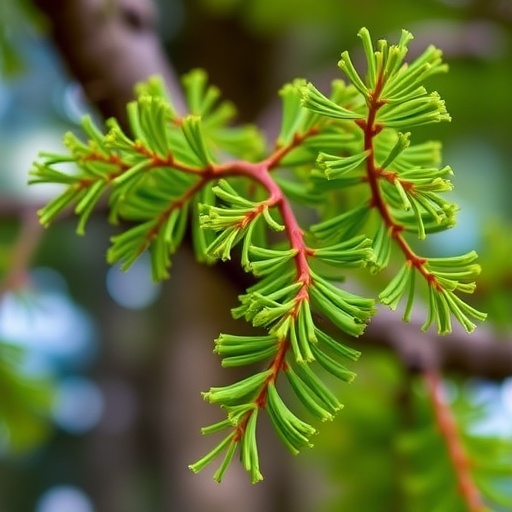
Taxol, also known as paclitaxel, has stood as a cornerstone chemotherapy agent for decades, revolutionizing treatments for ovarian, breast, and lung cancers worldwide. Despite its critical role in oncology, the current approach to Taxol production faces substantial limitations. Taxol is primarily harvested by extracting baccatin III, its chemical precursor, from the slow-growing yew trees. These trees’ languid growth rates impose bottlenecks on yield, limiting the drug’s availability in the face of soaring global demand. The molecule’s chemical complexity further complicates efforts at fully synthetic manufacturing, which remains prohibitively expensive and technically challenging.
Scientists have long pursued an alternative: harnessing the enzymatic machinery that yew trees use to assemble Taxol naturally. Unlocking these enzymes would enable transferring their genetic blueprints into fast-growing industrial microorganisms, like yeast, converting them into microbial factories that produce Taxol on scales far surpassing what nature offers. However, the yew’s vast and convoluted genome, which dwarfs typical bacterial chromosomes with around 50,000 genes, obscures the precise genetic components fueling Taxol biosynthesis. Prior progress had identified a dozen key genes but fell short of elucidating a complete pathway capable of synthesizing Taxol or even baccatin III at commercially viable levels.
In a landmark study published in Nature on June 11, 2025, researchers from Stanford University unveiled a pioneering method to sift through the abundant genetic data of yew trees to pinpoint enzymes critical to Taxol production. The team, led by postdoctoral scholar Conor McClune and senior author Elizabeth Sattely, leveraged a novel system inspired by recent advances in single-nucleus RNA sequencing. This technique enabled them to probe gene expression patterns from thousands of individual nuclei harvested from stressed yew needle cells, unraveling the intricate molecular choreography underlying defensive chemical synthesis, including Taxol.
The methodology combined biological mimicry and molecular genetics, exposing yew needles to elicitors such as plant hormones and microbial agents that triggered defensive responses. This simulated environmental stress flipped the genetic switches that stimulate Taxol-related biosynthetic pathways. Extracted nuclei then underwent RNA sequencing to catalog active messenger RNAs, revealing which genes were being transcribed concurrently — a strong indication of their collaborative roles in assembling the Taxol molecule. Through iterative filtering, the researchers expanded the known gene set from twelve to twenty-two, identifying eight new enzymes vital for various biosynthetic stages.
Among these discoveries, the enzyme dubbed FoTO1 emerged as a crucial piece that enhances the efficiency and directionality of the biosynthetic flow. Its function is akin to a molecular conductor, orchestrating chemical conversions that funnel intermediates toward baccatin III formation. Notably, when these enzymes were expressed in tobacco plants, the resulting baccatin III accumulation surpassed natural concentrations found in yew trees, underscoring the potential for optimized production outside the native host.
The research extended beyond baccatin III, pushing further down the biosynthetic route to Taxol itself. One previously elusive enzyme catalyzing an intermediate step bridging baccatin and Taxol was characterized, bringing the complete enzymatic pathway tantalizingly close to full assembly. Complementary work from the University of Copenhagen in April 2025 identified the final two enzymatic steps, effectively completing the enzymatic puzzle. Collectively, the twenty-two genes now recognized encapsulate the yew’s complete genetic recipe for Taxol biosynthesis.
This comprehensive gene set promises to transform industrial drug manufacture. By inserting these genes into microbes such as yeast, researchers can engineer strains capable of converting simple substrates into Taxol efficiently, sustainably, and at scale. This microbial fermentation strategy would obviate the need for harvesting yew trees, preserving natural resources while meeting clinical demands. Prior constraints imposed by slow plant growth and difficult synthetic chemistry would give way to flexible, controllable, and potentially cost-effective biosynthesis using bioreactors.
Validation efforts remain underway, with the Stanford team focused on verifying the compatibility and activity of the final enzymatic steps within heterologous plant systems like tobacco. Success in these validations would clear the path toward complete microbial synthesis pipelines. Such engineered organisms could revolutionize the supply chain for Taxol, ensuring robust availability for cancer patients worldwide.
Beyond Taxol, this innovative single-nucleus RNA sequencing approach opens new frontiers for decoding plant metabolism. Many agriculturally important crops harbor vast repositories of enzymes performing yet-to-be-discovered chemistries with pharmaceutical and industrial relevance. The ability to isolate and analyze thousands of individual nuclei under controlled elicitation conditions offers an unprecedented window into the metabolic lexicon encoded within plant genomes. Future applications may unlock novel pathways for synthesizing valuable compounds ranging from nutraceuticals to biofuels.
Elizabeth Sattely, an associate professor of chemical engineering and Howard Hughes Medical Institute investigator, highlighted the significance of these advancements: “Taxol has been the holy grail of biosynthesis in the plant natural products world. Being able to use a bioproduction strategy to manufacture a molecule like Taxol is a really exciting prospect.” Her team’s collaborative efforts, involving experts across bioengineering, genetics, and chemical biology, exemplify the integrated approach needed to tackle complex natural product challenges in the genomics era.
Equally important, this research embodies the growing synergy between synthetic biology and traditional plant science. By reverse-engineering nature’s intricate enzymatic toolkits, it becomes possible to transcend inherent biological limitations, synthesizing powerful medicines more sustainably and economically. Researchers anticipate that this momentum will spur greater exploration into how plant genomes encode chemical innovation, with implications for human health, agriculture, and green chemistry.
As the biotechnology landscape evolves, the successful microbial production of Taxol could serve as a flagship model for applying gene discovery and engineering workflows to other rare and valuable natural products. This prospect not only addresses supply constraints but also aligns with environmental stewardship goals by reducing reliance on slow-growing and ecologically sensitive plant species.
In sum, the unveiling of the full enzymatic ensemble responsible for Taxol biosynthesis marks a watershed moment in both fundamental plant biology and applied pharmaceutical manufacturing. It represents years of meticulous experimentation, vast data analysis, and biological ingenuity converging on a singular goal: ensuring life-saving chemotherapy drugs can be produced efficiently and sustainably for generations to come. The promise of transforming yew tree chemistry into microbial factories heralds an exciting new chapter in natural product biosynthesis, with ramifications that extend well beyond medicinal chemistry.
News Publication Date: 11-Jun-2025
Web References:
- https://www.nature.com/articles/s41586-025-09090-z
- https://www.nature.com/articles/s44160-025-00800-z
References:
Stanford University research team led by Conor McClune and Elizabeth Sattely, published in Nature, June 11, 2025.
Cite Scienmag News
Nathaniel Bowman. (June 18, 2025). Stanford Researchers Identify Missing Yew Tree Enzymes Crucial for Producing Common Cancer Drug. Scienmag. https://scienmag.com/stanford-researchers-identify-missing-yew-tree-enzymes-crucial-for-producing-common-cancer-drug/
Nathaniel Bowman. "Stanford Researchers Identify Missing Yew Tree Enzymes Crucial for Producing Common Cancer Drug." Scienmag, 18 June 2025, https://scienmag.com/stanford-researchers-identify-missing-yew-tree-enzymes-crucial-for-producing-common-cancer-drug/. Accessed 5 September 2026.
Nathaniel Bowman. "Stanford Researchers Identify Missing Yew Tree Enzymes Crucial for Producing Common Cancer Drug." Scienmag. June 18, 2025. https://scienmag.com/stanford-researchers-identify-missing-yew-tree-enzymes-crucial-for-producing-common-cancer-drug/


