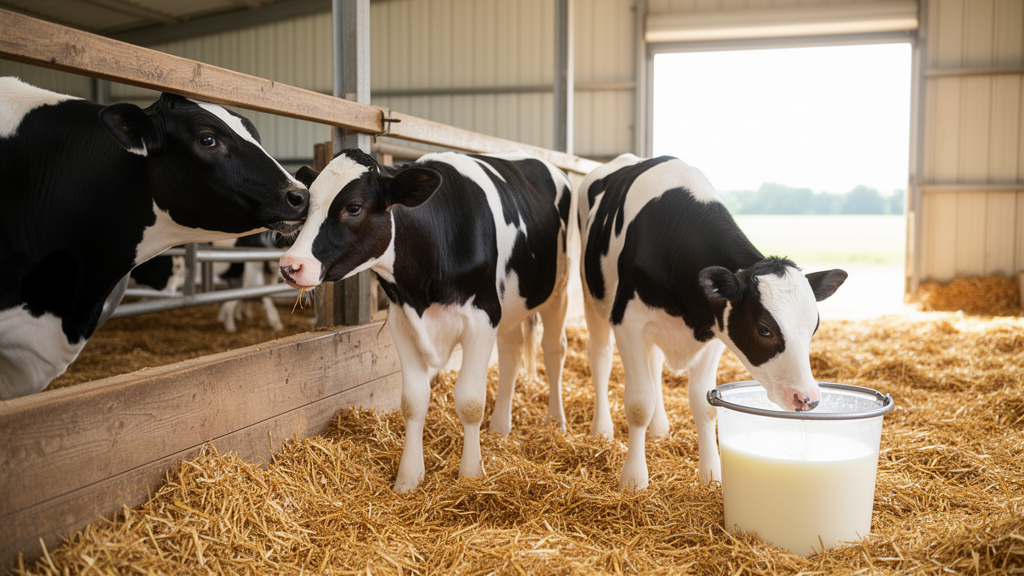
Keeping newborn calves with their mothers has become one of the most debated questions in dairy farming, with studies repeatedly suggesting that calves raised alongside their dams grow faster and sometimes stay healthier than calves separated at birth and fed by people. A new study from Germany now argues that much of that apparent advantage may be an artifact of how the comparisons have been designed. When artificially reared calves were given a standardized colostrum protocol and allowed to drink nearly as much whole milk as they wanted, they grew just as well and stayed just as healthy as calves that spent their whole day with the herd, according to research published in Dairy Science and Management.
The experiment was conducted at the research farm of the Thünen Institute of Organic Farming in Germany across two experimental periods, from August 2023 to April 2024 and from August 2024 to April 2025. The researchers followed 41 German Holstein calves through the first nine weeks of life. Twenty-four calves had whole-day contact with their dams in the dairy herd, able to reach the cow area through a transponder-controlled selection gate for roughly 17 hours per day outside milking times. Seventeen calves were reared artificially, separated from their dams within 24 hours of birth and fed whole milk through an automatic milk feeder that dispensed up to 16 liters per day.
A central feature of the design was that every calf, regardless of treatment, received the same colostrum management. Within the first hours after birth, all calves were offered 4 liters of colostrum through a teat bottle, either thawed colostrum from the herd’s colostrum bank or fresh colostrum from their own dam, in both cases with a Brix refractometer reading above 22 percent, a threshold used to discard poor-quality colostrum. Video recordings of the calving pens showed that calves were fed colostrum on average about 2.1 hours after birth, and only a small minority of calves managed to suckle their dams before staff arrived with the bottle. The researchers note that visually confirming that a calf is nursing may not guarantee a satisfying colostrum intake, which is why they argue that active, protocol-driven colostrum feeding should be applied in cow-calf contact systems just as it is in artificial rearing.
The results on passive immunity were clear. Blood serum Brix values, a reliable on-farm indicator of antibody transfer, did not differ between the artificially reared calves, at 9.5 plus or minus 0.4 percent Brix, and the contact calves, at 8.9 plus or minus 0.3 percent Brix, a difference that was not statistically significant. Higher Brix values in the colostrum fed to a calf predicted higher serum Brix values, while colostrum intake, birth weight, whether the calf had suckled before bottle feeding, and the age at blood sampling had no detectable effect. In other words, calves that stayed with their mothers did not suffer from failure of passive immunity transfer when caretakers took charge of colostrum delivery, addressing one of the main welfare criticisms raised against cow-calf contact systems.
The study also asked whether the presence of a suckling calf in the calving pen changes the quality of the milk the dam produces in the first days after calving, a question the authors say had received limited attention. It did not. Calf contact had no effect on the Brix values of either the colostrum collected at the first milking after birth or the transition milk collected at the second and third milkings. Brix values did decline predictably with each successive milking, from 22.5 percent at the first milking to 16.2 percent at the second and 13.4 percent at the third, and multiparous cows produced milk with Brix values about 2.0 percent higher than first-time mothers. Transition milk matters because it still contains substantial immunoglobulins and supports intestinal development and growth, and in this study both groups of calves could benefit from it equally.
Growth outcomes challenged the pattern reported in much of the earlier literature. Average daily gain increased with calf age but did not differ between treatments: artificially reared calves gained 987 plus or minus 55 grams per day while contact calves gained 1,051 plus or minus 46 grams per day, a non-significant difference. By the end of the observation period, at roughly 67 days of age, calves in both groups weighed nearly identically, at about 108 kilograms. The key to this equivalence, the researchers argue, lies in the milk allowance. Control calves consumed on average 10.3 liters of milk per day from the feeder, visiting it about 5.6 times daily, a frequency closely matching the natural suckling rhythm of dam-reared calves. Only rarely did a calf drink the full 16-liter ration, suggesting the allowance functioned as near ad libitum feeding rather than a ceiling.
This matters because previous studies comparing whole-day contact calves with artificially reared calves typically fed the separated calves far less milk, sometimes only 8 or 10.5 liters per day, and reported that the contact calves grew faster. Other work had already shown that when artificially reared calves received 12 to 14 liters of whole milk, the growth advantage of contact calves disappeared. Because milk is the main source of metabolizable energy for young calves whose rumens are not yet fully developed, the authors conclude that restrictive feeding, not the absence of the mother, explains the slower growth seen in many earlier comparisons. They recommend that future studies comparing the two rearing systems provide artificially reared calves with at least 16 liters of whole milk per day during the first two months of life, and note that older calves may need even more.
Health outcomes also failed to favor either system. Weekly health scores, compiled from rectal temperature and clinical symptoms such as nasal discharge, ocular discharge, coughing, and navel inflammation, did not differ between treatments. The number of calves receiving at least one veterinary treatment was similar in both groups, and of 35 diarrhea tests performed across the study, only 7 were positive for rotavirus infection, with no difference between treatments. The authors suggest that several factors protected both groups equally: all dams were vaccinated before calving, all calves received high-quality colostrum and transition milk, and all calves shared the same calf area, meaning artificially reared calves may have been exposed to the same pathogens carried back from the cow herd by contact calves. Interestingly, health scores were higher in the first experimental period than in the second, which the authors attribute to a barn renovation between periods that included replacing rubber mats and leaving the facility empty of animals, potentially reducing infection pressure.
The broader implication of the study is methodological. The authors point out that most published comparisons of cow-calf contact and artificial rearing have confounded the effect of maternal contact with differences in milk allowance, colostrum management, and housing, making it difficult to draw firm conclusions about contact itself. By holding colostrum management constant, housing both groups in the same calf area, and offering separated calves milk near ad libitum, this experiment isolated the effect of dam contact more cleanly than most previous work, and found that contact conferred no measurable growth or health advantage under these conditions. The findings do not mean that cow-calf contact systems lack benefits; enabling natural behavior remains a central motivation, and the European Food Safety Authority recommends keeping calves with their dams for at least one day after birth. But the study does suggest that where farmers separate calves, generous milk feeding and disciplined colostrum protocols can deliver equivalent early-life performance, and that researchers evaluating contact systems should adopt these standards before attributing differences in calf development to the presence of the mother herself.
Subject of Research: Effects of cow-calf contact versus artificial rearing on colostrum quality, passive immunity, growth, and health of dairy calves
Article Title: Improving consistency in cow-calf contact studies: the benefits of a protocol for colostrum supply and near ad libitum milk feeding for separated calves
Article References: Gillet, R., Hartung, E., & Barth, K. (2026). Improving consistency in cow-calf contact studies: the benefits of a protocol for colostrum supply and near ad libitum milk feeding for separated calves. Dairy Science and Management, 3(1), Article 3. https://doi.org/10.1186/s44363-026-00025-1
Image Credits: AI Generated
DOI: 10.1186/s44363-026-00025-1
Keywords: cow-calf contact, dairy calves, colostrum, passive immunity, milk feeding, calf growth, calf health, automatic milk feeder, Brix refractometry, transition milk, diarrhea, German Holstein
Cite Scienmag News
Violet Maxwell. (October 27, 2026). Standardized colostrum protocol and generous milk allowance erase growth gaps between dam-reared and artificially reared dairy calves. Scienmag. https://scienmag.com/standardized-colostrum-protocol-and-generous-milk-allowance-erase-growth-gaps-between-dam-reared-and-artificially-reared-dairy-calves/
Violet Maxwell. "Standardized colostrum protocol and generous milk allowance erase growth gaps between dam-reared and artificially reared dairy calves." Scienmag, 27 October 2026, https://scienmag.com/standardized-colostrum-protocol-and-generous-milk-allowance-erase-growth-gaps-between-dam-reared-and-artificially-reared-dairy-calves/. Accessed 28 October 2026.
Violet Maxwell. "Standardized colostrum protocol and generous milk allowance erase growth gaps between dam-reared and artificially reared dairy calves." Scienmag. October 27, 2026. https://scienmag.com/standardized-colostrum-protocol-and-generous-milk-allowance-erase-growth-gaps-between-dam-reared-and-artificially-reared-dairy-calves/