


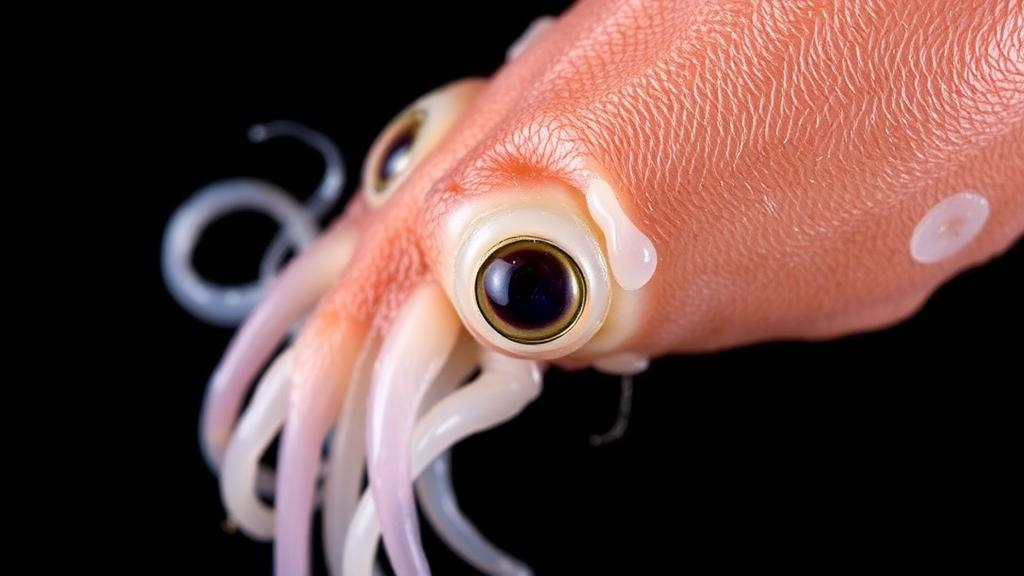
In a discovery that could reshape how scientists study human deafness, researchers at Case Western Reserve University have found that squid are covered from head to tail in specialized sensory cells remarkably similar to the ones buried deep inside the human ear that make hearing possible. Scientists have known for years that squid carry cells bearing bundles of tiny, hair-like protrusions on their heads and arms, structures that echo the hair cells of the mammalian cochlea. What the new study reveals is far more striking: hundreds more of these cells, known as hair cells, line the entire surface of the squid’s body, forming an anatomical map that no one had fully charted until now. The work, published in Current Biology, presents the first complete body-wide mapping of the lateral lines on squid, the arrays of hair cells that these animals use to sense their watery surroundings.
The implications reach well beyond cephalopod biology. In humans, the ability to hear depends on the cochlea, a snail-shaped organ in the inner ear that is lined with thousands of hair cells. Each of these cells carries a bundle of minute, hair-like projections called stereocilia. When sound vibrations reach the cochlea, they set these protrusions in motion, and the hair cells, which are wired directly into the nervous system, transmit messages to the brain where they are ultimately converted into meaningful sound. Because these delicate bundles cannot regenerate in humans, damage to them is a leading cause of permanent hearing loss, whether it occurs at birth or develops later in life.
Brian McDermott, associate professor at the Case Western Reserve School of Medicine, who led the research team, framed the significance of the finding in terms of both basic biology and human medicine. Squid, he noted, are cephalopods with a diverse population of hair cells on the surface of their bodies, a feature that may yield insights not only into how these fascinating animals detect water movement to survive, but also into how hearing and deafness occur in humans. The parallel is more than superficial. Sea creatures, including fish and cephalopods such as squid and octopuses, carry similar bundles of cilia on their bodies because their survival appears to depend on sensing different frequencies of water movement, much as the human ear detects different pitches of sound. In that sense, the skin of a squid seems to function like an ear spread across its entire body.
What makes the squid version of this sensory system especially valuable as a research model is a subtle but crucial difference from fish. The team’s work indicates that, unlike fish lateral lines, which have hair bundles that do not vary in length, squid appear to regulate the length of their hair bundles to tune individual cells to different frequencies. This is strikingly reminiscent of the organization of the human cochlea, where the bundles of stereocilia are taller in regions that detect low pitches and shorter where high pitches are detected. That graded architecture is what allows each hair cell to respond preferentially to a particular frequency of sound, and its presence in squid suggests that the underlying principles of frequency tuning may be shared across very distant branches of the animal tree.
This tuning similarity is precisely why the researchers see squid as a promising model for studying how human hearing works. Often, when a child is born deaf or a hearing person loses their hearing, it is the hair bundle that has been damaged, McDermott explained. Studying the squid’s hair bundle, he argued, holds promise for understanding how hearing loss occurs. Because squid hair cells are distributed across an accessible external surface rather than sealed inside the temporal bone, they offer an unprecedented experimental window into structures that are extraordinarily difficult to observe in living humans.
The discovery itself was made possible by an advanced imaging technique known as light sheet microscopy. The method uses a laser to create a thin sheet of light, illuminating just one plane of a specimen at a time. By capturing image after image in this way, researchers can build detailed three-dimensional reconstructions of entire biological structures while minimizing the phototoxic damage that conventional imaging inflicts on delicate tissue. For a specimen as large and structurally complex as a squid, this gentle, plane-by-plane illumination proved decisive, allowing the team to visualize hair cell distributions across the whole animal rather than in isolated fragments.
The research was conducted in part at the Marine Biological Laboratory in Woods Hole, Massachusetts, where McDermott’s team, which included Case Western Reserve graduate and undergraduate students, worked through a three-year fellowship program dedicated to studying how squid hear. At Woods Hole, the group collaborated with Carsten Wolff, associate director of Imaging Service and Imaging Scholar at the Marine Biological Laboratory, whose imaging expertise supported the light sheet work that revealed the full extent of the squid’s hair cell array. An image of a squid captured at the laboratory using light sheet microscopy documents the finding, showing hair cells distributed over the entire body rather than confined to the head and arms as previously understood.
The anatomical map that emerged from this effort carries the title of the published paper, An anatomical map of squid lateral lines, and it establishes for the first time the full layout of these sensory arrays in a cephalopod. Lateral lines are familiar to biologists from fish, where they run along the flanks and head and detect water displacement, currents, and the movement of prey and predators. The squid version, now shown to be far more extensive than earlier work suggested, appears to serve a comparable survival function, giving the animal a body-wide sense of the shifting water around it. The diversity of hair cell populations across that surface hints at a level of sensory sophistication that researchers are only beginning to appreciate.
For hearing science, the value of the squid model lies in the combination of accessibility and relevance. Human cochlear hair cells are hidden within one of the hardest bones in the body, are present in limited numbers, and do not regenerate once damaged, which makes direct study of living human hair bundles nearly impossible. Animal models have therefore long been essential to hearing research, but the most common laboratory organisms do not reproduce the graded frequency tuning of the mammalian cochlea in their peripheral hair cells. Squid, with hair bundles whose lengths vary in a way that mirrors cochlear organization, may allow scientists to examine how bundles are built, maintained, and damaged under conditions that are directly relevant to human deafness.
The research also underscores how much remains to be learned from animals that are often studied for other reasons. Cephalopods have long fascinated biologists for their camouflage, their behavior, and their unusually large nervous systems, yet their peripheral sensory world has remained poorly charted. The finding that the entire body surface of a squid functions as a frequency-tuned sensory sheet adds a new dimension to that picture and suggests that the evolutionary solutions to detecting water movement may converge on the same structural principles that evolution arrived at independently in the vertebrate ear. If the squid’s hair bundles can illuminate the mechanisms by which human hair bundles fail, the humble squid swimming off the coast of Massachusetts may end up contributing to one of medicine’s most persistent challenges: understanding, and ultimately preventing, the loss of hearing.
Subject of Research: Full-body mapping of frequency-tuned hair cells in squid lateral lines and their relevance to human hearing research
Article Title: Newly discovered hair cells on squid may offer clues to understand hearing loss in humans
Article References: Newly discovered hair cells on squid may offer clues to understand hearing loss in humans. (n.d.). Original publication
Image Credits: AI Generated
DOI: Not provided
Keywords: squid, hair cells, hearing loss, cochlea, stereocilia, lateral lines, light sheet microscopy, Marine Biological Laboratory, Current Biology, cephalopods, frequency tuning, Case Western Reserve University
Cite Scienmag News
Drew Townsend. (October 1, 2026). Squid Skin Is Covered in Hair Cells That Could Reveal How Human Hearing Fails. Scienmag. https://scienmag.com/squid-skin-is-covered-in-hair-cells-that-could-reveal-how-human-hearing-fails/
Drew Townsend. "Squid Skin Is Covered in Hair Cells That Could Reveal How Human Hearing Fails." Scienmag, 1 October 2026, https://scienmag.com/squid-skin-is-covered-in-hair-cells-that-could-reveal-how-human-hearing-fails/. Accessed 4 October 2026.
Drew Townsend. "Squid Skin Is Covered in Hair Cells That Could Reveal How Human Hearing Fails." Scienmag. October 1, 2026. https://scienmag.com/squid-skin-is-covered-in-hair-cells-that-could-reveal-how-human-hearing-fails/


