


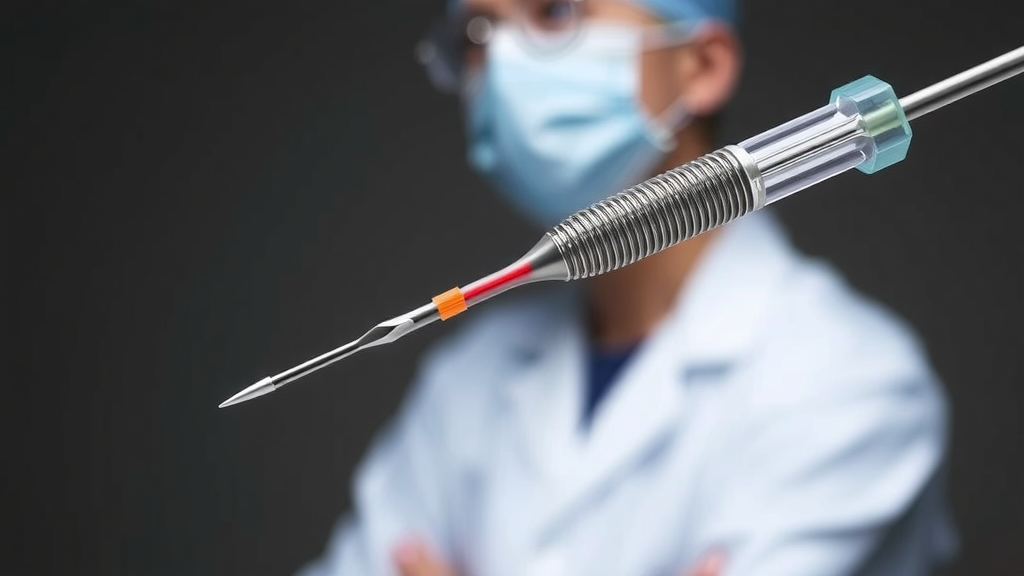
For patients diagnosed with a small kidney tumor, the traditional pathway has often meant two separate procedures: first a needle biopsy to confirm what the mass actually is, and then, days or weeks later, a treatment to destroy it. A new study from interventional radiologists at the University General Hospital Attikon in Athens suggests that both steps can be safely compressed into a single session, with the help of an ingeniously simple piece of engineering: a coaxial guide needle tipped with a spring-loaded, blunt stylet that pushes vessels and delicate structures aside rather than cutting through them. The research, published in CVIR Oncology, reports a 100 percent diagnostic yield and encouraging two-year cancer control in a small cohort of patients treated with combined biopsy and microwave ablation.
The retrospective study, spanning 2022 to 2023, enrolled 15 patients with a mean age of 67.8 years who carried 17 renal tumors with an average diameter of 2.77 centimeters. All lesions were classified as stage T1, meaning they were confined to the kidney, with the large majority falling into the smaller T1a category. Every case was reviewed and approved by a multidisciplinary tumor board of urologists, medical and radiation oncologists, and interventional radiologists, and all patients gave informed written consent before undergoing the combined procedure under computed tomography guidance.
The technical heart of the approach lies in the coaxial guide itself. A 15-gauge introducer fitted with a spring-loaded blunt-tip stylet is advanced through the skin and into the tumor under sequential CT scans. Because the tip is blunt rather than cutting, it displaces tissue planes and, according to prior preclinical work, can even be pushed against arterial walls without breaching them, a property that matters enormously in the kidney, where tumors frequently sit near vessels, the urine-collecting system, or the bowel. Once the guide is anchored in the lesion, an 18-gauge biopsy needle is passed down its lumen to harvest two core samples from each tumor.
With the tissue secured, the biopsy needle is withdrawn and a 16-gauge microwave antenna is slid through the very same tract. The 2.45 GHz system delivers energy according to published dosing charts for renal tumors, aiming to destroy the entire lesion plus a circumferential margin of at least half a centimeter of healthy parenchyma or surrounding fat. Reformatted images in three planes are checked intermittently during the session, and a contrast-enhanced CT at the end screens for immediate complications. Patients went home the following day if nothing adverse appeared. In one case involving a tumor close to the large intestine, the team added a hydrodissection step, injecting fluid through a second guide to push the bowel safely away before ablating.
The diagnostic results were flawless within the limits of the cohort. Every one of the 17 tumors yielded interpretable histology, producing a 100 percent diagnostic yield. Thirteen lesions proved to be clear cell renal cell carcinoma, the most common and most aggressive subtype; three were papillary renal cell carcinoma; and one was an oncocytoma, a benign tumor. That single benign result illustrates both the promise and the central tension of the single-session strategy: the patient received ablation before anyone knew the mass was harmless. The study authors argue that with careful selection based on high-suspicion imaging, comorbidity assessment, and multidisciplinary consensus, that trade-off can be acceptable for patients who prioritize one definitive treatment and a single recovery.
Oncologic outcomes over the two-year follow-up were strong. Metastasis-free survival stood at 100 percent at both one and two years. Recurrence-free survival was 100 percent at one year and 94.12 percent at two years by Kaplan-Meier estimation, with a single patient, roughly 6.7 percent of the cohort, developing a local recurrence during the first year. That patient had a T1b tumor and was salvaged with a radical nephrectomy, the surgical removal of the entire kidney. No distant metastases, no disease-related deaths, and no deaths of any kind were recorded during surveillance.
Safety figures were equally reassuring. Only two patients, 13.3 percent, experienced complications, both classified as grade 1a under the modified CIRSE system, the mildest category possible. These were limited perinephric hematomas, small collections of blood around the kidney, that required nothing more than observation. Technical success, defined as complete coverage of the tumor by the ablation zone, was achieved in all cases, and the single-puncture technique likely contributed to the low bleeding risk by minimizing the number of times the kidney was breached.
The single-session approach also carries a biological rationale beyond convenience. Because the tumor is ablated immediately after sampling through the same tract, any microscopic tumor cells dislodged along the needle path, a rare but recognized phenomenon known as needle-tract seeding, are理论上 destroyed by the thermal treatment. The immediate transition may likewise help control any post-biopsy bleeding. Procedurally, condensing diagnosis and therapy into one anesthetic session reduces patient burden, shortens the overall treatment timeline, and holds particular appeal for elderly patients or those with comorbidities, a single kidney, or multiple lesions who face elevated surgical risk.
The findings land in the middle of an ongoing international debate about biopsy timing. National Comprehensive Cancer Network guidelines generally favor confirming malignancy before any definitive local therapy, to avoid treating benign lesions, while American Urological Association guidance explicitly permits biopsy during ablation when single-session treatment offers logistical advantages. A large multicenter comparison cited in the study found that roughly 32.5 percent of patients who underwent biopsy during ablation were ultimately treated for benign or non-diagnostic lesions, a sobering overtreatment figure that the Greek team sought to counter with strict imaging-based selection and shared decision-making. Prior single-session studies, including work by Iguchi and colleagues using radiofrequency ablation, have shown feasibility but also flagged occasional non-diagnostic samples, making the 100 percent yield in the present series noteworthy.
The authors are candid about their limitations. The study was retrospective, single-center, and small, with 17 tumors treated by a single highly experienced operator, and the wide confidence interval on two-year recurrence-free survival, 82 to 100 percent, reflects that statistical uncertainty. There was no comparator group using sharp-tip guides or separate-session biopsy, and two years of follow-up cannot exclude late recurrences. Still, the researchers conclude that concomitant biopsy and microwave ablation through a spring-loaded blunt-tip coaxial guide is feasible, safe, and effective for T1 renal cell cancer, and they call for prospective, multicenter trials with longer follow-up to determine whether this one-stop workflow should become a standard option for selected patients with small kidney tumors.
Subject of Research: Single-session renal biopsy and microwave ablation of T1 renal cell carcinoma using a spring-loaded blunt-tip coaxial guide
Article Title: Renal biopsy performed during microwave ablation of T1 renal cancer using a coaxial guide with a spring-loaded blunt-tip stylet: focus on diagnostic yield and oncologic outcome
Article References: Balomenos, V., Papagianni, A., Chlorogiannis, D.-D., Giannakis, A., Moschovaki-Zeiger, O., Arkoudis, N.-A., Velonakis, G., & Filippiadis, D. (2026). Renal biopsy performed during microwave ablation of T1 renal cancer using a coaxial guide with a spring-loaded blunt-tip stylet: focus on diagnostic yield and oncologic outcome. CVIR Oncology, 2(1), Article 17. https://doi.org/10.1007/s44343-026-00052-4
Image Credits: AI Generated
DOI: 10.1007/s44343-026-00052-4
Keywords: renal cell carcinoma, microwave ablation, renal mass biopsy, coaxial guide, blunt-tip stylet, interventional radiology, T1 renal cancer, diagnostic yield, small renal masses, nephron-sparing, Renal, biopsy
Cite Scienmag News
Nathaniel Bowman. (September 12, 2026). Spring-Loaded Blunt-Tip Needle Lets Doctors Diagnose and Destroy Kidney Tumors in One Sitting. Scienmag. https://scienmag.com/spring-loaded-blunt-tip-needle-lets-doctors-diagnose-and-destroy-kidney-tumors-in-one-sitting/
Nathaniel Bowman. "Spring-Loaded Blunt-Tip Needle Lets Doctors Diagnose and Destroy Kidney Tumors in One Sitting." Scienmag, 12 September 2026, https://scienmag.com/spring-loaded-blunt-tip-needle-lets-doctors-diagnose-and-destroy-kidney-tumors-in-one-sitting/. Accessed 5 October 2026.
Nathaniel Bowman. "Spring-Loaded Blunt-Tip Needle Lets Doctors Diagnose and Destroy Kidney Tumors in One Sitting." Scienmag. September 12, 2026. https://scienmag.com/spring-loaded-blunt-tip-needle-lets-doctors-diagnose-and-destroy-kidney-tumors-in-one-sitting/


