


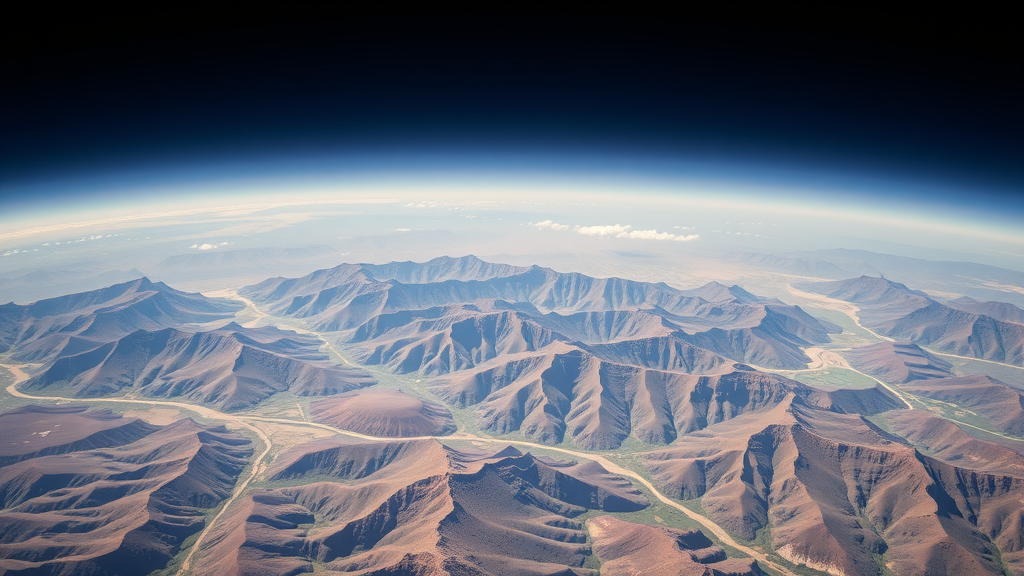
In one of the most heavily studied yet least understood corners of the Sahel, a new analysis of thirty years of satellite imagery has uncovered a quietly remarkable story: the vegetation of Sudan’s Jabel Marra highlands has been steadily getting greener, even as temperatures climbed and the surrounding region endured decades of armed conflict. The study, published in Environmental Earth Sciences, combined Landsat-derived vegetation data with satellite precipitation records, reanalysis temperatures, and a drought index to reconstruct the environmental history of a mountainous volcanic massif in Central Darfur between 1994 and 2024. The findings challenge simple narratives of relentless desertification in the Sahel and underline how much long-term environmental change in data-scarce, conflict-affected regions can now be revealed from orbit.
The research team, led by Abdalrahman Ahmed of the University of Sopron in Hungary and the University of Gezira in Sudan, together with colleagues in Hungary, the United Kingdom, Sudan, and India, set out to answer a deceptively simple question: has vegetation in Jabel Marra increased, decreased, or shifted over the past three decades, and what climatic forces best explain the pattern? Jabel Marra is ecologically unusual. Rising more than 3,000 meters above sea level, the volcanic massif forms part of the Sahelian ecotone, the transitional belt between the arid Sahara to the north and the sub-humid savanna woodlands to the south. Its slopes are cooler and wetter than the surrounding lowland plains, supporting denser and more diverse vegetation dominated by dryland savanna tree species such as Acacia senegal, Albizia amara, Anogeissus leiocarpus, and Balanites aegyptiaca. Many of these species regenerate vigorously through coppicing and basal resprouting, allowing them to persist under grazing, fuelwood harvesting, and fire.
Methodologically, the study leaned on the modern remote sensing toolkit. Because ground-based meteorological observations in Darfur are sparse and discontinuous, the researchers used the CHIRPS precipitation dataset, which merges satellite infrared imagery with station data at roughly 5.6-kilometer resolution, and the MERRA-2 atmospheric reanalysis for temperature, accessed through NASA’s POWER platform. Vegetation greenness was tracked with the Normalized Difference Vegetation Index, or NDVI, computed from Landsat-5, Landsat-7, and Landsat-8 surface reflectance products, with cloud and cloud-shadow masking applied to ensure comparability across sensors. Annual NDVI composites were built from all cloud-free observations in benchmark years 1994, 2004, 2014, and 2024, reducing the influence of short-lived atmospheric and phenological noise. Drought conditions were quantified with the Standardized Precipitation Evapotranspiration Index, or SPEI, at three-, six-, and twelve-month timescales, with potential evapotranspiration calculated using the FAO Penman-Monteith method. All spatial processing took place in Google Earth Engine, while statistical analyses were performed in R.
The statistical treatment was deliberately conservative. Long-term vegetation trends were detected with the non-parametric Mann-Kendall test, which makes no assumptions about data normality and resists outliers, and the magnitude of change was quantified with Sen’s slope estimator, which reports the median rate of change across the record. A pixel-based version of the Mann-Kendall analysis mapped where in the landscape vegetation trends were statistically significant. Pearson correlation analysis then linked annual NDVI to precipitation, temperature, and elevation, with variables standardized and checked for normality beforehand. The authors are careful to frame these correlations as statistical associations rather than proof of causation, noting that vegetation responses in drylands are shaped by soil properties, land-use history, antecedent moisture, and lagged responses to rainfall that contemporaneous annual correlations cannot capture.
The headline result is unambiguous. Annual NDVI showed a statistically significant positive trend, with a Mann-Kendall Z statistic of 4.78 and a p-value below 0.001, and a Sen’s slope of 0.00143 NDVI units per year. Over three decades, that translates into a gradual but real increase in vegetation greenness across the massif. Spatially, the picture was heterogeneous rather than uniform. Significant positive trends concentrated in the central and northeastern parts of the study area, especially in mid-to-high elevation vegetated zones, while localized significant declines appeared in the southwest, and large areas showed no statistically significant trend at all. Benchmark-year maps showed the highest NDVI values in the cooler, wetter uplands and the lowest values in lowlands and on sparsely vegetated mountain summits, and monthly composites confirmed the expected seasonal pulse, with greenness rising between June and October and fading from November through May. Peak monthly NDVI in 2014 and 2024 exceeded that of 1994 and 2004.
The climate record behind that greening is more complicated than a simple wetting trend. Annual precipitation fluctuated strongly from year to year, with a weak long-term linear trend explaining only six percent of the variance. The wettest year was 2018, with more than 800 millimeters of rain, followed by 2019 and 2003, while 1995, 2002, 2008, and 2016 recorded under 500 millimeters. Temperature, by contrast, rose consistently, with a linear trend explaining about half of the interannual variance; mean annual temperature climbed from roughly 23.0 degrees Celsius in 1994 to 24.5 degrees in 2024, peaking at 24.7 degrees in 2023. The SPEI analysis identified recurrent drought episodes before 2018, spanning 1996 to 1999, 2001 to 2003, 2009 to 2011, and 2015 to 2017, after which predominantly wetter conditions prevailed across all three timescales through 2024.
Correlation analysis tied the vegetation trajectory firmly to this climatic context. NDVI was positively correlated with precipitation, with a coefficient of 0.48, and negatively correlated with temperature, at minus 0.57, both highly significant. Elevation entered the picture as a strong organizing variable: precipitation correlated positively with elevation at 0.87, while temperature fell with elevation at minus 0.66, confirming that the massif creates sharp vertical climatic gradients. Elevation itself correlated positively with NDVI at 0.39. Taken together, the numbers suggest that water availability, mediated by drought conditions and shaped by topography, is the principal constraint on vegetation in Jabel Marra, while rising temperatures likely counteract growth by increasing atmospheric evaporative demand and drying soils, a pattern echoed across the Sahel and Horn of Africa.
What makes the study particularly provocative is its setting. Darfur has experienced prolonged armed conflict, mass displacement, and disrupted land use since the early 2000s, and an emerging body of warfare-ecology research has suggested that reduced cultivation and grazing pressure in abandoned areas can permit natural vegetation regeneration, much as passive rewilding does on farmland elsewhere. The authors treat these conflict-related processes explicitly as context rather than demonstrated drivers: no spatially explicit datasets on conflict intensity, displacement, grazing pressure, or land-use change were incorporated into the analysis, so no causal link between conflict and the observed greening can be claimed. Restoration programs led by Sudan’s Forest National Corporation, the UN Environment Programme, and local organizations, promoting tree planting, agroforestry, and soil rehabilitation, may also have contributed locally, but the study cannot separate their footprint from climate-driven change in the NDVI record.
The authors are equally candid about other limits. Annual NDVI composites smooth away seasonal and species-level variability, the 30-meter resolution of Landsat misses fine-scale changes in small fields and settlement margins, and widely validated climate products like CHIRPS and MERRA-2 carry uncertainties in complex mountain terrain that can blur drought estimates at fine scales. NDVI, moreover, measures greenness and photosynthetic activity, not biodiversity or ecosystem condition, so the greening trend should not be read as proof of ecological recovery in a fuller sense. Future work, the team argues, should integrate higher-resolution imagery such as Sentinel-2, field-based ecological observations, lagged climate-vegetation modeling, and spatially explicit socioeconomic and conflict datasets to disentangle the interacting climatic and human forces at work.
Even with those caveats, the study’s broader message resonates well beyond Darfur. It demonstrates that the combination of long-archive Landsat imagery, satellite precipitation and reanalysis products, cloud-based processing platforms, and rigorous non-parametric statistics can produce a credible environmental record even where security constraints have long prevented systematic field monitoring. For a region often reduced in the public imagination to images of drought and war, the satellite record tells a more nuanced story: a warming, drought-prone landscape in which moisture swings and altitude set the tempo of life, and in which the mountains of Jabel Marra have, for now, been quietly growing greener. That baseline, the authors conclude, is essential groundwork for climate adaptation planning, land management, and any future effort to reconcile environmental recovery with peacebuilding in Sudan and comparable dryland mountain regions.
Subject of Research: Long-term vegetation change and its climatic drivers in the Jabel Marra region of Darfur, Sudan, from 1994 to 2024
Article Title: Three decades of vegetation change in Jabel Marra: climate drivers and post-conflict vegetation dynamics
Article References: Ahmed, A., Czimber, K., Nadarajah, S., Mohammed, E. M. I., Mohamed, A. A. A., & Musa, F. I. (2026). Three decades of vegetation change in Jabel Marra: climate drivers and post-conflict vegetation dynamics. Environmental Earth Sciences, 85(15), Article 399. https://doi.org/10.1007/s12665-026-13109-7
Image Credits: AI Generated
DOI: 10.1007/s12665-026-13109-7
Keywords: NDVI, vegetation dynamics, Jabel Marra, Darfur, Sudan, climate variability, drought, SPEI, remote sensing, Landsat, precipitation, Sahel
Cite Scienmag News
Violet Maxwell. (September 12, 2026). Satellites reveal three decades of surprising greening in war-affected Sudanese mountains. Scienmag. https://scienmag.com/satellites-reveal-three-decades-of-surprising-greening-in-war-affected-sudanese-mountains/
Violet Maxwell. "Satellites reveal three decades of surprising greening in war-affected Sudanese mountains." Scienmag, 12 September 2026, https://scienmag.com/satellites-reveal-three-decades-of-surprising-greening-in-war-affected-sudanese-mountains/. Accessed 5 October 2026.
Violet Maxwell. "Satellites reveal three decades of surprising greening in war-affected Sudanese mountains." Scienmag. September 12, 2026. https://scienmag.com/satellites-reveal-three-decades-of-surprising-greening-in-war-affected-sudanese-mountains/


