


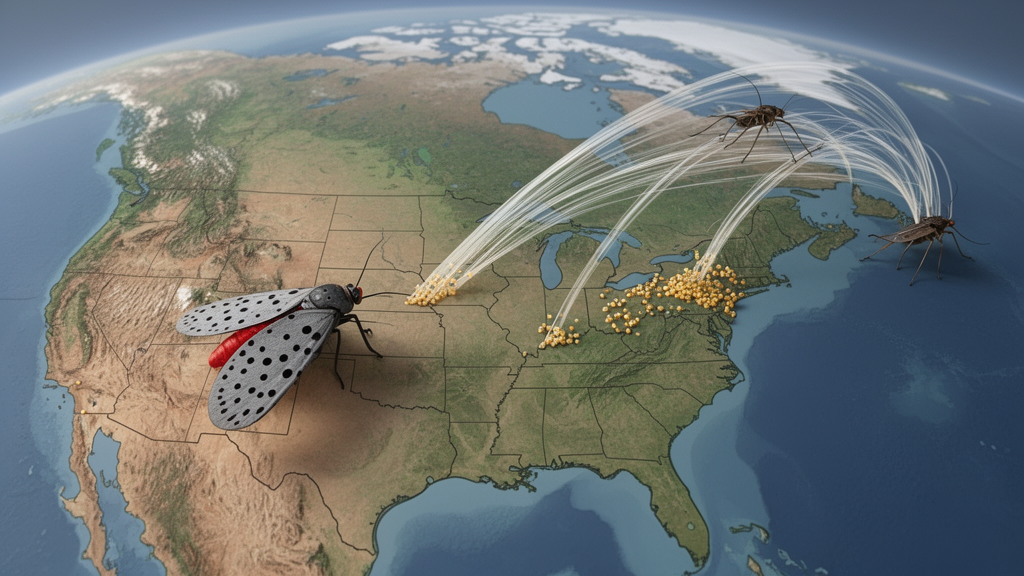
A combined climate, habitat and dispersal model indicates that the spotted lanternfly could spread rapidly through suitable parts of the United States and Japan, while extensive European regions remain vulnerable if populations become established. The study also finds that the insect’s apparent expansion can be separated from additional introductions by people: in the eastern United States, its modeled range grew from 1,797 square kilometres in 2015 to 127,721 square kilometres in 2024, an increase of roughly 70-fold. These estimates concern spread from the first documented introduction and exclude populations believed to have originated through later human-mediated translocations.
The researchers developed separate habitat and bioclimatic suitability models for the spotted lanternfly, Lycorma delicatula, and combined their probability maps to identify locations meeting broad-scale climatic and local environmental requirements. Models were calibrated principally with records from the species’ native range in mainland China rather than with occurrences from invaded regions, where populations may still be expanding or may have been introduced into unsuitable environments. The habitat model incorporated elevation, land cover, built-up areas, cultivated vegetation, natural vegetation and a composite layer representing numerous potential host plants. The bioclimatic model used temperature and precipitation variables at a broader geographic scale.
Performance was strong for both components. The best habitat models had area-under-the-curve values of 0.870 to 0.900 and true skill statistic values of 0.585 to 0.697, while the strongest bioclimatic models reached area-under-the-curve values of 0.971 to 0.985 and true skill statistic values of 0.855 to 0.898. The combined map achieved a Boyce index of 1 in the native-range calibration area and again in the eastern United States, indicating that occurrence records were strongly concentrated in locations the model rated as suitable. By contrast, the value of −0.133 for South Korea indicated a marked mismatch between predicted suitability and the scattered locations where the insect has been recorded.
Host plants were the most influential habitat variable, with an importance value of 0.542, followed by built-up land at 0.358. Cultivated and managed vegetation, herbaceous cover and elevation made smaller contributions. The model associated the highest occurrence probability with lowlands to mid-mountain areas, with an optimum near 750 metres above sea level. For climate, the mean temperature of the coldest quarter was the dominant predictor, with an importance value of 0.591 and apparent optimal conditions around 0 °C, chiefly between −5 and +2 °C. The minimum temperature of the warmest month and mean diurnal temperature range also influenced the fitted responses. The authors note that host distributions and land cover are themselves shaped by climate, so the habitat layer indirectly captures some climatic influence as well as local habitat availability.
Globally, the model identified eastern China as the most favorable part of the native range, the central-eastern United States as the largest continuous suitable region outside Asia, and nearly all of Japan as highly suitable. Additional potentially suitable areas were scattered across Europe, mostly south of 55 degrees north. In Europe, the mapped zone extended across central-eastern France, Switzerland, the Benelux countries and Germany, as well as northern Italy, Slovenia, Croatia, the Danube basin, parts of southeastern Ukraine and the Northern Caucasus. California was not identified as a critical invasion area; the researchers interpreted reported detections there as likely adventive occurrences sustained by transport rather than evidence of expanding populations.
To estimate movement rather than merely identify favorable habitat, the team analyzed 11,326 occurrence records from the eastern United States, where the invasion has been closely documented. Distances between the closest records in consecutive years produced a bootstrapped median of 1,720 metres, with a 95% confidence interval of 1,680 to 1,766 metres. The bootstrapped 99th percentile was 25,418 metres, with a 95% confidence interval of 18,479 to 37,038 metres. This upper estimate was treated as the maximum annual dispersal distance, and records lying beyond it were classified as likely human-mediated introductions rather than ordinary expansion from the initial population.
The researchers then converted predicted environmental suitability into landscape resistance and tested whether linear or nonlinear logistic resistance best reproduced the observed eastern United States expansion. The best-fitting configuration used a logistic function with a midpoint parameter of 0.5, a steepness value of 15 and a cumulative resistance threshold of 1,200. Under this model, the estimated invaded area increased from 1,797 square kilometres in 2015 to 8,611 in 2016, 35,724 in 2018, 72,511 in 2020 and 127,721 in 2024. The model’s year-by-year boundaries captured occurrences consistent with spread from the first introduction, but overlapping records also revealed secondary invasion hotspots that transport had apparently helped create.
Ten-year scenarios beginning from the species’ current distribution suggested two major fronts in the United States. One lies east of the Appalachian Mountains toward the Atlantic coast, where much of the suitable landscape has already been colonized. The second extends inland, west of the Appalachians and south of the Great Lakes, where the model projected movement toward the continental interior and near-complete occupation of the most suitable areas by the end of the period. Populations in California, the central-western states and Florida were considered less likely to develop into expanding invasions. South Korean expansion was projected to concentrate along the southwestern coast, but the interpretation remains uncertain because scattered records appear to reflect repeated human transport. In Japan, where environmental suitability is high, populations could spread rapidly across central and southern Honshu, without fully saturating suitable northern areas within ten years.
European simulations showed that a successful invasion would depend on establishment in suitable terrain rather than an isolated detection alone. The single iNaturalist record from Madrid was treated as a possible occurrence, but the surrounding area was modeled as too unsuitable to support substantial subsequent expansion from that point. Hypothetical introductions at Milan Malpensa Airport, Paris Charles de Gaulle Airport and Hamburg Port were more consequential because they were situated in highly suitable areas. The authors therefore interpret the European map as a conditional risk scenario: establishment at favorable entry points could enable rapid spread, whereas a population in a marginal environment may not. The projections did not include future human-mediated translocations, which the researchers say could accelerate expansion beyond the modeled trajectories.
The findings provide a map-based assessment rather than a measured ten-year outcome. They distinguish broad physiological limits imposed by climate from finer-scale filters involving host plants, urban habitat and local land cover, and they treat natural spread separately from transport-assisted establishment. South Korea’s poor model agreement and the uncertain status of scattered records in other invaded areas demonstrate the limits of predicting an insect whose distribution is being shaped by both ecological dispersal and human movement. Even so, the study identifies regions where establishment appears most consequential and where rapid expansion would be plausible. It also shows why records of introduction cannot automatically be interpreted as evidence that a species has occupied the full range of suitable habitat.
Subject of Research: Global habitat suitability and invasion scenarios for the spotted lanternfly
Article Title: Predicting the global distribution and invasion scenarios of the Spotted Lanternfly, Lycorma delicatula (White, 1845) ( Hemiptera , Fulgoridae )
Article References: Ruzzier, E., Scaccini, D., Tirozzi, P., Orioli, V., Dondina, O., Di Giulio, A., Pozzebon, A., & Bani, L. (2025). Predicting the global distribution and invasion scenarios of the Spotted Lanternfly, Lycorma delicatula (White, 1845) (Hemiptera, Fulgoridae). NeoBiota, 103, 267-298. https://doi.org/10.3897/neobiota.103.154246
Image Credits: AI Generated
DOI: 10.3897/neobiota.103.154246
Keywords: spotted lanternfly, species distribution modelling, biological invasion, climate suitability, habitat suitability, range expansion, dispersal modelling, grapevine pest, Europe, United States, Japan, South Korea
Cite Scienmag News
Patricia Pace. (October 20, 2026). Spotted lanternfly models map rapid U.S. spread and European risk. Scienmag. https://scienmag.com/spotted-lanternfly-models-map-rapid-u-s-spread-and-european-risk/
Patricia Pace. "Spotted lanternfly models map rapid U.S. spread and European risk." Scienmag, 20 October 2026, https://scienmag.com/spotted-lanternfly-models-map-rapid-u-s-spread-and-european-risk/. Accessed 20 October 2026.
Patricia Pace. "Spotted lanternfly models map rapid U.S. spread and European risk." Scienmag. October 20, 2026. https://scienmag.com/spotted-lanternfly-models-map-rapid-u-s-spread-and-european-risk/


