


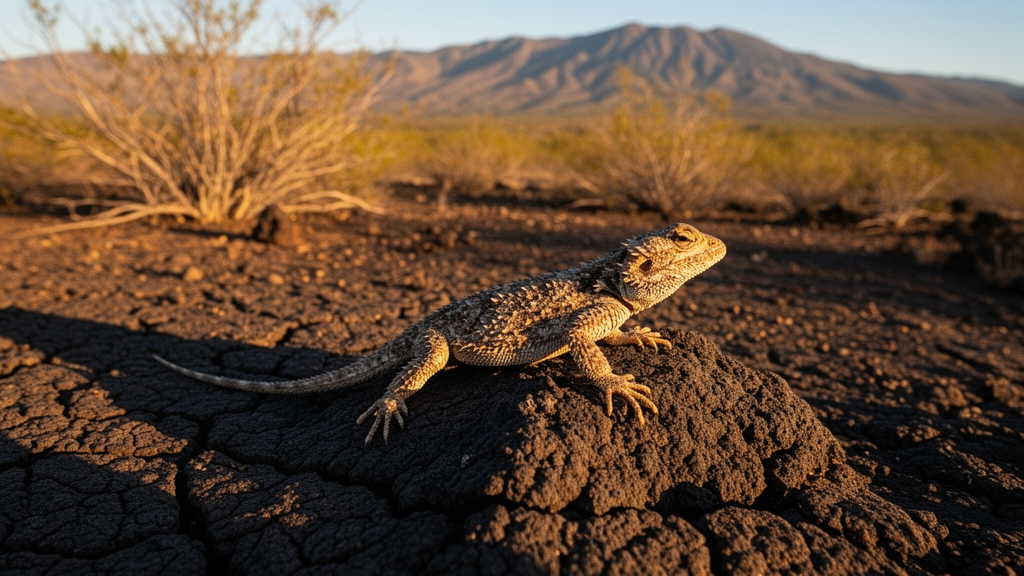
Across the volcanic highlands of central Mexico, a group of spiny lizards that has thrived for millions of years is quietly running out of space. A new spatial vulnerability assessment, published in the journal Nature Conservation, has combined ecological niche modelling, landscape connectivity analysis, habitat fragmentation metrics and protected-area mapping to evaluate the fate of 17 species of Sceloporus — the emblematic spiny lizards of the Trans-Mexican Volcanic Belt (TMVB). The verdict is stark: every one of the 17 species has predicted habitat overlapping with heavily transformed urban landscapes, and several lizards currently listed as
The Trans-Mexican Volcanic Belt, the geographic stage for this assessment, is a geological newcomer by evolutionary standards yet an ancient cradle of biodiversity. Formed by the subduction of the Cocos and Rivera plates beneath the North American Plate, this Neogene volcanic arc stretches roughly 160,000 square kilometres across central Mexico, from west to east, in a chain of stratovolcanoes, volcanic fields and highlands that in places rise above 4,000 metres. Repeated volcanic episodes, tectonic uplift and the climatic oscillations of the Pleistocene carved the region into a mosaic of temperate forests, alpine grasslands and xerophytic scrublands. That mosaic, in turn, generated the environmental gradients and geographic isolation that drive speciation. The result is a region that ranks second in herpetological richness nationwide and holds the highest number of endemic reptiles and amphibians in the country, with approximately a quarter of Mexico’s herpetofauna found there and more than 80 percent of those species endemic. For spiny lizards of the genus Sceloporus, many of which are montane specialists tied to particular elevational bands and rock outcrops, these gradients have acted both as engines of diversification and, increasingly, as traps: species adapted to narrow climatic conditions on isolated mountain blocks have limited capacity to shift their ranges when those blocks become surrounded by cities, fields and pastures.
The methodology behind the new study reflects a broader shift in conservation science away from single-metric assessments and toward integrative, spatially explicit frameworks. The researchers compiled occurrence records for the 17 species from a suite of biodiversity databases, including REMIB, UNIBIO, GBIF, HERPNET, VertNet and IREKANI, supplemented by community-sourced observations from iNaturalist, restricting records to recent decades to ensure the data reflected current distributions rather than historical ones. Occurrence data of this kind are the raw material of ecological niche modelling, a technique that relates known locations to environmental variables such as temperature, precipitation and vegetation cover to estimate the full envelope of suitable habitat. The team employed two complementary modelling strategies: Maxent, a widely used maximum-entropy approach tuned through the ENMeval package to avoid overfitting, and an ensemble method implemented in biomod2 that combines eight different algorithms. Ensemble approaches are increasingly favoured because individual algorithms can disagree, and averaging their predictions, optimised against known occurrences, tends to yield more robust estimates of where a species can persist. From the resulting binary distribution maps, the researchers calculated landscape metrics for each species: total habitat area, the number of discrete habitat patches and the mean size of those patches.
These fragmentation metrics matter because the fate of a population depends not only on how much habitat exists but on how it is arranged. Conservation biology has long recognised that a given area of habitat divided into many small, isolated patches supports fewer individuals and fewer species than the same area in a single contiguous block. Small patches suffer from edge effects, where conditions at the boundary of a fragment differ from the interior, and from demographic and genetic consequences of isolation. Lizards are particularly sensitive to these dynamics because their dispersal ability is limited; a Sceloporus population stranded on a volcanic slope surrounded by agricultural land is unlikely to recolonise neighbouring patches after a local extinction event. The study synthesised habitat area, patch count and patch size into a composite vulnerability index, allowing species to be ranked not merely by how much habitat they retain but by how broken up that habitat has become.
To capture the human dimension of the threat, the researchers overlaid species distributions with land-use layers representing urban development, agriculture and cultivated pasture. They then applied principal component analysis and k-means clustering to these pressure variables, producing a multivariate anthropogenic pressure zonation across the region. This statistical approach condenses multiple correlated pressure layers into a coherent spatial classification, distinguishing zones where pressures are predominantly urban from those dominated by agricultural conversion or mixed land use. The bivariate risk assessment that followed, crossing vulnerability with pressure, produced the study’s most consequential finding: Sceloporus megalepidurus emerged as the only species facing both high pressure and high vulnerability simultaneously, a combination that places it in the most precarious category of the analysis.
The protected-area component of the study addresses a persistent gap in conservation planning: representation. A protected area only benefits a species if it overlaps that species’ actual habitat. Mexico has invested substantially in its system of federal and state protected natural areas, but these were often established for scenic, hydrological or flagship-species values rather than for the fine-grained distribution of reptiles. The comparison of species distributions against protected-area coverage revealed how poorly the existing network captures the habitats of these lizards, leaving large portions of biologically rich landscape exposed to ongoing transformation. This mismatch is compounded by management shortcomings; even formally protected areas in the region are frequently under-resourced and subject to encroachment.
Perhaps the most sobering implication of the work concerns the IUCN Red List categories of the species involved. Most of the 17 lizards are currently classified as Least Concern or have never been evaluated at all. Only Sceloporus megalepidurus carries a Vulnerable listing internationally, and under Mexican national normative standards only S. grammicus and S. megalepidurus receive any formal protection status. Yet the spatial analysis flagged alarming risk signals in species such as S. anahuacus, S. albiventris and S. minor, all of which sit in the least-concern or unevaluated categories. This discrepancy illustrates a structural limitation of global assessments: they typically rely on geographic range size as a primary criterion, and a species with a moderately large mapped range can appear secure even when that range is riddled with cities, fragmented into small patches and largely unprotected. Red List criteria do include provisions for declining habitat quality and fragmented distributions, but these are difficult to apply without the kind of fine-scale spatial data that regional studies like this one generate. The authors argue, in effect, that conservation assessments should incorporate habitat quality, fragmentation and exposure to land-use pressures rather than relying on range extent alone.
The findings also resonate with a broader and troubling literature on lizard responses to environmental change. Research published under the leadership of Barry Sinervo and colleagues demonstrated that climate change has already driven measurable local extinctions in lizard populations worldwide, with roughly 12 percent of Mexican populations disappearing since 1975. Their physiologically grounded models, validated against field surveys across multiple continents, projected that by 2080 local extinctions could approach 39 percent globally, with up to 20 percent of lizard species lost. The mechanism is deceptively simple: lizards are ectotherms whose activity windows are constrained by temperature, and as warming shrinks the hours available for foraging and reproduction, populations decline even without any direct habitat destruction. When this thermal stress is layered on top of habitat loss, fragmentation and reduced connectivity, the risks compound rather than merely add. A population squeezed by urbanisation into a small remnant patch has neither the geographic room to track shifting climates nor the demographic resilience to absorb climate-driven reproductive failures.
The genus Sceloporus itself amplifies the significance of these results. With approximately 110 recognised species, 106 of them endemic to Mexico, spiny lizards represent one of the most successful radiations in the Mexican herpetofauna, occupying habitats from montane forests to arid scrublands and grasslands. Their ecological roles as insect predators and prey for birds, snakes and mammals weave them into food webs across the country. Yet despite decades of research on their thermal physiology, systematics and biogeographic history, fundamental questions about the environmental drivers of their distributions and their vulnerability to human pressures have remained unanswered. Few prior studies had combined ecological niche modelling with multivariate pressure mapping, fragmentation analysis and protected-area overlap in a single framework, which is precisely the integration this study delivers.
For conservation practitioners, the practical value of the approach lies in its ability to prioritise. By ranking species on a composite vulnerability index and mapping where high vulnerability coincides with high anthropogenic pressure, the framework identifies both the species most in need of attention and the specific landscapes where intervention would be most effective. It also provides an evidence base for revisiting national listings under Mexican environmental law, where the current coverage of Sceloporus species is sparse relative to the risks documented here. More broadly, the study offers a template that could be applied to other poorly assessed, range-restricted taxa in biodiversity hotspots worldwide, wherever the gap between formal conservation status and actual spatial risk remains wide. In a region where human population density and endemism both peak, that gap is not an academic concern but a measure of how much biodiversity may be lost before it is ever formally recognised as threatened.
Subject of Research: Spatial vulnerability assessment of 17 Sceloporus lizard species in the Trans-Mexican Volcanic Belt under anthropogenic pressure
Article Title: Assessment of the vulnerability of Spiny Lizards in Central Mexico under anthropogenic pressure: integrating habitat suitability, landscape connectivity, fragmentation and protected area coverage
Article References: Vargas-Jaimes, J., Manjarrez, J., Ramírez-Corona, F., Woolrich-Piña, G. A., González-Pedroza, M. G., Estrada-Zúñiga, M. E., Rangel-Patiño, C. A., Venegas-Barrera, C. S., Nieto-Trujillo, A., Vazquez-Marquez, A. M., Guido-Patiño, J. C., & Sunny, A. (2025). Assessment of the vulnerability of Spiny Lizards in Central Mexico under anthropogenic pressure: integrating habitat suitability, landscape connectivity, fragmentation and protected area coverage. Nature Conservation, 59, 351-386. https://doi.org/10.3897/natureconservation.59.159660
Image Credits: AI Generated
DOI: 10.3897/natureconservation.59.159660
Keywords: Sceloporus, Trans-Mexican Volcanic Belt, ecological niche modelling, habitat fragmentation, landscape connectivity, protected areas, anthropogenic pressure, conservation, reptiles, Mexico biodiversity, IUCN Red List, deforestation
Cite Scienmag News
Margaret Porter. (October 19, 2026). Spiny Lizards of Central Mexico Are Running Out of Room to Live, Landmark Study Warns. Scienmag. https://scienmag.com/spiny-lizards-of-central-mexico-are-running-out-of-room-to-live-landmark-study-warns/
Margaret Porter. "Spiny Lizards of Central Mexico Are Running Out of Room to Live, Landmark Study Warns." Scienmag, 19 October 2026, https://scienmag.com/spiny-lizards-of-central-mexico-are-running-out-of-room-to-live-landmark-study-warns/. Accessed 19 October 2026.
Margaret Porter. "Spiny Lizards of Central Mexico Are Running Out of Room to Live, Landmark Study Warns." Scienmag. October 19, 2026. https://scienmag.com/spiny-lizards-of-central-mexico-are-running-out-of-room-to-live-landmark-study-warns/


