


High on the mist-wrapped ridges of Mount Tabwemasana, the tallest peak in the Vanuatu archipelago, a moth collected more than half a century ago has finally been given a name — and it is turning out to be one of the strangest erebid moths ever described. In a paper published in Nota Lepidopterologica, entomologist Alberto Zilli of the Natural History Museum in London has erected an entirely new genus, Tabwecala, to accommodate a single new species, Tabwecala robinsoni, a large, sooty-brown moth with a wingspan approaching eight centimetres. The specimens sat unstudied in the museum’s collections since 1971, when lepidopterist Gaden S. Robinson gathered them during a Royal Society expedition to what was then the New Hebrides. Robinson himself had pencilled a note on the material suggesting it was a close ally of the genus Artena, but he suspected it might represent something genuinely novel. Five decades later, a detailed anatomical investigation has confirmed that his instinct was right — and then some.
The story of the moth’s home islands is central to why the discovery matters. Vanuatu’s Lepidoptera have been surveyed only a handful of times: Robinson’s 1971 expedition and a 2006 IBISCA biodiversity project on Espiritu Santo are essentially the only two major moth surveys ever conducted there. Robinson estimated that roughly 29 percent of the archipelago’s macrolepidoptera are endemic, yet he concluded the fauna was young, derived entirely from transoceanic dispersal, and morphologically conservative — only one endemic genus was known at the time. Subsequent work has steadily chipped away at that picture, revealing large and conspicuous endemics such as the swallowtail Polyura sacco and two hawkmoths in the genus Gnathothlibus. Tabwecala robinsoni adds a far more significant entry to that list, because it is not merely a new species but a new genus whose anatomy does not fit comfortably anywhere in the existing classification of its family.
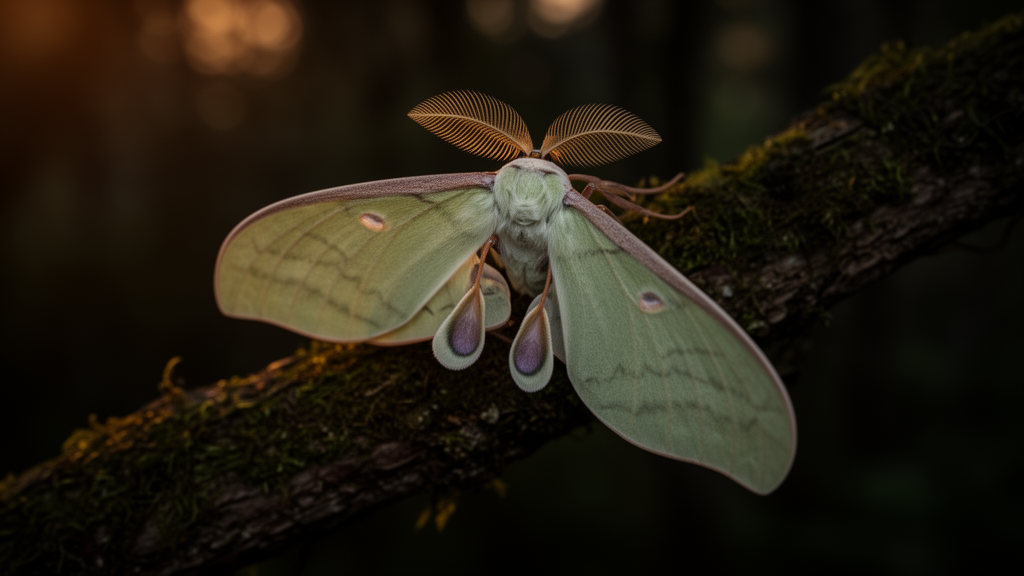
Superficially, the moth resembles familiar fruit-piercing relatives: it looks like a dark member of Artena, Achaea or Leistera, with uniformly blackish-brown forewings lacking any pale pattern, and a hindwing crossed by a broad, softly blurred white band with the faintest blue sheen when the wing catches the light. But the resemblance ends at the surface. Under the microscope, the species displays a combination of traits the author could not match in any other erebid genus: labial palps identical in both sexes, a pair of spines on the male’s front femur, a groove-like structure called an androteca on the middle tibia, and — most striking of all — a hindleg so modified it looks like it belongs to a different animal entirely. The male’s metatibia is greatly shortened and swollen into a teardrop shape, topped with a dorsal bulge from which sprays a conspicuous pencil of long, honey-coloured scent hairs that lie back along the first segment of the foot.
That scent apparatus is the moth’s headline feature, and possibly unique across the entire family Erebidae. Male moths in many groups bear androconial organs — brushes, pouches or inflatable tufts that disseminate pheromones during courtship — but the configuration in Tabwecala, with the scent pencil emerging from a swollen, shortened tibia, has no recorded parallel. Intriguingly, the paper argues that this organ probably did not evolve to prevent the male from mating with the wrong species. Tabwecala is so isolated, both geographically and systematically, that no close relatives share its habitat; there is no obvious risk of hybridisation errors. Instead, the author suggests the scent organ functions to synchronise and coordinate the sexes in a sparse island population, where finding a mate at the right moment is the real challenge. It is a subtle but important distinction in how we think about the evolution of sexual signalling on remote islands.
The genitalia deliver further surprises. In most members of the Ophiusini–Poaphilini clade to which the moth belongs, a sclerotised strip called the scaphium reinforces the roof of the anal tube, contributing to the characteristic ‘triple beak’ appearance of the male terminalia. Tabwecala has no scaphium at all — a loss never before recorded in this group — and compensates with an elaborate hood-like pocket that folds over the anus to shield the tip of the uncus, an arrangement more reminiscent of the distantly related Hypeninae. The female is equally distinctive, with a complex sterigma bearing not one but two ‘postvaginal lamellae’, a configuration rarely documented simply because taxonomists conventionally leave the seventh abdominal sternum in place during dissection. Together these traits form a morphological fingerprint that no existing genus can claim.
Even the wing venation misbehaves. Among the specimens examined, the branching pattern of the radial veins in the forewing occurs in two fundamentally different configurations — one with a long areole, one with a short one — and the two forms are not segregated by sex. Wing venation was once a cornerstone of moth classification, and Tabwecala’s variability is a vivid reminder of why it fell from favour: the same species can express two topologies that older taxonomists might have treated as different genera. The author documents both patterns with explicit homology interpretations, noting that the developmental mechanisms regulating vein formation can modulate their expression even within a single population.
Where, then, does the moth belong? The paper’s systematic analysis is as much a critique of moth classification as a description of a new species. Modern treatments split the large erebine clade into two tribes, Ophiusini and Poaphilini, largely on the strength of molecular data — each is recovered as monophyletic, and each is the sister of the other. Yet, as Zilli demonstrates through a character-by-character review, no unambiguous physical trait actually separates them. The supposed diagnostic features collapse under scrutiny: the fruit-piercing proboscis hooks attributed to Ophiusini turn out to be a misattribution belonging to the entirely different Calpinae, and direct examination of Artena and Achaea proboscides shows identical nail-like spines in both. Fruit-piercing behaviour itself occurs in both tribes, as does the waxy bloom on pupae once thought absent from Ophiusini, and the distribution of host plants — with Euphorbiaceae prominent in Poaphilini — looks like an ancient shared tendency rather than a tribal signature, since South African Achaea records show only a tiny fraction of larval feeds on euphorbs.
The leg characters that do carry signal — the position of the androteca on the middle tibia rather than the front femur — place Tabwecala firmly in Poaphilini, and that is where the new genus is provisionally assigned. But even these are symplesiomorphies, shared with Catocalini, Pericymini and Audeini, and therefore useless for defining the tribe itself. The author’s conclusion is blunt: the Ophiusini–Poaphilini split rests on molecular evidence alone, with no known autapomorphies supporting either tribe, and the two may not deserve separate taxonomic status at all. A moth like Tabwecala, which mixes traits from both branches — a mesotibial androteca from the poaphiline side, a subbasal uncus process more typical of ophiusines such as Clytie — is precisely the kind of oddball taxon that should be prioritised in future molecular analyses to test whether the split is real.
Biogeographically, the moth deepens an existing puzzle. Vanuatu sits at the crossroads of two faunal distribution patterns, the New Caledonian and the Fijian, and its closest plant-distribution links run eastward to Samoa, Fiji and Tonga — islands where nothing resembling Tabwecala has been found. The most plausible candidates for living relatives may therefore lurk in the poorly surveyed Solomon and Bismarck archipelagos to the west. Notably, Espiritu Santo hosts the richest concentration of single-island endemics in Vanuatu, a pattern attributed to its size, elevation and ecological heterogeneity, and Tabwecala fits neatly into the ‘montane forest element’ Robinson identified from his site clusters, having been collected between roughly 1,050 and 1,400 metres in Agathis–Calophyllum and cloud forest on the Tabwemasana range.
The species is named in memory of Gaden S. Robinson, the collector of the entire type series and a former curator of Lepidoptera at the Natural History Museum, who died in 2009 — a fitting tribute, since the moth’s very existence in the collection testifies to the value of carefully curated material that can wait decades for the right analytical tools. The broader message is sobering: one of the richest families of Lepidoptera still yields not just new species but new genera with anatomies that challenge tribal boundaries, and they are doing so from montane forests that remain inadequately protected. As the paper concludes, poorly explored southern hemisphere mountains like Tabwemasana are likely to harbour further unusual lineages of Erebidae and other Noctuoidea — provided the forests where they live survive long enough for us to meet them.
Subject of Research: New genus and species of erebid moth from Vanuatu and its implications for the classification of the Ophiusini-Poaphilini clade
Article Title: Tabwecala robinsoni gen. nov., sp. nov., from Vanuatu and its systematic position in the ‘ Ophiusini – Poaphilini ’ clade ( Lepidoptera , Erebidae )
Article References: Zilli, A. (2021). Tabwecala robinsoni gen. nov., sp. nov., from Vanuatu and its systematic position in the ‘Ophiusini-Poaphilini’ clade (Lepidoptera, Erebidae). Nota Lepidopterologica, 44, 193-211. https://doi.org/10.3897/nl.44.70359
Image Credits: AI Generated
DOI: 10.3897/nl.44.70359
Keywords: Tabwecala robinsoni, Vanuatu, Erebidae, Lepidoptera, taxonomy, new genus, Espiritu Santo, androconial organs, Ophiusini, Poaphilini, island endemism, Gaden S. Robinson
Cite Scienmag News
Gavin Prescott. (October 19, 2026). A Giant Moth With Teardrop Legs Rewrites the Moth Family Tree. Scienmag. https://scienmag.com/a-giant-moth-with-teardrop-legs-rewrites-the-moth-family-tree/
Gavin Prescott. "A Giant Moth With Teardrop Legs Rewrites the Moth Family Tree." Scienmag, 19 October 2026, https://scienmag.com/a-giant-moth-with-teardrop-legs-rewrites-the-moth-family-tree/. Accessed 19 October 2026.
Gavin Prescott. "A Giant Moth With Teardrop Legs Rewrites the Moth Family Tree." Scienmag. October 19, 2026. https://scienmag.com/a-giant-moth-with-teardrop-legs-rewrites-the-moth-family-tree/


