


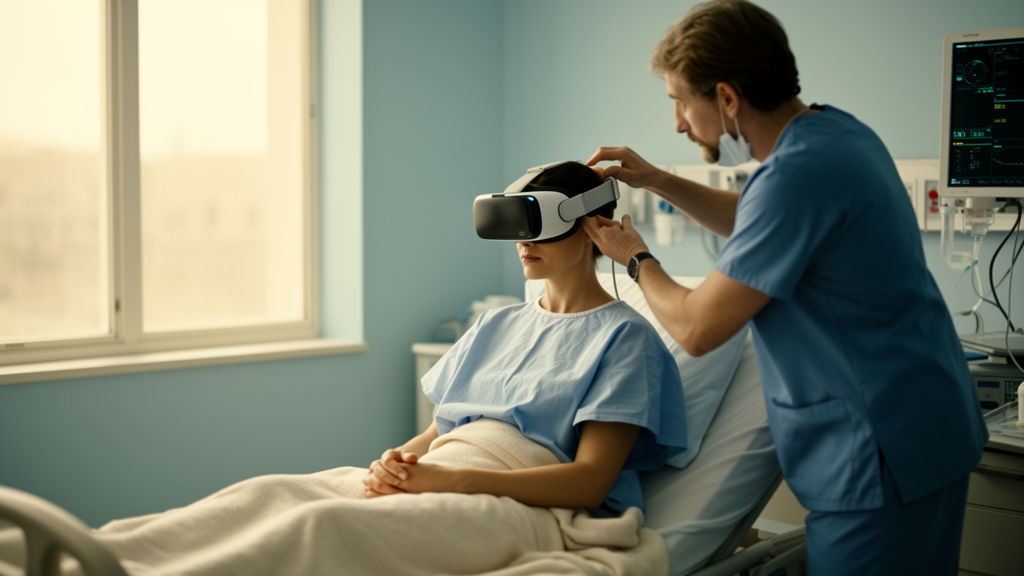
Virtual reality has long been pitched as the next frontier of medicine, mostly through the lens of surgeons training on digital replicas of organs or clinicians navigating three-dimensional scans before an operation. A new study flips the headset around and asks the people who arguably matter most: the patients themselves. In a survey of 114 adults being evaluated for elective spine surgery at a large academic medical center, researchers from the University of Pennsylvania and the University of Alabama at Birmingham found that patients are not just tolerant of the idea of VR-based medical education — they are strikingly enthusiastic about it. On a 10-point scale, the average respondent rated their likelihood of trying VR to learn about their diagnosis or upcoming procedure at 8.19, with a standard deviation of 2.24, and an overwhelming 97 percent said they would be willing to use the technology during post-surgical recovery.
The enthusiasm is notable given the demographic reality of spine care. Degenerative spine disease disproportionately affects older adults, and 42 percent of the survey respondents were over 65 years old. Yet age, the study suggests, is not the barrier many clinicians might assume. When the researchers tested associations statistically, younger age was significantly linked to greater openness to VR-based diagnostic education (p = 0.035) and to learning about surgery (p = 0.007), but openness to medical technology in general was largely independent of age, prior VR experience, and education level. Formal schooling made no measurable difference at all: highest educational degree showed no significant association with openness to VR or likelihood of use. In other words, the drivers of enthusiasm appear to be experiential — familiarity, exposure, and perceived usefulness — rather than demographic.
That distinction between general technology openness and VR-specific receptivity runs throughout the statistical analysis. Using Spearman’s rank correlations with Bonferroni correction, the team found very strong relationships between a patient’s openness to technology that teaches about diagnoses and their openness to VR for the same purpose (ρ = 0.79, p < 0.001), and similarly for learning about surgery (ρ = 0.82, p < 0.001). General tech openness also predicted the stated likelihood of trying VR education (ρ = 0.63–0.66, p < 0.001). Meanwhile, prior VR use was significantly associated with openness to VR specifically for learning about diagnoses (p = 0.046, ρ = 0.19). The pattern suggests that once a patient is comfortable with digital tools broadly, the jump to immersive technology is a small one — and that hands-on experience with VR itself adds a further increment of willingness.
When patients rated specific potential benefits on a five-point Likert scale, the most compelling use case was procedural rehearsal. Nearly 72 percent agreed or strongly agreed that they would feel more prepared for surgery if they could watch a VR simulation of their own procedure, and a similar proportion — 61 percent — believed VR could reduce preoperative anxiety. A slim majority, about 58 percent, agreed the technology could help them understand their medical condition better than traditional verbal or written explanations. These are clinically meaningful hopes, because preoperative anxiety is not a trivial inconvenience: prior research links it to higher complication rates, more severe postoperative pain, and longer recoveries. VR, by letting patients explore a three-dimensional model built from their own MRI or CT data, promises to compress complex anatomy into an intuitive experience that a pamphlet or a hurried office conversation cannot match.
But enthusiasm is not uniform, and this is where the study makes its most distinctive contribution. Rather than treating the cohort as a single bloc of average opinions, the researchers applied an exploratory cluster analysis — partitioning around medoids (PAM) — to sort patients with similar response patterns. Because survey data mix continuous Likert ratings, categorical demographics, and binary answers, they used Gower distance, a metric designed to handle heterogeneous data types. Silhouette analysis identified three as the optimal number of clusters, and bootstrap resampling with 500 iterations confirmed the partition was reproducible, with Jaccard similarity indices ranging from 0.786 to 0.888, values generally interpreted as good-to-high stability.
The three clusters are vividly different. The first, dubbed Tech-Savvy Professionals (n = 41), comprised mostly middle-aged patients aged 31 to 65, nearly half of whom had medical work experience, and 76 percent of whom had actually used VR before. They showed the highest openness to both technology and VR, rated the likelihood of trying VR education at 8.9 out of 10, and only 15 percent worried about understanding the technology. The second cluster, Open-Minded Novices (n = 37), is perhaps the most intriguing: despite zero prior VR experience among its members, their openness scores matched the first group, with the same mean likelihood of 8.9 — though 32 percent expressed concerns about grasping the technology. The third cluster, Skeptics (n = 36), skewed heavily over 65, had the lowest familiarity, a mean likelihood of only 6.6, and 86 percent flagged difficulty understanding the technology as a concern; just 39 percent would use VR for postoperative rehabilitation.
The authors are careful about what these clusters do and do not mean. The mean silhouette width of 0.210 — below the conventional threshold of 0.25, and echoed by a value of 0.23 from an independent hierarchical clustering method — indicates limited separation between groups. Patient attitudes toward VR, they caution, likely exist along a continuum rather than as discrete subgroups, and the clusters should be treated as hypothesis-generating profiles, not validated clinical phenotypes. Still, the framework has practical implications. Open-Minded Novices may need only low-barrier exposure and guidance to become adopters, while Skeptics may require targeted, experiential interventions. Prior research on older adults supports that approach: in one study cited by the team, attitudes toward head-mounted VR shifted from neutral to positive after direct exposure.
The barriers patients named are refreshingly concrete. The most common concern was difficulty understanding the technology (42.98 percent), followed by motion sickness (24.56 percent) and time constraints (16.67 percent). Some respondents also worried that VR might displace the human element of surgical consultation — one participant put it bluntly, noting that “the human factor is far better” — while others raised accuracy, personalization, cost, and physical discomfort with headsets. The authors emphasize that successful implementation will hinge on designing experiences that are intuitive, time-efficient, comfortable, and explicitly complementary to the surgeon-patient relationship rather than a substitute for it.
Contextually, the study fills a real gap. A 2022 systematic review of VR in neurosurgery found that only about 5 percent of studies were patient-oriented, and patients remain underrepresented across the broader field of extended reality in neurosurgery, where research has concentrated on surgeon training, neuronavigation, and pain management. Earlier intervention studies — including a randomized controlled trial showing lower preoperative anxiety and higher preparedness among surgical patients given VR — hinted at the benefits, but baseline patient attitudes before implementation had been largely unmeasured. This survey, conducted in two neurosurgical offices (one suburban, one urban) with a five-to-ten-minute anonymous questionnaire, provides that missing snapshot, though the authors acknowledge limitations: the cross-sectional, single-center design, possible sampling bias from voluntary waiting-room recruitment, exclusion of 18 percent of surveys below an 80 percent completion threshold, a non-validated survey instrument, and the absence of any actual VR exposure during data collection.
The bottom line is encouraging for anyone hoping to see immersive technology in the preoperative waiting room. Patients facing spine surgery — a population that is older, often anxious, and drowning in unfamiliar medical jargon — are broadly ready and willing to put on a headset if it helps them understand what is about to happen to their bodies. The challenge ahead is not persuading patients but engineering for them: validating these exploratory response patterns prospectively, measuring hard endpoints like comprehension scores and anxiety measures after real exposure, and tailoring the experience so that the tech-savvy are challenged, the open-minded novices are guided, and the skeptics are won over one intuitive demo at a time.
Subject of Research: Patient attitudes toward virtual reality in spine surgery education
Article Title: Exploratory clustering of spine surgery patients’ attitudes toward virtual reality
Article References: Exploratory clustering of spine surgery patients’ attitudes toward virtual reality. (n.d.). https://doi.org/10.3389/frvir.2026.1948670
Image Credits: AI Generated
DOI: 10.3389/frvir.2026.1948670
Keywords: virtual reality, spine surgery, patient education, cluster analysis, neurosurgery, preoperative anxiety, patient attitudes, survey study, healthcare technology, Gower distance, partitioning around medoids, technology acceptance
Cite Scienmag News
Ophelia Keating. (October 16, 2026). Spine Surgery Patients Embrace Virtual Reality, but Three Distinct Attitudes Emerge. Scienmag. https://scienmag.com/spine-surgery-patients-embrace-virtual-reality-but-three-distinct-attitudes-emerge/
Ophelia Keating. "Spine Surgery Patients Embrace Virtual Reality, but Three Distinct Attitudes Emerge." Scienmag, 16 October 2026, https://scienmag.com/spine-surgery-patients-embrace-virtual-reality-but-three-distinct-attitudes-emerge/. Accessed 16 October 2026.
Ophelia Keating. "Spine Surgery Patients Embrace Virtual Reality, but Three Distinct Attitudes Emerge." Scienmag. October 16, 2026. https://scienmag.com/spine-surgery-patients-embrace-virtual-reality-but-three-distinct-attitudes-emerge/


