


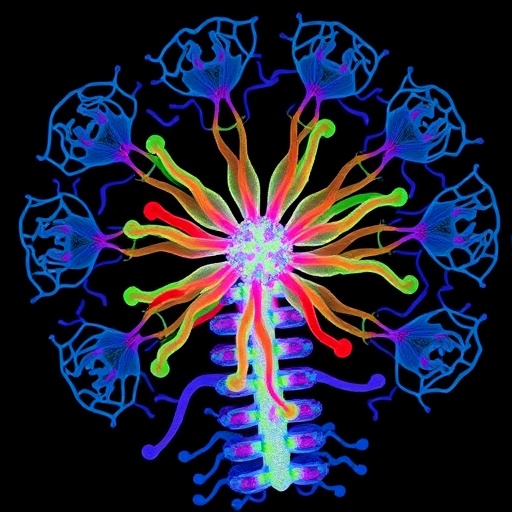
In a groundbreaking advance that could redefine therapeutic approaches for spinal cord injuries, researchers have innovated two distinctive human spinal cord organoid models that simulate traumatic injury with remarkable fidelity. These cutting-edge organoid systems replicate not only the physical damage experienced during severe spinal cord injury (SCI) but also the ensuing biological responses that contribute to paralysis and sensory loss. By integrating these models with a novel supramolecular nanotherapeutic approach, the study heralds the potential for translational applications that may reverse damage previously deemed irreversible, offering fresh hope for sufferers of spinal trauma worldwide.
Spinal cord injury remains one of the most daunting clinical challenges due to its complex pathophysiology and the central nervous system’s limited capacity for repair. Traditional animal models, while invaluable, often fall short of accurately capturing the human-specific nuances of SCI. To bridge this translational gap, this research team has created organoids — miniature, three-dimensional cultures of human spinal cord tissue — that faithfully reflect both cellular diversity and network complexity of the human spinal cord. These organoids serve as a controllable, reproducible platform to dissect injury mechanisms and screen potential interventions with unprecedented precision.
The two distinct injury paradigms employed in these spinal cord organoids are a laceration model induced by a scalpel and a compressive contusion that simulates impact trauma. Both methodologies result in an immediate wave of neuronal death and the emergence of scar-like tissue characteristic of glial scarring observed in vivo. This scarring not only physically impedes axonal regrowth but also creates a hostile microenvironment rich in inhibitory molecules and pro-inflammatory factors, exacerbating functional loss. Recreating this pathology in vitro allows detailed interrogation of the molecular and cellular cascades triggered by SCI.
Central to the therapeutic breakthrough described are bioactive supramolecular assemblies of peptide amphiphiles, which the authors had previously demonstrated can restore locomotor function following acute SCI in mouse models. These assemblies self-organize into nanostructures capable of interfacing with neural tissue at a molecular level, modulating pathogenic processes and fostering regeneration. Their application to the injured human organoids yielded suppression of the glial scar phenotype and robust promotion of axonal regrowth, closely mirroring therapeutic effects seen in live animal studies.
The study takes a significant leap forward by incorporating human microglia into the spinal cord organoids—a critical advancement given microglia’s pivotal role in neuroinflammation following CNS injury. These resident immune cells, when activated by injury, release cytokines and reactive species that exacerbate tissue damage. Remarkably, treatment with the supramolecular nanomaterial significantly reduced the expression of pro-inflammatory mediators in this co-culture model, illuminating a dual function of the therapy in both neuroprotection and immunomodulation.
This dual-action therapeutic strategy could address two of the most formidable barriers to SCI repair: the physical blockade of axonal pathways by scar tissue and the deleterious microenvironment sustained by chronic inflammation. By leveraging human-derived tissue constructs imbued with native immune components, the research team has crafted a platform with translational relevance far surpassing that of previous animal or simplified cell culture models.
Moreover, the implications of this research extend beyond spinal cord trauma. The central nervous system frequently suffers similar degenerative and inflammatory responses in a variety of diseases and injuries, such as multiple sclerosis, stroke, and neurodegenerative disorders. Thus, the human spinal cord organoid models and the therapeutic peptide assemblies present a versatile toolbox for broader investigation and potential intervention across neuropathologies characterized by injury-induced inflammation and scarring.
Methodologically, the organoids were cultivated under stringent conditions to promote maturation and differentiation into functional neuronal and glial lineages. Injuries were meticulously administered to ensure reproducibility, while quantitative measures of cell death, scar formation, and axonal extension were performed using advanced imaging techniques and molecular assays. The integration of microglia employed sophisticated protocols to mimic their physiological development and ensure responsiveness akin to native spinal tissue.
Significantly, this research confirms that bioactive supramolecular assemblies can modulate the SCI microenvironment at multiple levels — mitigating harmful inflammation, preventing scar progression, and catalyzing regenerative growth. These findings challenge the longstanding dogma of permanent paralysis post-SCI and set the stage for clinical translation of nanomaterial-based therapies.
Future directions will likely include further refinement of the organoid models to incorporate vascular and meningeal components, which are critical contributors to injury and repair in vivo. Additionally, scaling up these systems will enable high-throughput screening of therapeutic candidates, expediting drug discovery pipelines. The success of this approach also motivates exploration of personalized medicine applications, where patient-derived organoids could inform individualized treatment strategies for SCI.
This work represents a milestone in bioengineering, regenerative medicine, and neuroscience, epitomizing a confluence of interdisciplinary innovation. By recapitulating human injury processes in a dish and demonstrating effective reversal using engineered nanomaterials, the study offers a beacon of hope for millions affected by spinal cord injuries globally.
In conclusion, the development of human spinal cord organoid injury models, combined with the application of supramolecular peptide amphiphile assemblies, marks a transformative advance in spinal cord biology and therapy. This research not only provides a powerful new platform to unravel complex injury responses but also delivers compelling evidence that paralysis resulting from SCI can be ameliorated through targeted molecular intervention. The ramifications of these discoveries extend far beyond the laboratory, promising a future wherein spinal cord injury recovery becomes an attainable goal rather than a distant dream.
Cite Scienmag News
Cassandra Pierce. (February 28, 2026). Spinal Cord Organoids Reveal Injury and Therapy Insights. Scienmag. https://scienmag.com/spinal-cord-organoids-reveal-injury-and-therapy-insights/
Cassandra Pierce. "Spinal Cord Organoids Reveal Injury and Therapy Insights." Scienmag, 28 February 2026, https://scienmag.com/spinal-cord-organoids-reveal-injury-and-therapy-insights/. Accessed 4 September 2026.
Cassandra Pierce. "Spinal Cord Organoids Reveal Injury and Therapy Insights." Scienmag. February 28, 2026. https://scienmag.com/spinal-cord-organoids-reveal-injury-and-therapy-insights/


