


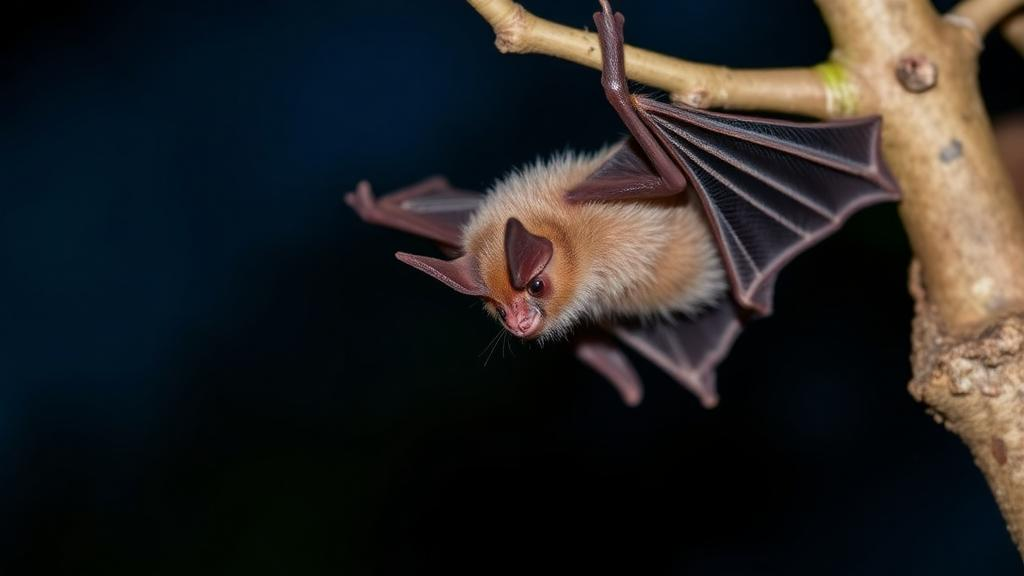
Deep in the night, a medium-sized bat with a distinctive notch in its outer ear swoops through European forests, plucking motionless prey from webs and vegetation. New research shows that this spider-hunting specialist, the notch-eared bat (Myotis emarginatus), maintains a remarkably consistent diet across hundreds of kilometres of varied landscapes — but the pest flies it famously gleans from cattle sheds appear in its meals only under specific conditions, and the surrounding land cover quietly reshapes how much of these harmful insects the bats actually eat.
The study, published in the journal Metabarcoding and Metagenomics, analysed the diet of sixteen maternity colonies spread across the northern Iberian Peninsula and southern France, the heart of the species’ western European range. Using DNA metabarcoding on 318 faecal samples collected in May and July of 2020, the researchers identified 241 prey species belonging to 97 families and 16 orders. The results confirm what smaller studies had hinted at: orb-web building spiders are the notch-eared bat’s most important prey, followed by diurnal pest flies associated with livestock farming.
Spiders dominated the diet with a weighted percentage of occurrence of 52 percent and appeared in 83 percent of samples. Among them, the European garden spider (Araneus diadematus) was the single most consumed species, particularly in July. House flies (Musca domestica) ranked second overall, followed by stable flies (Stomoxys calcitrans), both notorious livestock pests. Together, spiders and flies accounted for 68 percent of the total dietary composition, reinforcing the bat’s reliance on gleaning — a slow, manoeuvrable hunting style that allows it to snatch prey resting on substrates rather than chasing flying insects.
The research team, led by N. Vallejo and colleagues, collected samples from colonies ranging from 30 to 800 individuals, all roosting in buildings across climatic profiles stretching from temperate oceanic to Mediterranean. They characterized the landscape within a 10-kilometre radius of each colony using Sentinel-1 and Sentinel-2 satellite data, reclassifying land uses into forests, non-forested natural areas, pastures, croplands, urban areas and water bodies. Official cattle census data from Spain and France allowed them to estimate both the total number of cows and the mean number per farm around each roost.
Seasonal patterns emerged clearly. Dietary diversity was significantly higher in May at all taxonomic levels, while the proportion of spiders in the diet increased significantly from May to July. The researchers attribute this decline in diversity to higher prey availability in late summer, allowing bats to become more selective and specialize in the most profitable items. Spider species richness was also higher in May, and Mediterranean colonies showed greater spider richness in their diet, likely reflecting richer arthropod communities and a broader range of foraging habitats including scrublands and semi-open natural areas.
The most striking finding concerns the relationship between pest fly consumption and livestock. Using a hurdle model designed for zero-inflated data, the researchers found that the probability of consuming diurnal flies increased significantly with the number of cattle near the colony, with consumption becoming likely once cattle numbers exceeded roughly 2,000 heads within the 10-kilometre radius. In areas where cattle farming was negligible, fly consumption was none or minimal — contradicting the assumed dependence of northern notch-eared bat populations on livestock farming.
Yet once fly consumption occurred, its relative importance in the diet was not related to cattle numbers. Instead, forest cover and urban areas shaped the weighted percentage of occurrence of pest flies. Higher forested area reduced the importance of flies in the diet, likely because forests provide alternative prey such as spiders, moths and beetles that increase dietary diversity. Urban areas had the opposite effect: as natural prey declines with urbanization, bats appear forced to forage more intensively on cattle sheds, exploiting their original gleaning behaviour in a new context.
This behavioural plasticity is remarkable for a species with a relatively narrow trophic niche compared to other European bats. Previous studies in the Basque Country found that five nursing colonies focused on no more than a dozen prey species throughout their active season, with spiders and flies accounting for around 80 percent of total prey volume. The new research confirms this consistency across a much larger geographical and climatic range, from oceanic northern Spain to the Mediterranean south.
The predator-prey interaction between the notch-eared bat and livestock pest flies carries practical implications. Both stable flies and house flies are epiparasitic, harming cattle, transmitting viral and bacterial diseases and reducing milk production. The researchers suggest the notch-eared bat presents an interesting opportunity for integrated pest management strategies in Europe, though quantifying the predation pressure a single colony can exert remains challenging given the complex interplay between fly consumption, geography, climate and landscape characteristics.
The authors conclude that conservation efforts for the notch-eared bat should go beyond protecting forests alone. Because spiders common in semi-open Mediterranean habitats — such as Argiope bruennichi and Cyclosa algerica — are important prey, management should focus on broad-scale preservation of a variety of native habitat types and their associated arthropod communities. Meanwhile, restricting bats’ access to cowsheds would negatively impact pest fly profitability, and colonies would be most vulnerable if suitable sources of pest flies disappear while surrounding natural habitats are also degraded.
Subject of Research: DNA metabarcoding of notch-eared bat faeces across 16 Iberian and French colonies reveals orb-web spiders as the dominant prey and links livestock pest fly consumption to cattle density, forest cover and urbanization.
Article Title: DNA metabarcoding reveals the influence of land cover and farming on the dietary composition of a spider-specialist bat
Article References: Vallejo, N., Aldasoro, M., Olasagasti, L., Aihartza, J., & Garin, I. (2025). DNA metabarcoding reveals the influence of land cover and farming on the dietary composition of a spider-specialist bat. Metabarcoding and Metagenomics, 9, Article e144371. https://doi.org/10.3897/mbmg.9.144371
Image Credits: AI Generated
Keywords: bats, DNA metabarcoding, notch-eared bat, spiders, livestock pest flies, agriculture, land cover, gleaning, Iberian Peninsula, conservation, metabarcoding, reveals
Cite Scienmag News
Daisy Hatcher. (October 18, 2026). Spider-eating bat’s diet shaped by forests, farms and urban sprawl. Scienmag. https://scienmag.com/spider-eating-bats-diet-shaped-by-forests-farms-and-urban-sprawl/
Daisy Hatcher. "Spider-eating bat’s diet shaped by forests, farms and urban sprawl." Scienmag, 18 October 2026, https://scienmag.com/spider-eating-bats-diet-shaped-by-forests-farms-and-urban-sprawl/. Accessed 18 October 2026.
Daisy Hatcher. "Spider-eating bat’s diet shaped by forests, farms and urban sprawl." Scienmag. October 18, 2026. https://scienmag.com/spider-eating-bats-diet-shaped-by-forests-farms-and-urban-sprawl/


