


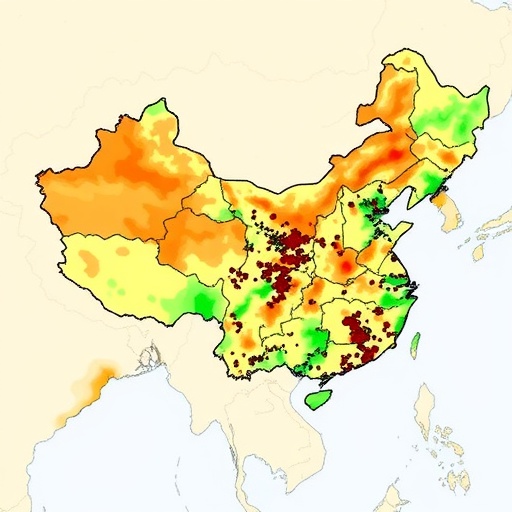
In a world grappling with the accelerating impacts of climate change, urban centers stand out as both major contributors to carbon emissions and critical arenas for mitigation efforts. A groundbreaking study recently published in npj Urban Sustainability explores the intricate spatial heterogeneity of ecological and socioeconomic factors underlying relative carbon deficits in cities across China, revealing nuanced patterns that could inform future urban planning and climate policy initiatives. This research sheds unprecedented light on how carbon dynamics vary not merely between cities but within them, highlighting opportunities for targeted interventions that could reshape sustainable urban futures.
The study confronts one of the most pressing challenges of our time — understanding how urban environments embody carbon deficits, a metric reflecting the imbalance between carbon emissions and carbon absorption potential. Unlike traditional assessments that treat cities monolithically, this research delves into the spatial complexities that define carbon footprints at a granular scale. By analyzing ecological variables such as land cover, vegetation density, and topography alongside socioeconomic indicators like income levels, population density, and industrial activity, the authors provide a multidimensional view of carbon distribution patterns within Chinese urban landscapes.
China’s rapid urbanization has often been characterized by sprawling industrial zones, dense residential areas, and green spaces unevenly scattered across cityscapes. These factors combine to produce highly heterogeneous carbon profiles, where some neighborhoods manifest disproportionately large carbon deficits while others maintain relative carbon neutrality or surpluses. The novelty of the study lies in its spatial analytical approach, leveraging advanced geospatial tools and statistical models to map these variations with unprecedented detail. This methodology not only quantifies carbon deficits but also attributes them to specific ecological and social drivers.
One of the study’s key revelations is the role that socioeconomic disparities play in shaping carbon outcomes within cities. Neighborhoods with higher income levels tend to exhibit lower relative carbon deficits, a finding attributed to greater access to green infrastructure, energy-efficient buildings, and sustainable transportation options. Conversely, economically disadvantaged districts often face compounded challenges: limited greenery, higher population density, and reliance on fossil fuel-intensive practices, culminating in elevated carbon deficits. This spatial inequity highlights the need for policies that integrate environmental justice with climate action.
Ecological heterogeneity emerges as another significant factor influencing carbon deficits. Urban areas boasting extensive vegetative cover demonstrate enhanced carbon absorption capabilities, offsetting emissions from local activities. The study meticulously quantifies this phenomenon, demonstrating that even small pockets of green space — urban parks, street trees, and rooftop gardens — can collectively lower the carbon footprint of a neighborhood. However, these ecological assets are unevenly distributed, often concentrated in more affluent zones, which exacerbates spatial carbon disparities.
The interplay between industrial land use and carbon deficits is also dissected with precision. Industrial districts exhibit some of the highest relative carbon deficits, owing to concentrated emissions from manufacturing processes, transportation logistics, and energy consumption. The spatial clustering of such industries in certain urban peripheries creates ‘carbon hotspots’ that are both ecological and public health concerns. The researchers advocate for zoning reforms that encourage the diffusion of industrial activity and investments in cleaner technologies to mitigate these localized carbon surpluses.
Urban morphology and infrastructure design further compound the complexity of carbon distributions. Dense high-rise developments may reduce per capita land consumption but can strain energy resources unless paired with energy-efficient technologies. In contrast, low-density suburban developments often entail higher transportation emissions due to automobile dependency. The study’s spatial models capture these nuances, indicating that urban form must be critically considered alongside ecological and socioeconomic factors to address carbon deficits comprehensively.
Transportation networks represent a particularly conspicuous source of carbon emissions in Chinese cities, a factor the study addresses in depth. Areas with inadequate public transit infrastructure correlate strongly with elevated carbon deficits due to higher reliance on private vehicles and fossil fuel consumption. Conversely, regions integrated with efficient mass transit systems and bike-friendly pathways display markedly lower carbon footprints. These findings emphasize the potential for sustainable mobility solutions to transform urban carbon landscapes if implemented equitably.
Climate variability and meteorological conditions add another layer of complexity to the observed spatial heterogeneity. Variations in temperature, humidity, and solar radiation influence both carbon sequestration rates and energy demand patterns. The study incorporates climate data into its models, revealing that cities with higher average temperatures tend to experience increased cooling demands, potentially elevating carbon emissions unless offset by renewable energy use. The research underscores the importance of integrating climate resilience with carbon management strategies.
The study’s methodological rigor is evident in its use of satellite remote sensing combined with ground-level socioeconomic datasets. This fusion enables a comprehensive spatial analysis across multiple scales, from neighborhood blocks to entire metropolitan regions. Statistical techniques such as geographically weighted regression provide insights into local variations and interdependencies, facilitating a more precision-based approach to carbon management than conventional city-wide aggregates allow.
A critical implication of this research is its potential to reshape urban policy frameworks in China. The nuanced understanding of spatial carbon deficits enables policymakers to prioritize investments, from expanding urban greenery in carbon-intensive neighborhoods to retrofitting buildings with energy-efficient technologies where carbon intensity is most pronounced. Furthermore, integrating social equity considerations ensures that carbon reduction benefits are distributed fairly across diverse communities.
Beyond policy, the study opens new avenues for public engagement and urban design innovation. For instance, community-driven initiatives to increase vegetative cover or adopt renewable energy sources can be strategically facilitated in identified carbon deficit hotspots. Urban planners and architects might leverage these findings to embed sustainability into the fabric of city landscapes, creating environments that are both livable and climate-resilient.
The global significance of this research cannot be overstated. As cities worldwide confront similar challenges of balancing growth with environmental stewardship, the insights from Chinese urban contexts offer transferable lessons. The emphasis on spatial heterogeneity — recognizing that cities are mosaics of varying ecological and socioeconomic conditions — is vital for crafting tailored, effective carbon reduction strategies globally.
In conclusion, the study by Liu, Jiang, Wang, and colleagues represents a seminal contribution to urban sustainability science. By illuminating the complex spatial patterns governing carbon deficits in Chinese cities, it provides a robust framework for integrating ecological, social, and infrastructural dimensions into climate action. The multi-scaled, data-driven approach sets a new standard for urban carbon analysis, promising to guide both scholarly inquiry and practical interventions in the race against climate change.
As cities continue to expand and evolve, harnessing the nuanced understanding of spatial carbon heterogeneity will be essential for steering urban development toward sustainability. This research not only underscores the urgency of addressing carbon inefficiencies but also offers hope — through informed, targeted strategies, the daunting challenge of urban carbon management can be met with innovation, equity, and science-backed resolve. The journey towards carbon-neutral cities, once a distant aspiration, is now an attainable goal guided by studies such as this, which bridge the gap between data, policy, and action.
Cite Scienmag News
Courtney Benton. (July 1, 2026). Spatial Variations Linked to Urban Carbon Deficits in China. Scienmag. https://scienmag.com/spatial-variations-linked-to-urban-carbon-deficits-in-china/
Courtney Benton. "Spatial Variations Linked to Urban Carbon Deficits in China." Scienmag, 1 July 2026, https://scienmag.com/spatial-variations-linked-to-urban-carbon-deficits-in-china/. Accessed 3 September 2026.
Courtney Benton. "Spatial Variations Linked to Urban Carbon Deficits in China." Scienmag. July 1, 2026. https://scienmag.com/spatial-variations-linked-to-urban-carbon-deficits-in-china/


