


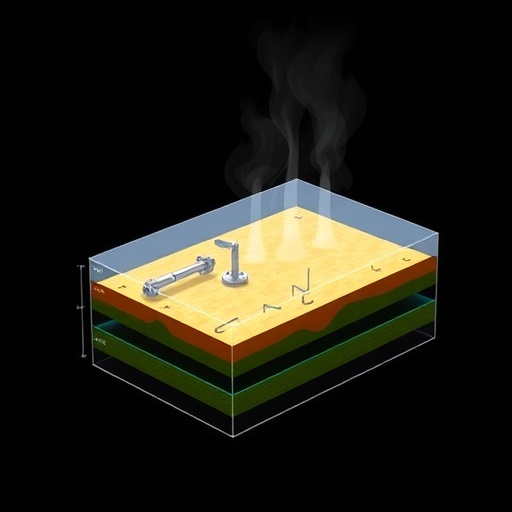
A groundbreaking study conducted by researchers at The University of Texas at Austin has shed new light on the vast network of underground natural gas storage facilities that underpin the United States’ energy infrastructure. This comprehensive geological and engineering analysis presents a crucial resource for enhancing the country’s natural gas storage capacity, optimizing existing systems, and exploring emerging avenues such as underground hydrogen and carbon storage. Published in the renowned journal Earth Energy Science, the study pioneers an integrated evaluation of reservoirs, aquifers, and salt caverns used for natural gas storage across the nation.
The United States maintains the world’s largest underground natural gas storage network, comprising nearly 400 facilities situated within depleted oil and gas fields, saline aquifers, and engineered salt caverns. Collectively, these reservoirs hold an impressive capacity nearing 9.2 trillion cubic feet, critical for balancing the nation’s daily natural gas consumption, which averages around 92 billion cubic feet. As demand for natural gas escalates amid energy transitions, expanding and optimizing subterranean storage infrastructure is paramount to ensuring supply reliability and enhancing energy security.
Central to this development is the novel database compiled by researchers led by Abouzar Mirzaei Paiaman from the Bureau of Economic Geology at the UT Jackson School of Geosciences. Unlike previous efforts by the U.S. Energy Information Administration (EIA) and the Pipeline and Hazardous Materials Safety Administration (PHMSA), which offered basic facility-level data, this new resource integrates detailed geological characterizations, reservoir engineering parameters, and operational performance data. This multidisciplinary approach provides a holistic understanding of storage site viability and operational potential, surpassing the capabilities of existing public datasets.
The study’s analytical framework evaluates storage sites based on multiple performance metrics, including geological stability, storage capacity, injection and withdrawal rates, and reservoir integrity. These metrics enable stakeholders to assess the suitability of various sites for potential expansion or development of new facilities. Furthermore, the research delineates the distinctions among depleted reservoirs, saline aquifers, and salt caverns, providing insights into their respective technological challenges and benefits. For instance, salt caverns offer rapid injection and withdrawal capabilities, whereas depleted reservoirs benefit from established containment but may have more complex operational constraints.
Beyond natural gas, the implications of this research extend into the burgeoning field of clean energy storage and carbon management. As hydrogen fuel and carbon dioxide sequestration gain prominence in efforts to reduce greenhouse gas emissions, the potential to repurpose underground natural gas storage infrastructure for these new vectors emerges as an innovative strategy. The study highlights that the existing geological formations and operational techniques might be adapted to securely store hydrogen – a carbon-free energy carrier – or permanently sequester CO₂, thereby mitigating atmospheric emissions and supporting climate change mitigation goals.
A particularly intriguing aspect of the study involves the role of “cushion gas” in underground storage facilities. Cushion gas refers to the volume of gas permanently retained in these reservoirs to maintain adequate pressure, ensuring efficient withdrawal when demand surges. Currently, around half of the stored natural gas serves as cushion gas. The researchers suggest that replacing this cushion gas with alternative substances such as CO₂ could unlock more natural gas for productive use and simultaneously provide a geologically secure method for carbon capture and storage (CCS). This dual-purpose innovation exemplifies the synergy between traditional fossil fuel infrastructure and emerging decarbonization technologies.
The research team’s efforts received support from the State of Texas Advanced Resource Recovery (STARR) program, which focuses on sustainable exploitation and profitability of earth resources. The collaboration highlights the importance of aligning geological expertise with energy policy and industry needs to foster resilient and environmentally responsible energy solutions. State and federal efforts aimed at modernizing underground storage capacity stand to benefit greatly from the insights generated by this multidisciplinary analysis.
Looking forward, the integrated database and its analytical framework pave the way for sophisticated engineering strategies aimed at improving the performance of existing storage facilities. Efforts to enhance reservoir integrity, increase injection and withdrawal efficiency, and incorporate alternative gases as cushion materials could revolutionize the operational economics of underground storage. Such strategies would ensure better responsiveness to fluctuating market dynamics and energy demands, reinforcing the reliability of the natural gas supply chain.
Another noteworthy focus is the exploration of hybrid storage systems that integrate natural gas and hydrogen. Developing safe, efficient, and scalable hydrogen storage within existing geological formations could accelerate the adoption of hydrogen as a mainstream fuel, complementing the country’s decarbonization roadmap. Understanding the geochemical interactions and pressure dynamics within these reservoirs is crucial to preventing operational hazards and ensuring long-term storage integrity.
The comprehensive nature of the study also serves as a powerful decision-making tool for energy companies, regulatory bodies, and policy makers. By ranking facilities based on rigorous geoscience-informed criteria, stakeholders can prioritize investments, regulatory approvals, and technological upgrades where they yield the greatest impact. This data-driven approach fosters more transparent and evidence-based management of underground storage assets.
Beyond the immediate technical and operational benefits, the study contributes to national energy resilience, a priority underscored by recent market volatilities and supply disruptions. Having a robust underground storage framework supports seasonal demand shifts, mitigates supply shocks, and undergirds the continued evolution toward a cleaner energy economy. The adaptability of these subterranean systems for multi-commodity storage augments the flexibility and sustainability of energy infrastructure.
The integration of geological assessments with operational data signifies a maturation in energy resource management, where subsurface complexities are no longer viewed as obstacles but as strategic advantages. This holistic understanding empowers operational innovations and fosters synergy between traditional energy sectors and emerging clean energy technologies. As the energy landscape rapidly transforms, the ability to leverage existing natural geological formations for multifaceted storage functions epitomizes a forward-thinking approach to energy security and climate stewardship.
In summary, the study by The University of Texas at Austin offers a landmark contribution to the field of underground energy storage, leveraging geoscience, reservoir engineering, and operational insights to enhance the United States’ capacity and capability in natural gas storage. Its implications ripple far beyond fossil fuels, charting a course for integrated storage solutions that support hydrogen fuel adoption and carbon sequestration. This research not only addresses immediate energy storage challenges but also aligns with visionary goals for a resilient, sustainable, and low-carbon energy future.
News Publication Date: 1-Jun-2026
Web References:
– https://doi.org/10.1016/j.ees.2026.100052
– Bureau of Economic Geology, UT Austin: https://www.beg.utexas.edu/
– UT Jackson School of Geosciences: https://www.jsg.utexas.edu/
Keywords
Applied sciences and engineering, Energy resources, Fossil fuels, Natural gas, Hydrogen fuel, Underground gas storage, Carbon capture and storage, Salt caverns, Saline aquifers, Reservoir engineering, Energy infrastructure, Subsurface geological analysis
Cite Scienmag News
Faith Mcneil. (July 1, 2026). Innovative Database for Subsurface Energy Storage Promises New Opportunities for Natural Gas Sector. Scienmag. https://scienmag.com/innovative-database-for-subsurface-energy-storage-promises-new-opportunities-for-natural-gas-sector/
Faith Mcneil. "Innovative Database for Subsurface Energy Storage Promises New Opportunities for Natural Gas Sector." Scienmag, 1 July 2026, https://scienmag.com/innovative-database-for-subsurface-energy-storage-promises-new-opportunities-for-natural-gas-sector/. Accessed 4 September 2026.
Faith Mcneil. "Innovative Database for Subsurface Energy Storage Promises New Opportunities for Natural Gas Sector." Scienmag. July 1, 2026. https://scienmag.com/innovative-database-for-subsurface-energy-storage-promises-new-opportunities-for-natural-gas-sector/


