


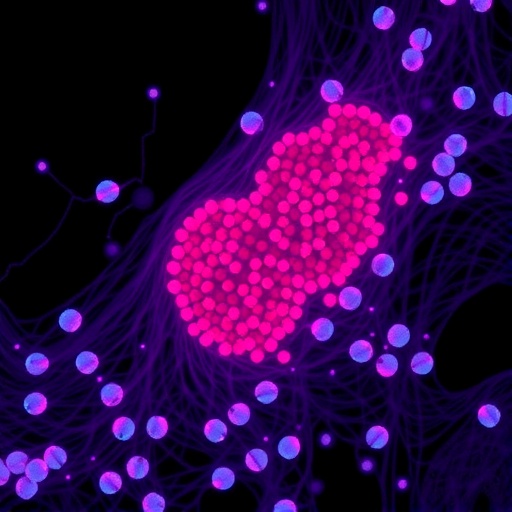
In a groundbreaking leap forward for cancer research, a multidisciplinary team has unveiled a spatially resolved atlas of gastric cancer, shedding unprecedented light on the complex tumor microenvironment and, most notably, defining a lymphocyte-aggregated region within tumors. This pioneering study, published in Nature Communications, is set to transform how scientists and clinicians understand the cellular architecture of gastric cancer and its implications for immune response, paving the way for novel therapeutic strategies.
Gastric cancer, a malignancy often diagnosed at advanced stages and with poor prognosis, has long puzzled researchers due to its heterogeneity and intricate interactions between cancer cells and the surrounding immune milieu. Traditional bulk tissue analyses fail to capture this spatial complexity, leading to generalized conclusions that lack the nuance needed to tailor effective, personalized treatments. By constructing a detailed three-dimensional map of gastric tumors, the researchers have created a high-resolution blueprint of cellular organization and interactions at a level never before achieved.
Central to their findings is the identification and characterization of a lymphocyte-aggregated region within the gastric cancer microenvironment. Lymphocytes, particularly T cells and B cells, play crucial roles in anti-tumor immunity, yet their distribution and functional states in gastric tumors have remained elusive. The study reveals that lymphocytes cluster in discrete regions, forming immunological niches that may represent sites of active immune surveillance or, alternately, immune evasion. These lymphocyte-rich microdomains exhibit distinct genetic and molecular profiles compared to the rest of the tumor, suggesting spatially variable immune landscapes within a single neoplasm.
Leveraging cutting-edge spatial transcriptomics and multiplexed imaging technologies, the researchers charted the precise locations of various cellular phenotypes alongside their gene expression signatures. This approach marries the power of high-throughput sequencing with spatial context, ensuring that insights into cellular function are grounded in their physical tumor niche. The atlas delineates not only the cancer cells and lymphocytes but also stromal elements, blood vessels, and myeloid cell populations, exposing a complex and heterogeneous tissue ecosystem.
Intriguingly, the lymphocyte-aggregated regions exhibited signs of immune activation and exhaustion simultaneously, suggesting a dynamic tug-of-war between tumor-promoting mechanisms and host defenses. Markers indicative of cytotoxic T cell activity were co-expressed with inhibitory receptors, hinting at a suppressed yet poised immune state. This duality may explain why some gastric cancers evade immune eradication despite significant lymphocyte infiltration, underscoring the importance of spatial context in interpreting immune signatures.
Further, the spatial atlas highlights varying metabolic and signaling pathways active within the lymphocyte aggregates, which could influence immune cell function and persistence. For example, hypoxia-inducible factors and nutrient deprivation mechanisms appear spatially enriched in certain zones, potentially modulating immune cell efficacy and shaping tumor evolution. By pinpointing these microenvironmental features, the work opens avenues to manipulate local conditions therapeutically, enhancing immunotherapy responses.
The practical implications of this study are vast. Clinicians may soon be able to leverage spatial profiling to predict patient prognosis more accurately or choose immunomodulatory treatments based on the presence and quality of lymphocyte aggregation within tumors. Moreover, pharmaceutical development can focus on designing agents that either bolster lymphocyte clusters or disrupt the immunosuppressive barriers impeding their function, refining the precision medicine paradigm.
Importantly, this research bridges a critical gap between histopathology and molecular biology. Whereas histological techniques offer insight into tissue morphology, and omics approaches reveal molecular states, this spatially resolved atlas synergizes both realms, rendering a comprehensive picture of tumor biology. As illustrated by this work, such integration is essential to unraveling the nuances of tumor-immune interplay that ultimately governs disease progression and therapeutic success.
The study also highlights how spatial heterogeneity within tumors complicates one-size-fits-all treatment strategies. The existence of micro-niches with differing immune contexts cautions against oversimplified classifications of tumors as simply “immune hot” or “cold.” Instead, this sophistication requires high-resolution approaches like spatial transcriptomics to capture the true immune landscape, which varies not only between patients but within tumors themselves.
Future research building upon this atlas can investigate temporal dynamics, examining how lymphocyte-aggregated regions develop, resolve, or remodel over time or in response to treatment. Such longitudinal spatial profiling could identify biomarkers of therapeutic response or resistance, allowing adaptive treatment modifications and thereby improving clinical outcomes for gastric cancer patients.
Moreover, these findings may hold relevance beyond gastric cancer. Many solid tumors exhibit heterogeneous immune landscapes, and the methodological framework presented here can be adapted to other malignancies. This establishes a new standard for spatially resolved cancer biology research, moving beyond snapshots of gene expression to incorporate the spatial and functional contextuality essential for clinical translation.
In conclusion, the construction of a spatially resolved atlas of gastric cancer marks a transformative moment in oncological research. By illuminating the nature of lymphocyte-aggregated regions within tumors, the study deepens our understanding of immune-tumor interaction complexities and adds an invaluable tool to the arsenal seeking to outsmart cancer. As the field advances, integrating spatial data into clinical practice promises to refine patient stratification and enhance the efficacy of immunotherapies, potentially ushering in a new era of precision oncology.
This landmark work offers not only a detailed map but a conceptual framework for how the tumor microenvironment can be dissected with exquisite resolution — a beacon guiding future discoveries in cancer immunology and therapeutic innovation. It exemplifies the power of combining state-of-the-art spatial technologies and comprehensive molecular analysis to decode the cancer ecosystem, fostering hope for improved treatments and patient survival worldwide.
Cite Scienmag News
Nathaniel Bowman. (January 27, 2026). Spatial Atlas Reveals Lymphocyte Cluster in Gastric Cancer. Scienmag. https://scienmag.com/spatial-atlas-reveals-lymphocyte-cluster-in-gastric-cancer/
Nathaniel Bowman. "Spatial Atlas Reveals Lymphocyte Cluster in Gastric Cancer." Scienmag, 27 January 2026, https://scienmag.com/spatial-atlas-reveals-lymphocyte-cluster-in-gastric-cancer/. Accessed 4 September 2026.
Nathaniel Bowman. "Spatial Atlas Reveals Lymphocyte Cluster in Gastric Cancer." Scienmag. January 27, 2026. https://scienmag.com/spatial-atlas-reveals-lymphocyte-cluster-in-gastric-cancer/


