


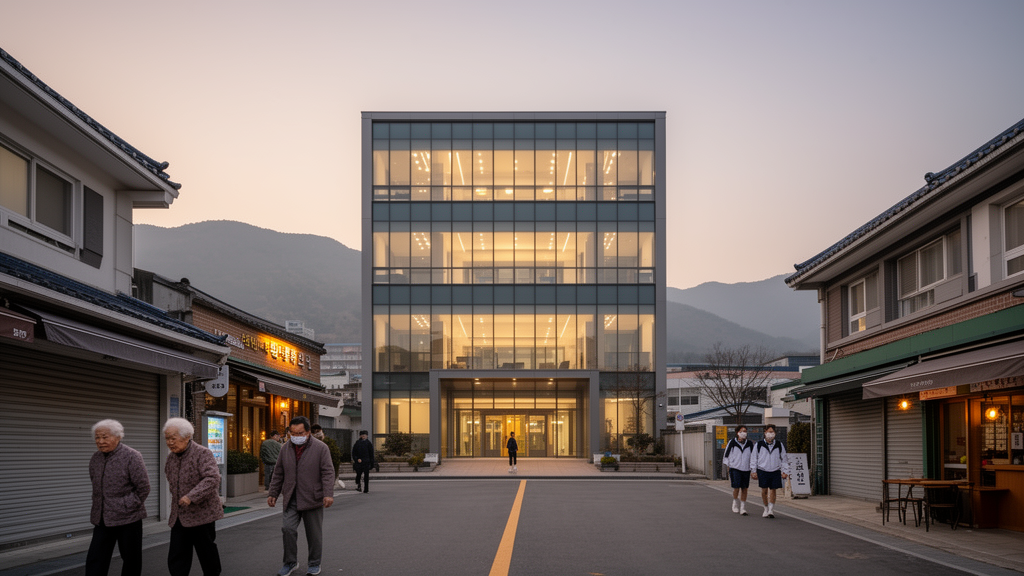
South Korea has done something no other country has: it has turned the disappearance of its own towns into a formal category of government. In 2021, the Ministry of the Interior and Safety designated 89 population-declining areas using an extinction-risk index built on the ratio of women aged 20 to 39 to residents aged 65 and over, with a value below 0.5 marking a place at risk of vanishing. Then, in June 2026, the Ministry of Education released two flagship policies that placed universities at the center of this survival machinery, and a new open-access study in Higher Education argues that these documents reveal a profound mutation in how the Korean state governs.
The demographic backdrop is the most extreme in the world. South Korea is the only OECD member whose fertility rate has stayed below one since 2018, touching a global low of 0.72 in 2023 and rebounding only to 0.80 in 2025, still the world's lowest. The population peaked in 2020 and is projected to fall by nearly 30 percent by 2072.
Projections cited in the FIRST Basic Plan show the school-age population falling from about 7.5 million in 2022 to about 4.24 million in 2052, with the non-Capital Region contracting far faster than the Seoul metropolitan area. The paradox at the heart of the two June 2026 policies is stark. In regions the state itself has classified as facing extinction, the government now requires universities to serve as anchors of local revitalization, institutions whose value depends on demographic agglomeration, talent pooling, and knowledge spillovers.
Instruments premised on growth are being deployed in a context defined by contraction. The study, which analyzes the policy texts through Bacchi's "What's the Problem Represented to Be" approach combined with an institutional mapping of programs, funds, and selection authority, names this configuration "developmental survivalism": the East Asian developmental state has not withered away but has fused the organization of growth with the organization of survival. The two policies are mirror images divided along ownership lines.
The Package Support for Flagship National Universities, promoted under the slogan "Making Ten Seoul National Universities," addresses the nine regional national universities outside the Capital Region but selects only three for a package worth roughly 100 billion won more per institution than the previous year: about 40 billion won for a growth-engine brand college, 10 billion for an AI hub university, and 20 billion through 2029 for shared specialization programs. Notably, the flagships are strengthened fiscally and functionally rather than enlarged, with no mandated increase in enrollment capacity. Selection is deliberately strategic rather than indicator-driven, a qualitative review led by the vice minister and finalized by a pan-governmental council chaired by the Prime Minister, with conformity to the national territorial transformation strategy heading the criteria.
The second policy, the Specialized Leading University Project known as FIRST, targets non-Capital-Region private universities and works in the opposite direction: it pays them to shrink. Participation requires reducing admission quotas by at least 3 percent by the 2030 academic year and completing program restructuring. Of the project funds, 40 percent, some 34 billion won, is allocated according to the enrollment-reduction plan, with cuts priced on a graduated scale: a pre-emptive reduction counts each eliminated place as one full unit, while cutting only already-unfilled quotas counts each place as 0.2, meaning active slimming is credited at five times the rate of passive slimming.
Deeper cuts carry heavier weights, with reductions above 5 percent weighted at 3.0. The state is not merely permitting contraction; it is purchasing earlier and deeper contraction, an instrument the study calls paying for slimming. The discursive construction of the problem is as revealing as the money.
Both policy texts represent the crisis not as the existential fact of disappearing regions but as a repairable competitiveness deficit, anchored in statistics on institutional finances, per-student expenditure, and employment rates, and framed through a vicious circle of under-enrollment, fiscal deterioration, reduced investment, talent outflow, and regional stagnation. Survival is quietly equated with competitiveness, and competitiveness with selection and concentration. Education Minister Choi Kyo-jin declared that the specialization of regional universities "is not a choice but a necessity," naturalizing structural adjustment as an inescapable imperative, while the plan's own consultation record shows experts deliberately supplying phrases like "inter-university big deal" and "pre-emptive restructuring," and the medicalized metaphor of "constitutional improvement" rewriting consolidation as a cure rather than a trade-off.
The study identifies three structural tensions embedded in this apparatus. The first, and deepest, is what the author calls anchoring the unanchorable. The anchor-university literature presupposes a region that is vulnerable but still subsists; under extinction, the anchor's core input, the people available to agglomerate, is precisely what is vanishing.
Strengthening three flagships may even replay agglomeration at a smaller scale, drawing talent from surrounding counties toward the flagship cities, a little Seoul within the regions, since metropolitan location is itself among the selection criteria. Meanwhile the 89 designated extinction-risk areas are mostly rural counties demographically distinct from the provincial cities where the flagships sit, so the apparatus derives its legitimacy from extinction in places its instruments bypass. The second tension is a contradictory rescaling the study terms centralized decentralization.
Delivery is devolved: the RISE program, launched in 2023, transfers at least half of the ministry's university support budget to metropolitan and provincial governments. But the highest-stakes decisions are recentralized: flagship selection sits with the Prime-Minister-chaired council, FIRST is evaluated by the National Research Foundation without regional-bloc distinction, and even the Higher Education Innovation Special Zones have had their authority migrate from governor-chaired regional committees to direct ministerial review. The logic is structural: under contraction, survival resources are zero-sum, a locality can neither cut itself nor cut others, and only the center can arbitrate which institutions live and which contract.
Wherever the question is who survives, power is recalled to the center. The third tension lies between promise and means. The banner of balanced national growth pledges to lift all nine flagships and revive every region, yet execution delivers selection and concentration: three chosen of nine, roughly fifteen institutions admitted to FIRST with enrollment reduction as the ticket of entry, and the earlier Glocal University competition halting at 27 of the originally planned 30.
Triage necessarily produces the rejected, the six unselected flagships, the private universities outside FIRST, and the regions that are neither. The study argues this raises urgent normative questions about the transparency and contestability of a qualitative strategic review, and about who answers for the faculty, students, and residents of institutions screened as non-priority for survival. The theoretical stakes extend well beyond Korea.
The study positions South Korea as a vanguard case for China and other ageing societies facing enrollment cliffs, offering a conceptual template rather than a ready-made conclusion. China, despite negative population growth since 2022, has not institutionalized extinction as a category of governance, and its vertically integrated party-state would likely conduct any equivalent triage in a more concentrated manner. The author is candid about limitations: this is a text-oriented interpretive analysis of policy design, not an assessment of implementation outcomes, and the 2026 programs have only just begun, so their actual effects on talent retention and regional survival are not yet observable.
The reading of a survival telos fused with growth instruments is itself interpretive, distilled through analysis rather than avowed by the policies, which still speak the growth era's competitive language. But the core insight stands on the documentary record: when the state's defining problem shifts from growth to survival, the university becomes the site where the transformation first becomes visible, and the developmental state's habitual method of picking winners has expanded into something new, the adjudication of who is entitled to continue existing at all.
Subject of Research: How South Korea's 2026 regional-university revitalization policies reconfigure the developmental state under demographic contraction
Article Title: Anchoring the unanchorable: the survival turn of the developmental state in an era of demographic contraction and the instrumentalization of South Korea’s Regional Universities
Article References: Li, M. (2026). Anchoring the unanchorable: the survival turn of the developmental state in an era of demographic contraction and the instrumentalization of South Korea’s Regional Universities. Higher Education. https://doi.org/10.1007/s10734-026-01803-1
Image Credits: AI Generated
DOI: 10.1007/s10734-026-01803-1
Keywords: South Korea, developmental state, demographic contraction, regional universities, local extinction, higher education policy, developmental survivalism, triage, enrollment cliff, population decline, FIRST project, flagship national universities
Cite Scienmag News
Courtney Benton. (October 27, 2026). South Korea Bets Its Dying Regions on Universities in a Radical Experiment of State Survival. Scienmag. https://scienmag.com/south-korea-bets-its-dying-regions-on-universities-in-a-radical-experiment-of-state-survival/
Courtney Benton. "South Korea Bets Its Dying Regions on Universities in a Radical Experiment of State Survival." Scienmag, 27 October 2026, https://scienmag.com/south-korea-bets-its-dying-regions-on-universities-in-a-radical-experiment-of-state-survival/. Accessed 27 October 2026.
Courtney Benton. "South Korea Bets Its Dying Regions on Universities in a Radical Experiment of State Survival." Scienmag. October 27, 2026. https://scienmag.com/south-korea-bets-its-dying-regions-on-universities-in-a-radical-experiment-of-state-survival/


